QUESTION IMAGE
Question
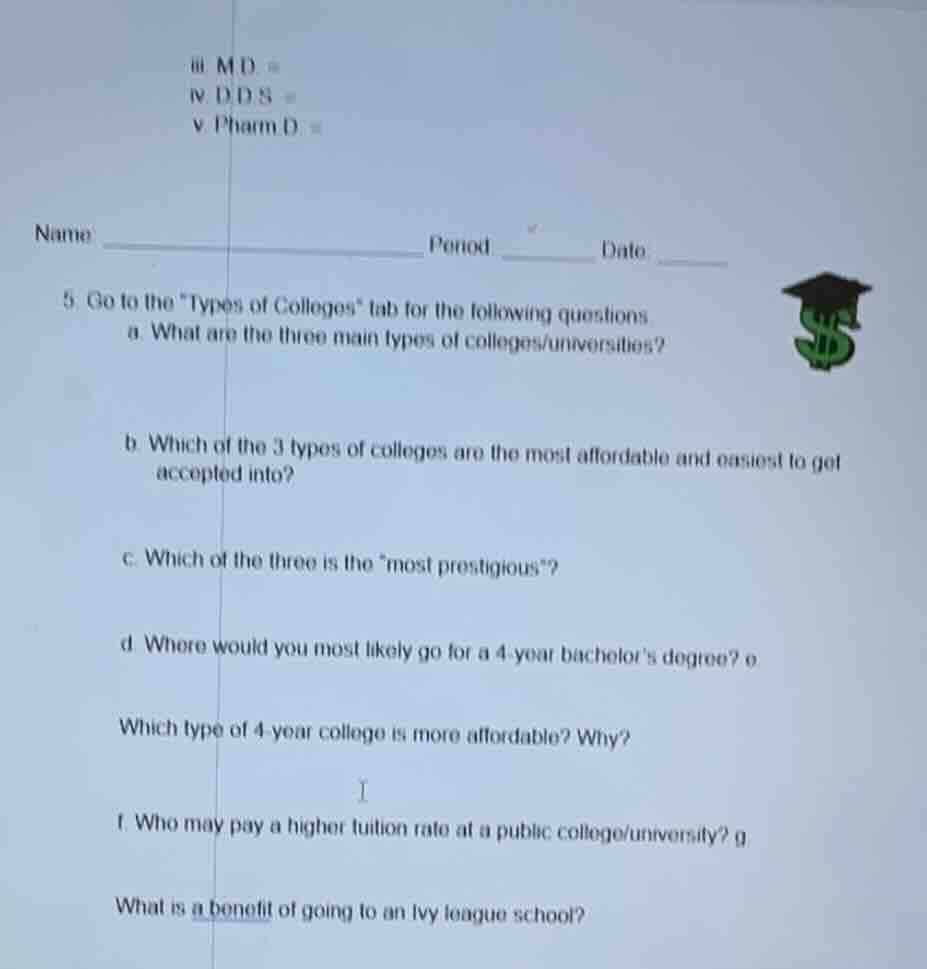
iii. m.d. =
iv. d.d.s. =
v. pharm d. =
name
period
date
- go to the \types of colleges\ tab for the following questions.
a. what are the three main types of colleges/universities?
b. which of the 3 types of colleges are the most affordable and easiest to get accepted into?
c. which of the three is the \most prestigious\?
d. where would you most likely go for a 4-year bachelor’s degree?
e. which type of 4 year college is more affordable? why?
f. who may pay a higher tuition rate at a public college/university?
g. what is a benefit of going to an ivy league school?
To answer these questions, we refer to the general knowledge about types of colleges/universities:
Part a
The three main types of colleges/universities are typically Public (State) Colleges/Universities, Private Colleges/Universities, and Community Colleges. Public institutions are funded by state governments, private ones by private sources/endowments, and community colleges offer 2 - year programs (and some 4 - year options) with a focus on accessibility and affordability.
Community Colleges are generally the most affordable (lower tuition, often with in - state or local resident discounts) and easiest to get accepted into. They have open - access or less competitive admission policies, aiming to serve a wide range of students including those seeking career training, transfer pathways, or basic education.
Private Colleges/Universities (especially elite ones like Ivy League schools) are often considered the “most prestigious.” They have a long - standing reputation for academic excellence, research output, and a highly selective admission process, along with a strong alumni network and resources.

Snap & solve any problem in the app
Get step-by-step solutions on Sovi AI
Photo-based solutions with guided steps
Explore more problems and detailed explanations
The three main types of colleges/universities are Public (State) Colleges/Universities, Private Colleges/Universities, and Community Colleges.