QUESTION IMAGE
Question
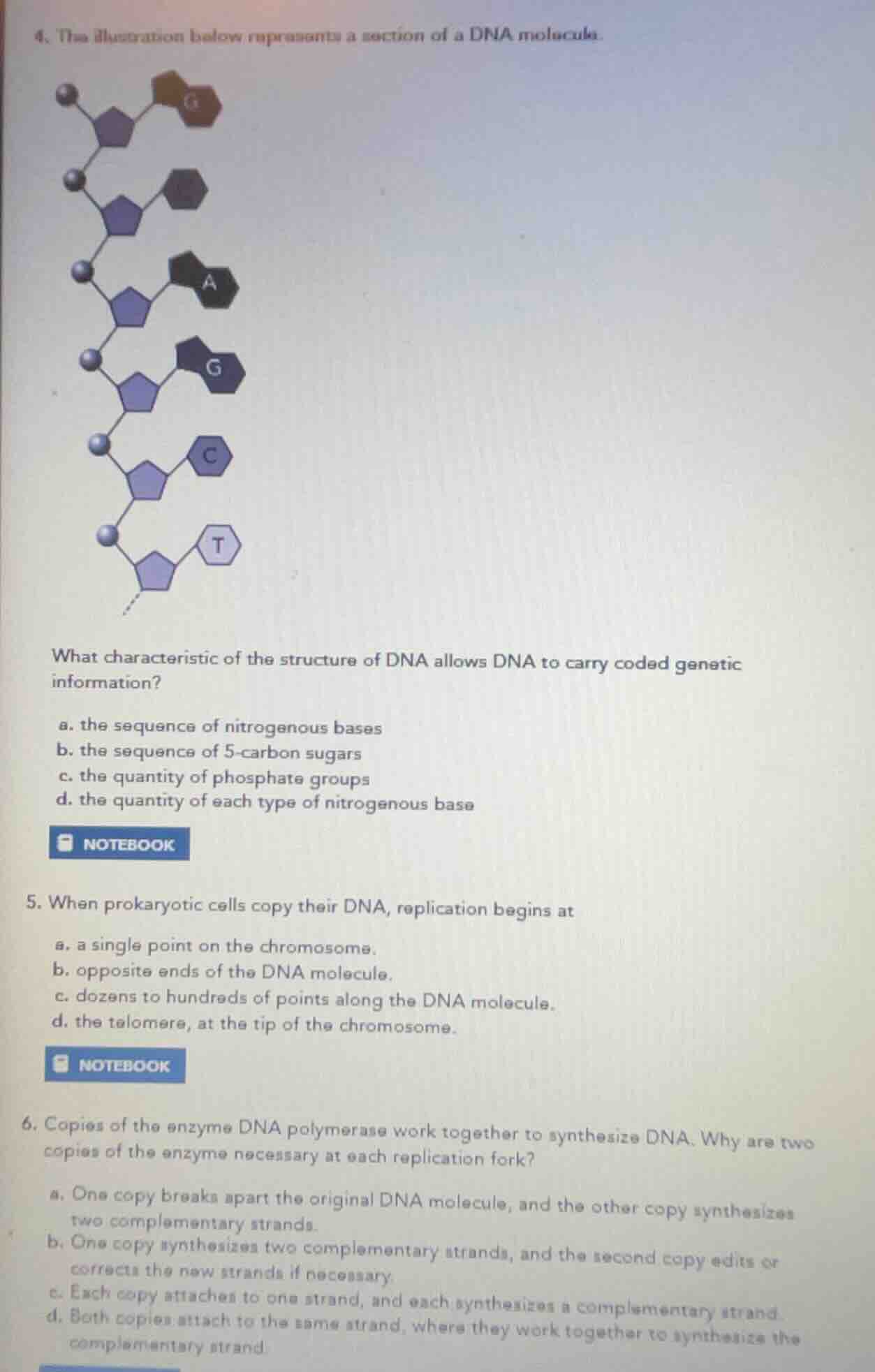
- the illustration below represents a section of a dna molecule.
what characteristic of the structure of dna allows dna to carry coded genetic information?
a. the sequence of nitrogenous bases
b. the sequence of 5 - carbon sugars
c. the quantity of phosphate groups
d. the quantity of each type of nitrogenous base
- when prokaryotic cells copy their dna, replication begins at
a. a single point on the chromosome.
b. opposite ends of the dna molecule.
c. dozens to hundreds of points along the dna molecule.
d. the telomere, at the tip of the chromosome.
- copies of the enzyme dna polymerase work together to synthesize dna. why are two copies of the enzyme necessary at each replication fork?
a. one copy breaks apart the original dna molecule, and the other copy synthesizes two complementary strands.
b. one copy synthesizes two complementary strands, and the second copy edits or corrects the new strands if necessary.
c. each copy attaches to one strand, and each synthesizes a complementary strand.
d. both copies attach to the same strand, where they work together to synthesize the complementary strand.
For Question 4:
DNA's genetic code is stored in the unique order of its nitrogenous bases (A, T, C, G). The sugar-phosphate backbone is identical across all DNA, and base quantity follows Chargaff's rules, so only the base sequence carries unique coded information.
For Question 5:
Prokaryotic DNA is a single, circular chromosome. Unlike eukaryotes with multiple replication origins, prokaryotic DNA replication starts at one single origin point on the chromosome.
For Question 6:
DNA is double-stranded and antiparallel. DNA polymerase can only synthesize new strands in one direction. At a replication fork, each original strand acts as a template, so one DNA polymerase copies each template strand to build a complementary strand.

Snap & solve any problem in the app
Get step-by-step solutions on Sovi AI
Photo-based solutions with guided steps
Explore more problems and detailed explanations
- a. the sequence of nitrogenous bases
- a. a single point on the chromosome
- c. Each copy attaches to one strand, and each synthesizes a complementary strand.