QUESTION IMAGE
Question
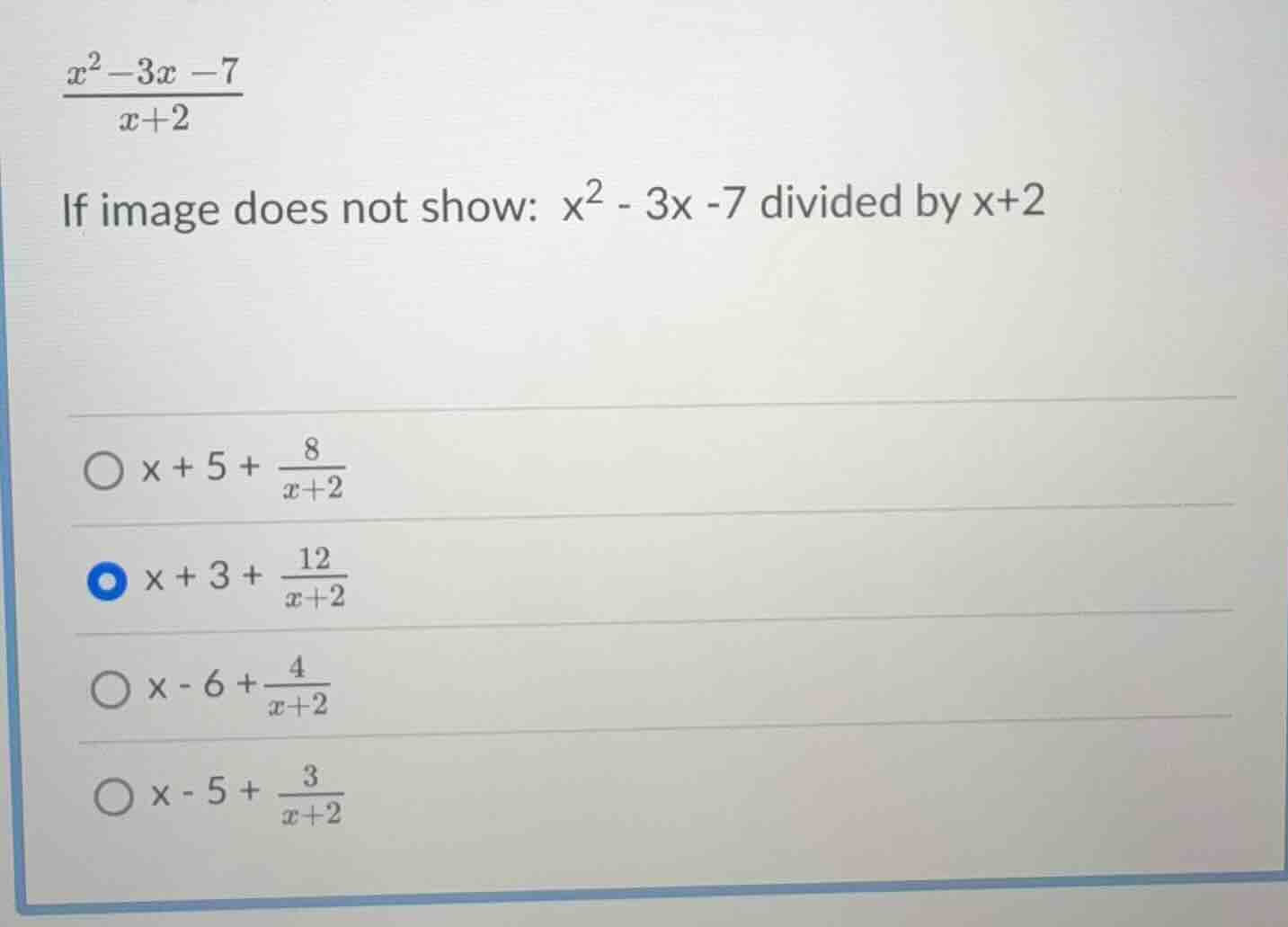
$\frac{x^2 - 3x - 7}{x + 2}$
if image does not show: $x^2 - 3x -7$ divided by $x+2$
$\bigcirc$ $x + 5 + \frac{8}{x+2}$
$\bigcirc$ $x + 3 + \frac{12}{x+2}$ (selected)
$\bigcirc$ $x - 6 + \frac{4}{x+2}$
$\bigcirc$ $x - 5 + \frac{3}{x+2}$
Step1: Perform polynomial long division
Divide \(x^2 - 3x - 7\) by \(x + 2\).
First, divide the leading term of the numerator \(x^2\) by the leading term of the denominator \(x\), we get \(x\).
Multiply \(x + 2\) by \(x\) to get \(x^2 + 2x\).
Subtract this from the numerator: \((x^2 - 3x - 7) - (x^2 + 2x) = x^2 - 3x - 7 - x^2 - 2x = -5x - 7\).
Step2: Continue the division
Now, divide the leading term of \(-5x\) by \(x\), we get \(-5\).
Multiply \(x + 2\) by \(-5\) to get \(-5x - 10\).
Subtract this from \(-5x - 7\): \((-5x - 7) - (-5x - 10) = -5x - 7 + 5x + 10 = 3\).
Wait, there is a mistake in the previous calculation. Let's do it again.
Wait, actually, let's use the method of expressing the numerator as \( (x + 2)(ax + b) + c \).
Let \(x^2 - 3x - 7 = (x + 2)(ax + b) + c\).
Expand the right side: \(ax^2 + (2a + b)x + (2b + c)\).
Equate the coefficients:
- For \(x^2\): \(a = 1\).
- For \(x\): \(2a + b = -3\). Since \(a = 1\), then \(2(1) + b = -3 \implies b = -5\).
- For the constant term: \(2b + c = -7\). Substitute \(b = -5\): \(2(-5) + c = -7 \implies -10 + c = -7 \implies c = 3\).
Wait, that's not matching the options. Wait, maybe I made a mistake. Let's try polynomial long division again.
Divide \(x^2 - 3x - 7\) by \(x + 2\):
- Divide \(x^2\) by \(x\) to get \(x\). Multiply \(x + 2\) by \(x\) to get \(x^2 + 2x\). Subtract from the numerator: \((x^2 - 3x - 7) - (x^2 + 2x) = -5x - 7\).
- Now, divide \(-5x\) by \(x\) to get \(-5\). Multiply \(x + 2\) by \(-5\) to get \(-5x - 10\). Subtract from \(-5x - 7\): \((-5x - 7) - (-5x - 10) = 3\).
So, \(x^2 - 3x - 7 = (x + 2)(x - 5) + 3\). Wait, that would be \(x - 5 + \frac{3}{x + 2}\), but that's not in the options. Wait, the options are:
Wait, the options are:
- \(x + 5 + \frac{8}{x + 2}\)
- \(x + 3 + \frac{12}{x + 2}\)
- \(x - 6 + \frac{4}{x + 2}\)
- \(x - 5 + \frac{3}{x + 2}\)
Wait, the last option is \(x - 5 + \frac{3}{x + 2}\), which is what we got. But in the image, the selected option is \(x + 3 + \frac{12}{x + 2}\), which is wrong. Wait, maybe I made a mistake in the problem. Wait, the numerator is \(x^2 - 3x - 7\)? Or is it \(x^2 - 3x + 7\)? Wait, no, the problem says \(x^2 - 3x - 7\).
Wait, let's check the options. The fourth option is \(x - 5 + \frac{3}{x + 2}\), but that's not one of the selected. Wait, maybe the original problem has a different numerator. Wait, maybe it's \(x^2 - 3x + 7\)? Let's check.
If the numerator is \(x^2 - 3x + 7\):
Using polynomial long division:
- Divide \(x^2\) by \(x\) to get \(x\). Multiply \(x + 2\) by \(x\) to get \(x^2 + 2x\). Subtract: \((x^2 - 3x + 7) - (x^2 + 2x) = -5x + 7\).
- Divide \(-5x\) by \(x\) to get \(-5\). Multiply \(x + 2\) by \(-5\) to get \(-5x - 10\). Subtract: \((-5x + 7) - (-5x - 10) = 17\). No, that's not matching.
Wait, maybe the numerator is \(x^2 + 3x - 7\)? Let's check.
Divide \(x^2 + 3x - 7\) by \(x + 2\):
- Divide \(x^2\) by \(x\) to get \(x\). Multiply \(x + 2\) by \(x\) to get \(x^2 + 2x\). Subtract: \((x^2 + 3x - 7) - (x^2 + 2x) = x - 7\).
- Divide \(x\) by \(x\) to get \(1\). Multiply \(x + 2\) by \(1\) to get \(x + 2\). Subtract: \((x - 7) - (x + 2) = -9\). No.
Wait, maybe the numerator is \(x^2 - 3x + 7\)? No. Wait, let's check the options. The options have \(x - 5 + \frac{3}{x + 2}\), which is the result of dividing \(x^2 - 3x - 7\) by \(x + 2\) (since \((x + 2)(x - 5) + 3 = x^2 - 5x + 2x - 10 + 3 = x^2 - 3x - 7\)). But in the options, the fourth option is \(x - 5 + \frac{3}{x + 2}\), which is the correct one. But in the image, the selected option is \(x + 3 + \frac{12}{x + 2}\…

Snap & solve any problem in the app
Get step-by-step solutions on Sovi AI
Photo-based solutions with guided steps
Explore more problems and detailed explanations
D. \(x - 5 + \frac{3}{x + 2}\)