QUESTION IMAGE
Question
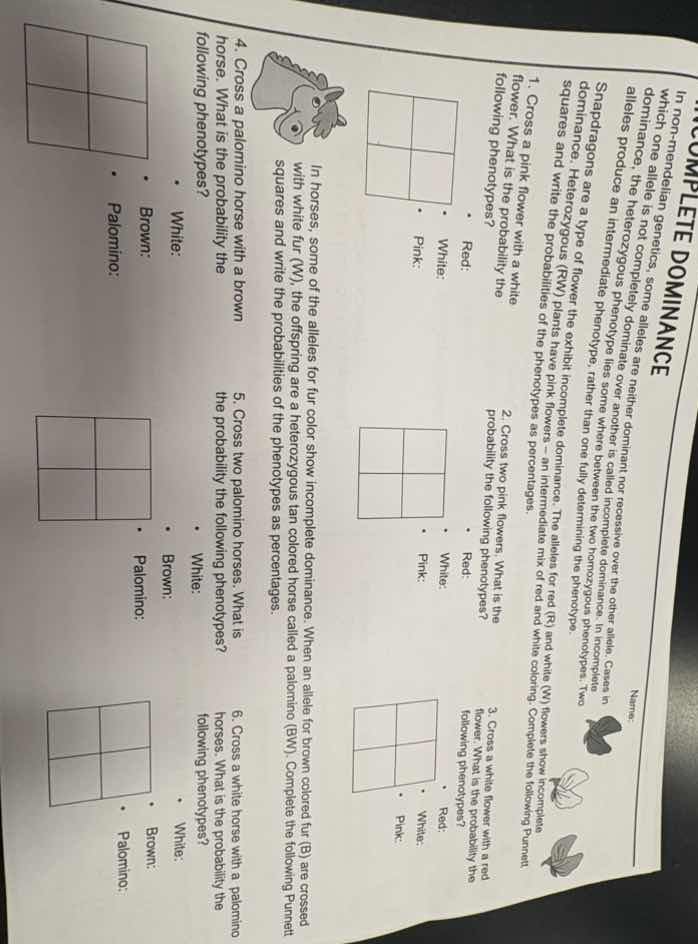
incomplete dominance name: in non - complete dominance, some alleles which one allele is not completely dominant over another allele, neither dominant, the heterozygous phenotype are neither dominant nor recessive over the other allele. causes in snapdragons are an intermediate phenotype, rather than what is called incomplete dominance in incomplete dominance. heterozygous (rw) flower plants exhibit incomplete dominance, meaning neither allele is truly determining the phenotypes. two squares and write the probabilities of the phenotypes. the mix of red (r) and white (w) genes new recognize 1 cross a pink flower with a white flower. what is the probability the following phenotypes? red: white: pink: 2 cross two pink flowers. what is the probability the following phenotypes? red: white: pink: 3 cross a white flower with a red flower. what is the probability the following phenotypes? red: white: pink: in horses, some of the alleles for fur color show incomplete dominance. when an allele for brown colored fur (b) are crossed with white fur (ww), the offspring are a heterozygous tan colored horse called a palomino (bw). complete the following punnett squares and write the probabilities of the phenotypes as percentages. 4 cross a palomino horse with a brown horse. what is the probability the following phenotypes? white: brown: palomino: 5 cross two palomino horses. what is the probability the following phenotypes? white: brown: palomino: 6 cross a white horse with a palomino horse. what is the probability the following phenotypes? white: brown: palomino:
To solve these incomplete dominance problems, we'll analyze each cross using Punnett squares and the principles of incomplete dominance (where the heterozygous phenotype is intermediate between the two homozygous phenotypes).
Problem 1: Cross a pink flower (RW) with a white flower (WW)
In incomplete dominance, flower color alleles are: Red (\( R \)), White (\( W \)). Pink is heterozygous (\( RW \)), White is homozygous (\( WW \)).
Step 1: Set up the Punnett square
| \( W \) | \( W \) | |
|---|---|---|
| \( W \) | \( WW \) (White) | \( WW \) (White) |
Step 2: Calculate probabilities
- Pink (\( RW \)): \( \frac{2}{4} = 50\% \)
- White (\( WW \)): \( \frac{2}{4} = 50\% \)
Problem 2: Cross two pink flowers (RW × RW)
Pink flowers are heterozygous (\( RW \)).
Step 1: Set up the Punnett square
| \( R \) | \( W \) | |
|---|---|---|
| \( W \) | \( RW \) (Pink) | \( WW \) (White) |
Step 2: Calculate probabilities
- Red (\( RR \)): \( \frac{1}{4} = 25\% \)
- Pink (\( RW \)): \( \frac{2}{4} = 50\% \)
- White (\( WW \)): \( \frac{1}{4} = 25\% \)
Problem 3: Cross a white flower (WW) with a red flower (RR)
White (\( WW \)) × Red (\( RR \)).
Step 1: Set up the Punnett square
| \( R \) | \( R \) | |
|---|---|---|
| \( W \) | \( RW \) (Pink) | \( RW \) (Pink) |
Step 2: Calculate probabilities
- All offspring are \( RW \) (Pink). Thus, probability of Pink: \( 100\% \), Red/White: \( 0\% \).
Problem 4: Cross a palomino horse (BW) with a brown horse (BB)
Horse fur color alleles: Brown (\( B \)), White (\( W \)). Palomino is heterozygous (\( BW \)), Brown is homozygous (\( BB \)).
Step 1: Set up the Punnett square
| \( B \) | \( B \) | |
|---|---|---|
| \( W \) | \( BW \) (Palomino) | \( BW \) (Palomino) |
Step 2: Calculate probabilities
- Brown (\( BB \)): \( \frac{2}{4} = 50\% \)
- Palomino (\( BW \)): \( \frac{2}{4} = 50\% \)
- White (\( WW \)): \( 0\% \)
Problem 5: Cross two palomino horses (BW × BW)
Palomino is heterozygous (\( BW \)).
Step 1: Set up the Punnett square
| \( B \) | \( W \) | |
|---|---|---|
| \( W \) | \( BW \) (Palomino) | \( WW \) (White) |
Step 2: Calculate probabilities
- Brown (\( BB \)): \( \frac{1}{4} = 25\% \)
- Palomino (\( BW \)): \( \frac{2}{4} = 50\% \)
- White (\( WW \)): \( \frac{1}{4} = 25\% \)
Problem 6: Cross a white horse (WW) with a palomino horse (BW)
White (\( WW \)) × Palomino (\( BW \)).
Step 1: Set up the Punnett square
| \( W \) | \( W \) | |
|---|---|---|
| \( W \) | \( WW \) (White) | \( WW \) (White) |
Step 2: Calculate probabilities
- Palomino (\( BW \)): \( \frac{2}{4} = 50\% \)
- White (\( WW \)): \( \frac{2}{4} = 50\% \)
- Brown (\( BB \)): \( 0\% \)
Summary of Answers:
- Pink: \( 50\% \), White: \( 50\% \)
- Red: \( 25\% \), Pink: \( 50\% \), White: \( 25\% \)
- Pink: \( 100\% \), Red/White: \( 0\% \)
- Brown: \( 50\% \), Palomino: \( 50\% \), White: \( 0\% \)
- Brown: \( 25\% \), Palomino: \( 50\% \), White: \( 25\% \)
- Palomino: \( 50\% \), White: \( 50\% \), Brown: \( 0\% \)

Snap & solve any problem in the app
Get step-by-step solutions on Sovi AI
Photo-based solutions with guided steps
Explore more problems and detailed explanations
To solve these incomplete dominance problems, we'll analyze each cross using Punnett squares and the principles of incomplete dominance (where the heterozygous phenotype is intermediate between the two homozygous phenotypes).
Problem 1: Cross a pink flower (RW) with a white flower (WW)
In incomplete dominance, flower color alleles are: Red (\( R \)), White (\( W \)). Pink is heterozygous (\( RW \)), White is homozygous (\( WW \)).
Step 1: Set up the Punnett square
| \( W \) | \( W \) | |
|---|---|---|
| \( W \) | \( WW \) (White) | \( WW \) (White) |
Step 2: Calculate probabilities
- Pink (\( RW \)): \( \frac{2}{4} = 50\% \)
- White (\( WW \)): \( \frac{2}{4} = 50\% \)
Problem 2: Cross two pink flowers (RW × RW)
Pink flowers are heterozygous (\( RW \)).
Step 1: Set up the Punnett square
| \( R \) | \( W \) | |
|---|---|---|
| \( W \) | \( RW \) (Pink) | \( WW \) (White) |
Step 2: Calculate probabilities
- Red (\( RR \)): \( \frac{1}{4} = 25\% \)
- Pink (\( RW \)): \( \frac{2}{4} = 50\% \)
- White (\( WW \)): \( \frac{1}{4} = 25\% \)
Problem 3: Cross a white flower (WW) with a red flower (RR)
White (\( WW \)) × Red (\( RR \)).
Step 1: Set up the Punnett square
| \( R \) | \( R \) | |
|---|---|---|
| \( W \) | \( RW \) (Pink) | \( RW \) (Pink) |
Step 2: Calculate probabilities
- All offspring are \( RW \) (Pink). Thus, probability of Pink: \( 100\% \), Red/White: \( 0\% \).
Problem 4: Cross a palomino horse (BW) with a brown horse (BB)
Horse fur color alleles: Brown (\( B \)), White (\( W \)). Palomino is heterozygous (\( BW \)), Brown is homozygous (\( BB \)).
Step 1: Set up the Punnett square
| \( B \) | \( B \) | |
|---|---|---|
| \( W \) | \( BW \) (Palomino) | \( BW \) (Palomino) |
Step 2: Calculate probabilities
- Brown (\( BB \)): \( \frac{2}{4} = 50\% \)
- Palomino (\( BW \)): \( \frac{2}{4} = 50\% \)
- White (\( WW \)): \( 0\% \)
Problem 5: Cross two palomino horses (BW × BW)
Palomino is heterozygous (\( BW \)).
Step 1: Set up the Punnett square
| \( B \) | \( W \) | |
|---|---|---|
| \( W \) | \( BW \) (Palomino) | \( WW \) (White) |
Step 2: Calculate probabilities
- Brown (\( BB \)): \( \frac{1}{4} = 25\% \)
- Palomino (\( BW \)): \( \frac{2}{4} = 50\% \)
- White (\( WW \)): \( \frac{1}{4} = 25\% \)
Problem 6: Cross a white horse (WW) with a palomino horse (BW)
White (\( WW \)) × Palomino (\( BW \)).
Step 1: Set up the Punnett square
| \( W \) | \( W \) | |
|---|---|---|
| \( W \) | \( WW \) (White) | \( WW \) (White) |
Step 2: Calculate probabilities
- Palomino (\( BW \)): \( \frac{2}{4} = 50\% \)
- White (\( WW \)): \( \frac{2}{4} = 50\% \)
- Brown (\( BB \)): \( 0\% \)
Summary of Answers:
- Pink: \( 50\% \), White: \( 50\% \)
- Red: \( 25\% \), Pink: \( 50\% \), White: \( 25\% \)
- Pink: \( 100\% \), Red/White: \( 0\% \)
- Brown: \( 50\% \), Palomino: \( 50\% \), White: \( 0\% \)
- Brown: \( 25\% \), Palomino: \( 50\% \), White: \( 25\% \)
- Palomino: \( 50\% \), White: \( 50\% \), Brown: \( 0\% \)