QUESTION IMAGE
Question
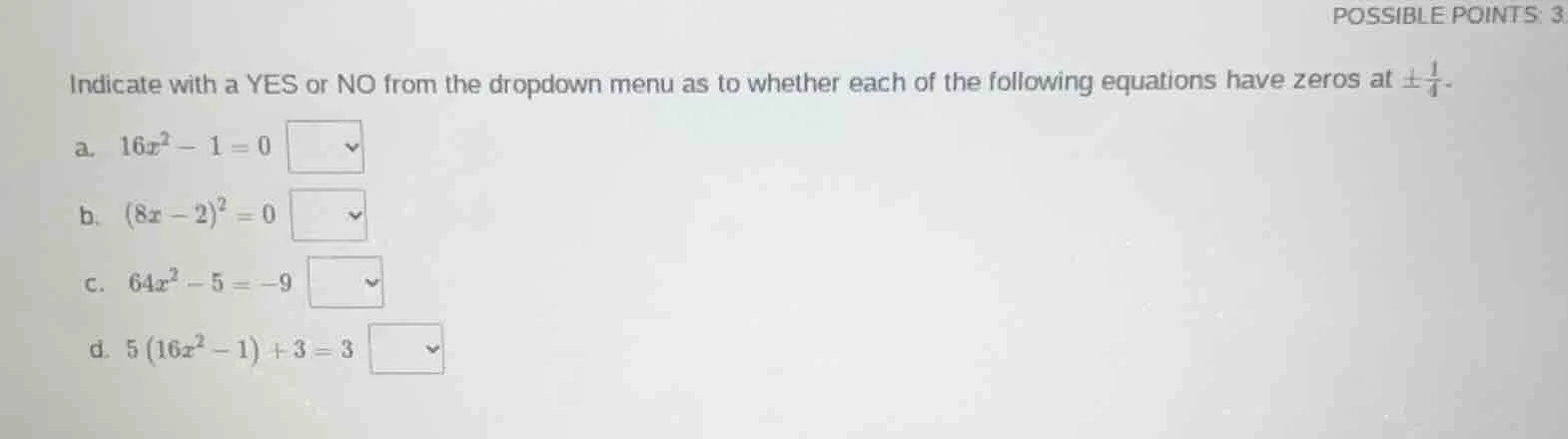
indicate with a yes or no from the dropdown menu as to whether each of the following equations have zeros at (pm \frac{1}{4}).
a. (16x^2 - 1 = 0)
b. ((8x - 2)^2 = 0)
c. (64x^2 - 5 = -9)
d. (5(16x^2 - 1) + 3 = 3)
Part a: \(16x^2 - 1 = 0\)
Step1: Solve for \(x\)
\(16x^2 = 1\)
\(x^2 = \frac{1}{16}\)
\(x = \pm\sqrt{\frac{1}{16}} = \pm\frac{1}{4}\)
Step2: Check zeros
Zeros are \(\pm\frac{1}{4}\), so answer is YES.
Part b: \((8x - 2)^2 = 0\)
Step1: Solve for \(x\)
\(8x - 2 = 0\)
\(8x = 2\)
\(x = \frac{2}{8} = \frac{1}{4}\)
Only zero is \(\frac{1}{4}\), not \(\pm\frac{1}{4}\) (since it's a repeated root, not \(-\frac{1}{4}\)). So answer is NO.
Part c: \(64x^2 - 5 = -9\)
Step1: Solve for \(x\)
\(64x^2 = -9 + 5\)
\(64x^2 = -4\)
\(x^2 = \frac{-4}{64} = -\frac{1}{16}\)
No real solutions (since square of real number can't be negative), so no zeros at \(\pm\frac{1}{4}\). Answer is NO.
Part d: \(5(16x^2 - 1) + 3 = 3\)

Snap & solve any problem in the app
Get step-by-step solutions on Sovi AI
Photo-based solutions with guided steps
Explore more problems and detailed explanations
a. YES
b. NO
c. NO
d. YES