QUESTION IMAGE
Question
indifference elicits no response. indifference is not a response.
indifference is not a beginning, it is an end. and, therefore,
indifference is always the friend of the enemy, for it benefits the
aggressor -- never his victim, whose pain is magnified when he or
she feels forgotten. the political prisoner in his cell, the hungry
children, the homeless refugees -- not to respond to their plight,
not to relieve their solitude by offering them a spark of hope is to
exile them from human memory. and in denying their humanity,
we betray our own.
indifference, then, is not only a sin, it is a punishment.
and this is one of the most important lessons of this outgoing
century’s wide - ranging experiments in good and evil.
in the place that i come from, society was composed of three
simple categories: the killers, the victims, and the bystanders.
during the darkest of times, inside the ghettoes and death camps --
and i’m glad that mrs. clinton mentioned that we are now
commemorating that event, that period, that we are now in the
days of remembrance -- but then, we felt abandoned, forgotten.
all of us did.
and our only miserable consolation was that we believed that
auschwitz and treblinka were closely guarded secrets; that the
leaders of the free world did not know what was going on behind
those black gates and barbed wire; that they had no knowledge of
the war against the jews that hitler’s armies and their accomplices
waged as part of the war against the allies. if they knew, we
thought, surely those leaders would have moved heaven and earth
to intervene. they would have spoken out with great outrage and
conviction. they would have bombed the railways leading to
birkenau, just the railways, just once.
and now we knew, we learned, we discovered that the pentagon
knew, the state department knew. and the illustrious occupant of
the white house then, who was a great leader -- and i say it with
some anguish and pain, because, today is exactly 54 years marking
his death -- franklin delano roosevelt died on april the 12th,
- so he is very much present to me and to us. no doubt, he
was a great leader. he mobilized the american people and the
world, going into battle, bringing hundreds and thousands of
valiant and brave soldiers in america to fight fascism, to fight
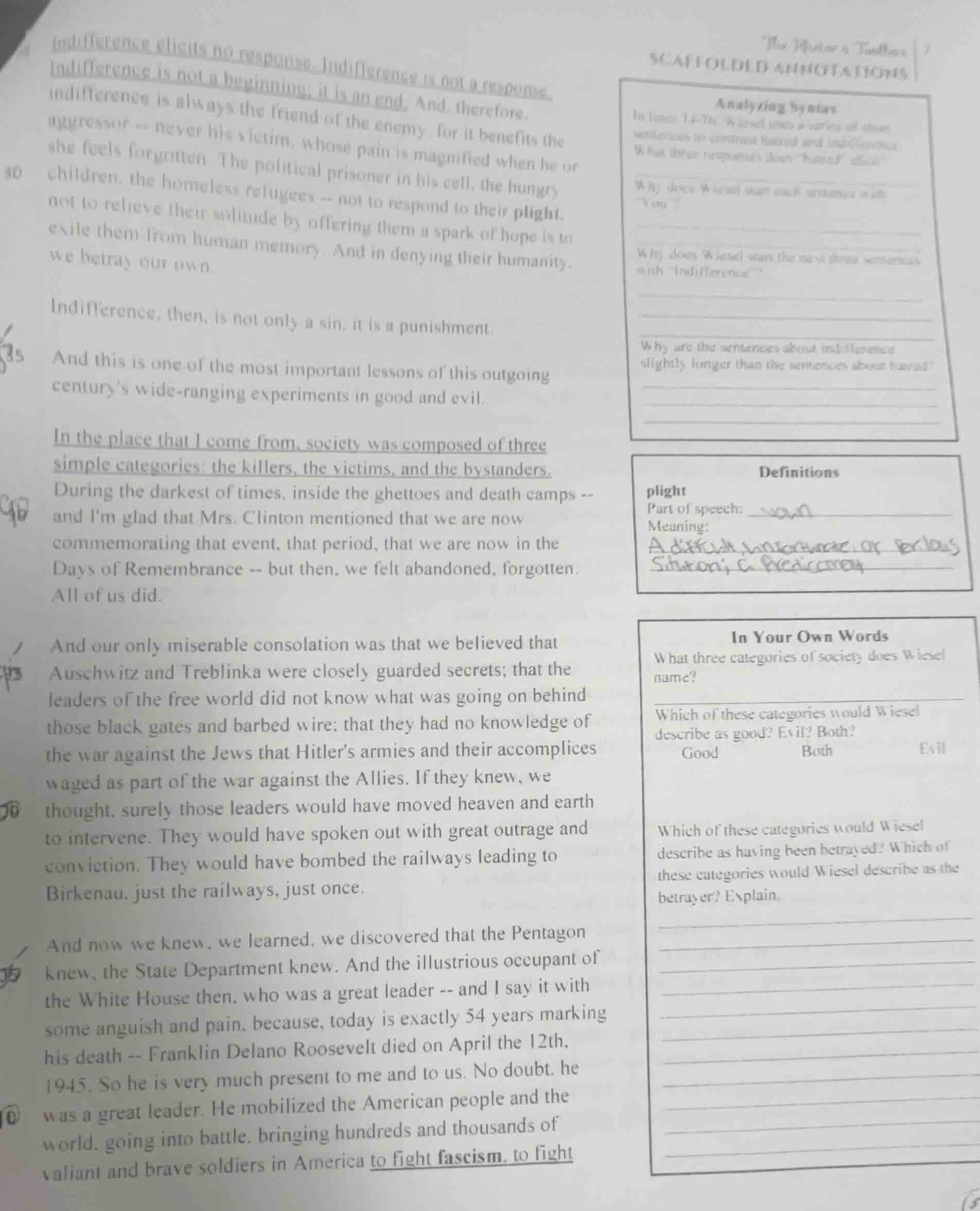
the writers timeline
scaffolded annotations
analyzing syntax
in lines 14 - 76, wiesel uses a variety of short
sentences to contrast hatred and indifference.
what effect do these “short” ideas?
why does wiesel start each sentence with
“you”?
why does wiesel want the sentences
with “indifference”?
why are the sentences about indifference
slightly longer than the sentences about hatred?
definitions
plight
part of speech:
meaning:
in your own words
what three categories of society does wiesel
name?
which of these categories would wiesel
describe as good? evil? both?
\tgood \tboth \tevil
which of these categories would wiesel
describe as having been betrayed? which of
these categories would wiesel describe as the
betrayer? explain.
1. In Your Own Words - First Question
The text explicitly states the three categories of society from Wiesel's origin.
2. In Your Own Words - Second Question
Victims are innocent people harmed, so they are good; Killers perpetrated violence, so they are evil; Bystanders failed to act, enabling harm, making them a mix of failing to do good (complicit in evil).
3. In Your Own Words - Third Question
Victims felt abandoned by the world's leaders, so they were betrayed. Bystanders (including the aware Allied leaders who did not intervene) are the betrayers, as their inaction let the atrocities continue.
4. Definitions - "plight"
Confirmed part of speech and clarified standard definition.
5. Analyzing Syntax - First Question
The short, direct "hate" responses create a sharp, visceral contrast to the drawn-out, passive language of indifference, emphasizing hate is an active (if harmful) response while indifference is empty and unresponsive.
6. Analyzing Syntax - Second Question
Starting with "You" directly addresses the reader, forcing personal engagement with the moral weight of indifference.
7. Analyzing Syntax - Third Question
Repeating "Indifference" at the start of sentences emphasizes it as the central, recurring evil being condemned, reinforcing its significance.
8. Analyzing Syntax - Fourth Question
Longer sentences about indifference mirror the lingering, insidious nature of indifference itself, while shorter "hate" sentences reflect hate's blunt, immediate quality, highlighting that indifference is a slower, more pervasive harm.

Snap & solve any problem in the app
Get step-by-step solutions on Sovi AI
Photo-based solutions with guided steps
Explore more problems and detailed explanations
In Your Own Words
- The three categories are the killers, the victims, and the bystanders.
- Good: The victims; Evil: The killers; Both: The bystanders
- Wiesel would describe the victims as betrayed—they were abandoned and forgotten while suffering atrocities. The bystanders (including Allied leaders who knew about the camps but did not intervene) are the betrayers; their indifference and inaction allowed the suffering of the victims to continue, violating their duty to help.
Definitions
plight
Part of speech: Noun
Meaning: A difficult, serious, or distressing situation.
Analyzing Syntax
- The short, direct "hate" responses create a sharp contrast, framing hate as an active (if harmful) reaction, while indifference is framed as a passive, empty lack of response.
- Starting with "You" directly engages the reader, making the moral message about indifference personal and urgent.
- Repeating "Indifference" emphasizes it as the core, condemnable subject of the passage, drawing focus to its harm.
- Longer sentences about indifference mirror its lingering, insidious, and pervasive nature, while shorter "hate" sentences reflect hate's blunt, immediate (but less enduringly harmful) quality.