QUESTION IMAGE
Question
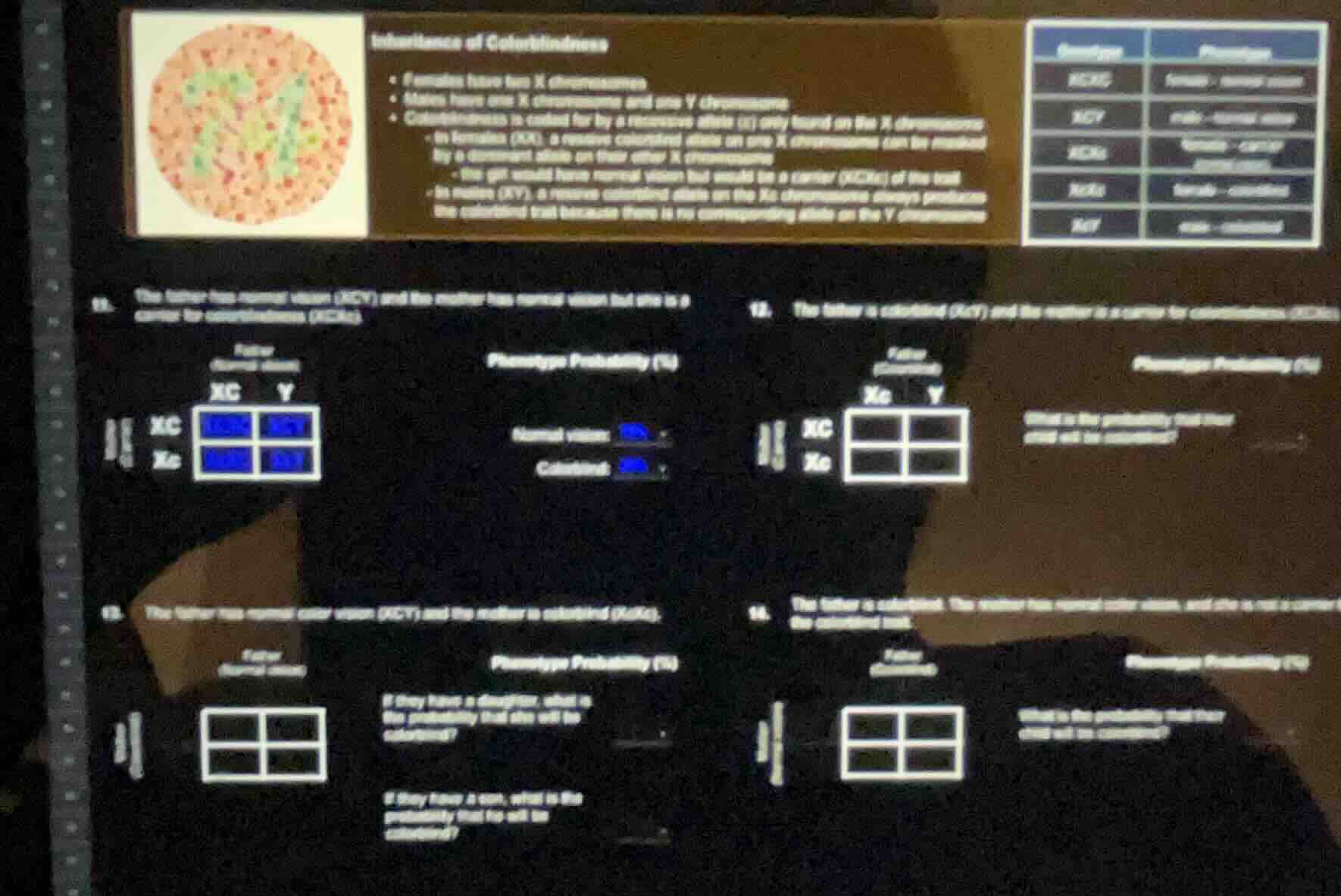
inheritance of colorblindness
- females have two x chromosomes
- males have one x chromosome and one y chromosome
- colorblindness is coded for by a recessive allele (c) only found on the x chromosome
- in females (xx), a recessive colorblind allele on one x chromosome can be masked by a dominant allele on their other x chromosome
- the girl would have normal vision but would be a carrier (xcxc) of the trait
- in males (xy), a recessive colorblind allele on the xc chromosome always produces the colorblind trait because there is no corresponding allele on the y chromosome
| genotype | phenotype |
|---|---|
| xcy | male - normal vision |
| xcxc | female - carrier |
| xcxc | female - colorblind |
| xcy | male - colorblind |
- the father has normal vision (xcy) and the mother has normal vision but she is a carrier for colorblindness (xcxc).
father (normal vision)
| xc | y | |
|---|---|---|
| xc |
phenotype probability (%)
normal vision:
colorblind:
- the father is colorblind (xcy) and the mother is a carrier for colorblindness (xcxc).
father (colorblind)
| xc | y | |
|---|---|---|
| xc |
phenotype probability (%)
what is the probability that their child will be colorblind?
- the father has normal color vision (xcy) and the mother is colorblind (xcxc).
father (normal vision)
phenotype probability (%)
if they have a daughter, what is the probability that she will be colorblind?
if they have a son, what is the probability that he will be colorblind?
- the father is colorblind. the mother has normal color vision, and she is not a carrier of the colorblind trait.
father (colorblind)
phenotype probability (%)
what is the probability that their child will be colorblind?
To solve these genetics problems related to colorblindness (an X - linked recessive trait), we analyze each problem using Punnett squares and the rules of X - linked inheritance.
Problem 11
- Father's genotype: \(X^{C}Y\) (normal vision, since he has one \(X\) with the dominant allele \(C\) and a \(Y\)).
- Mother's genotype: \(X^{C}X^{c}\) (normal vision but a carrier, as she has one dominant \(C\) and one recessive \(c\) on her \(X\) chromosomes).
- Punnett Square Setup:
- The father can contribute \(X^{C}\) or \(Y\) gametes.
- The mother can contribute \(X^{C}\) or \(X^{c}\) gametes.
- The Punnett square will have the following combinations:
- \(X^{C}\) (father) and \(X^{C}\) (mother) \(\to X^{C}X^{C}\) (female, normal)
- \(X^{C}\) (father) and \(X^{c}\) (mother) \(\to X^{C}X^{c}\) (female, carrier)
- \(Y\) (father) and \(X^{C}\) (mother) \(\to X^{C}Y\) (male, normal)
- \(Y\) (father) and \(X^{c}\) (mother) \(\to X^{c}Y\) (male, colorblind)
- Phenotype Probabilities:
- Total number of possible offspring genotypes: 4.
- Normal vision ( \(X^{C}X^{C}\), \(X^{C}X^{c}\), \(X^{C}Y\)): 3 out of 4. So the probability of normal vision is \(\frac{3}{4}\times100 = 75\%\).
- Colorblind ( \(X^{c}Y\)): 1 out of 4. So the probability of being colorblind is \(\frac{1}{4}\times100=25\%\).
Problem 12
- Father's genotype: \(X^{c}Y\) (colorblind, as he has the recessive \(c\) on his \(X\) and a \(Y\)).
- Mother's genotype: \(X^{C}X^{c}\) (carrier, with one \(C\) and one \(c\) on her \(X\) chromosomes).
- Punnett Square Setup:
- The father can contribute \(X^{c}\) or \(Y\) gametes.
- The mother can contribute \(X^{C}\) or \(X^{c}\) gametes.
- The possible offspring genotypes are:
- \(X^{C}X^{c}\) (female, carrier)
- \(X^{c}X^{c}\) (female, colorblind)
- \(X^{C}Y\) (male, normal)
- \(X^{c}Y\) (male, colorblind)
- Probability of Having a Colorblind Child:
- Out of 4 possible genotypes, the colorblind genotypes are \(X^{c}X^{c}\) and \(X^{c}Y\), which is 2 out of 4. So the probability is \(\frac{2}{4}\times100 = 50\%\).
Problem 13
- Father's genotype: \(X^{C}Y\) (normal vision).
- Mother's genotype: \(X^{c}X^{c}\) (colorblind, since she has two recessive \(c\) alleles on her \(X\) chromosomes).
- For a Daughter:
- The father can only contribute \(X^{C}\) (because if he contributes \(Y\), the offspring will be male).
- The mother can only contribute \(X^{c}\).
- The daughter's genotype will be \(X^{C}X^{c}\) (carrier, not colorblind). So the probability of a daughter being colorblind is \(0\%\).
- For a Son:
- The father contributes \(Y\), and the mother contributes \(X^{c}\).
- The son's genotype is \(X^{c}Y\) (colorblind). So the probability of a son being colorblind is \(100\%\).
Problem 14 (Incomplete Information, but General Approach)
- Father's genotype: \(X^{c}Y\) (colorblind).
- Mother's genotype: \(X^{C}X^{C}\) (normal vision, not a carrier, as she has two dominant \(C\) alleles).
- Punnett Square Setup:
- The father can contribute \(X^{c}\) or \(Y\) gametes.
- The mother can only contribute \(X^{C}\) gametes.
- The possible offspring genotypes:
- \(X^{C}X^{c}\) (female, carrier)
- \(X^{C}Y\) (male, normal)
- Probability of Having a Colorblind Child:
- None of the offspring genotypes result in colorblindness (since all offspring have at least one dominant \(C\) allele from the mother). So the probability is \(0\%\).
Final Answ…

Snap & solve any problem in the app
Get step-by-step solutions on Sovi AI
Photo-based solutions with guided steps
Explore more problems and detailed explanations
To solve these genetics problems related to colorblindness (an X - linked recessive trait), we analyze each problem using Punnett squares and the rules of X - linked inheritance.
Problem 11
- Father's genotype: \(X^{C}Y\) (normal vision, since he has one \(X\) with the dominant allele \(C\) and a \(Y\)).
- Mother's genotype: \(X^{C}X^{c}\) (normal vision but a carrier, as she has one dominant \(C\) and one recessive \(c\) on her \(X\) chromosomes).
- Punnett Square Setup:
- The father can contribute \(X^{C}\) or \(Y\) gametes.
- The mother can contribute \(X^{C}\) or \(X^{c}\) gametes.
- The Punnett square will have the following combinations:
- \(X^{C}\) (father) and \(X^{C}\) (mother) \(\to X^{C}X^{C}\) (female, normal)
- \(X^{C}\) (father) and \(X^{c}\) (mother) \(\to X^{C}X^{c}\) (female, carrier)
- \(Y\) (father) and \(X^{C}\) (mother) \(\to X^{C}Y\) (male, normal)
- \(Y\) (father) and \(X^{c}\) (mother) \(\to X^{c}Y\) (male, colorblind)
- Phenotype Probabilities:
- Total number of possible offspring genotypes: 4.
- Normal vision ( \(X^{C}X^{C}\), \(X^{C}X^{c}\), \(X^{C}Y\)): 3 out of 4. So the probability of normal vision is \(\frac{3}{4}\times100 = 75\%\).
- Colorblind ( \(X^{c}Y\)): 1 out of 4. So the probability of being colorblind is \(\frac{1}{4}\times100=25\%\).
Problem 12
- Father's genotype: \(X^{c}Y\) (colorblind, as he has the recessive \(c\) on his \(X\) and a \(Y\)).
- Mother's genotype: \(X^{C}X^{c}\) (carrier, with one \(C\) and one \(c\) on her \(X\) chromosomes).
- Punnett Square Setup:
- The father can contribute \(X^{c}\) or \(Y\) gametes.
- The mother can contribute \(X^{C}\) or \(X^{c}\) gametes.
- The possible offspring genotypes are:
- \(X^{C}X^{c}\) (female, carrier)
- \(X^{c}X^{c}\) (female, colorblind)
- \(X^{C}Y\) (male, normal)
- \(X^{c}Y\) (male, colorblind)
- Probability of Having a Colorblind Child:
- Out of 4 possible genotypes, the colorblind genotypes are \(X^{c}X^{c}\) and \(X^{c}Y\), which is 2 out of 4. So the probability is \(\frac{2}{4}\times100 = 50\%\).
Problem 13
- Father's genotype: \(X^{C}Y\) (normal vision).
- Mother's genotype: \(X^{c}X^{c}\) (colorblind, since she has two recessive \(c\) alleles on her \(X\) chromosomes).
- For a Daughter:
- The father can only contribute \(X^{C}\) (because if he contributes \(Y\), the offspring will be male).
- The mother can only contribute \(X^{c}\).
- The daughter's genotype will be \(X^{C}X^{c}\) (carrier, not colorblind). So the probability of a daughter being colorblind is \(0\%\).
- For a Son:
- The father contributes \(Y\), and the mother contributes \(X^{c}\).
- The son's genotype is \(X^{c}Y\) (colorblind). So the probability of a son being colorblind is \(100\%\).
Problem 14 (Incomplete Information, but General Approach)
- Father's genotype: \(X^{c}Y\) (colorblind).
- Mother's genotype: \(X^{C}X^{C}\) (normal vision, not a carrier, as she has two dominant \(C\) alleles).
- Punnett Square Setup:
- The father can contribute \(X^{c}\) or \(Y\) gametes.
- The mother can only contribute \(X^{C}\) gametes.
- The possible offspring genotypes:
- \(X^{C}X^{c}\) (female, carrier)
- \(X^{C}Y\) (male, normal)
- Probability of Having a Colorblind Child:
- None of the offspring genotypes result in colorblindness (since all offspring have at least one dominant \(C\) allele from the mother). So the probability is \(0\%\).
Final Answers
- Normal vision: \(\boldsymbol{75\%}\), Colorblind: \(\boldsymbol{25\%}\)
- Probability of colorblind child: \(\boldsymbol{50\%}\)
- Probability of colorblind daughter: \(\boldsymbol{0\%}\), Probability of colorblind son: \(\boldsymbol{100\%}\)
- Probability of colorblind child: \(\boldsymbol{0\%}\)