QUESTION IMAGE
Question
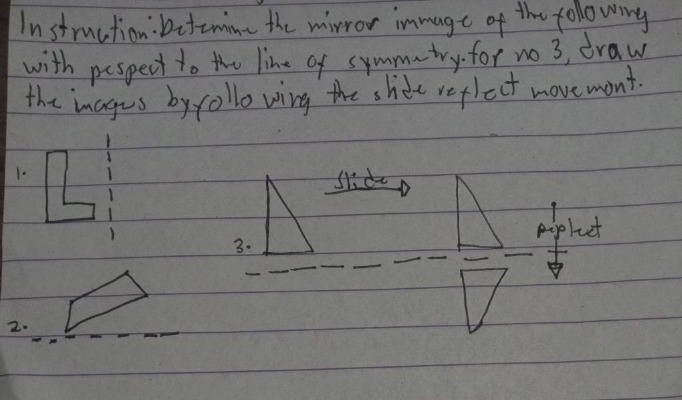
instruction: determine the mirror image of the following with respect to the line of symmetry. for no 3, draw the images by following the slide reflect movement.
1.
2.
3.
For Problem 1 (Mirror Image over Vertical Dashed Line)
Step 1: Identify Key Points of the "L" Shape
Let's denote the vertices of the "L" shape. Let the bottom - left corner be \(A\), the bottom - right corner (on the vertical dashed line side) be \(B\), and the top - right corner be \(C\).
Step 2: Reflect Points over the Vertical Line
For a vertical line of symmetry (the dashed line), the reflection of a point \((x,y)\) over the line \(x = a\) (where \(a\) is the \(x\) - coordinate of the vertical line) is given by the formula \((2a - x,y)\).
- If the vertical dashed line is at \(x = a\), and the \(x\) - coordinate of point \(A\) is \(x_A\), the \(x\) - coordinate of its reflection \(A'\) is \(2a - x_A\), and the \(y\) - coordinate remains the same.
- Similarly, reflect points \(B\) and \(C\) to get \(B'\) and \(C'\).
Step 3: Connect the Reflected Points
Connect the reflected points \(A'\), \(B'\), and \(C'\) in the same order as the original "L" shape to get the mirror image. The mirror image of the "L" shape will be a mirror - reversed "L" with respect to the vertical dashed line.
For Problem 2 (Mirror Image over Horizontal Dashed Line)
Step 1: Identify Key Points of the Quadrilateral
Let the vertices of the quadrilateral be \(P\), \(Q\), \(R\), and \(S\) (starting from the bottom - left vertex).
Step 2: Reflect Points over the Horizontal Line
For a horizontal line of symmetry (the dashed line), the reflection of a point \((x,y)\) over the line \(y = b\) (where \(b\) is the \(y\) - coordinate of the horizontal line) is given by the formula \((x,2b - y)\).
- If the horizontal dashed line is at \(y = b\), and the \(y\) - coordinate of point \(P\) is \(y_P\), the \(y\) - coordinate of its reflection \(P'\) is \(2b - y_P\), and the \(x\) - coordinate remains the same.
- Reflect points \(Q\), \(R\), and \(S\) in the same way to get \(Q'\), \(R'\), and \(S'\).
Step 3: Connect the Reflected Points
Connect the reflected points \(P'\), \(Q'\), \(R'\), and \(S'\) in the same order as the original quadrilateral to get the mirror image. The mirror image will be a mirror - reversed quadrilateral with respect to the horizontal dashed line (flipped upside - down relative to the original quadrilateral).
For Problem 3 (Slide - Reflect Movement)
Step 1: Slide (Translate) the Triangle First
First, perform the slide (translation) of the left - hand triangle in the direction of the "slide" arrow (to the right, as per the diagram). Let the vertices of the original triangle be \(X\), \(Y\), \(Z\). After translation, the vertices become \(X_1\), \(Y_1\), \(Z_1\) (each vertex is moved the same distance in the direction of the slide).
Step 2: Reflect the Translated Triangle over the Vertical Dashed Line (the "Apothet" - like line)
For the vertical dashed line (the line of reflection), use the reflection formula for a vertical line (as in Problem 1). Reflect the vertices \(X_1\), \(Y_1\), \(Z_1\) over the vertical line to get \(X_2\), \(Y_2\), \(Z_2\).
Step 3: Connect the Reflected (after Slide) Points
Connect the points \(X_2\), \(Y_2\), \(Z_2\) to get the image after the slide - reflect movement. The resulting triangle will be the image of the original triangle after first sliding it to the right and then reflecting it over the vertical line.
Final Answers (Descriptive)
- The mirror image of the "L" shape over the vertical dashed line is a mirror - reversed "L" with respect to that line.
- The mirror image of the quadrilateral over the horizontal dashed line is a mirror - reversed (upside -…

Snap & solve any problem in the app
Get step-by-step solutions on Sovi AI
Photo-based solutions with guided steps
Explore more problems and detailed explanations
For Problem 1 (Mirror Image over Vertical Dashed Line)
Step 1: Identify Key Points of the "L" Shape
Let's denote the vertices of the "L" shape. Let the bottom - left corner be \(A\), the bottom - right corner (on the vertical dashed line side) be \(B\), and the top - right corner be \(C\).
Step 2: Reflect Points over the Vertical Line
For a vertical line of symmetry (the dashed line), the reflection of a point \((x,y)\) over the line \(x = a\) (where \(a\) is the \(x\) - coordinate of the vertical line) is given by the formula \((2a - x,y)\).
- If the vertical dashed line is at \(x = a\), and the \(x\) - coordinate of point \(A\) is \(x_A\), the \(x\) - coordinate of its reflection \(A'\) is \(2a - x_A\), and the \(y\) - coordinate remains the same.
- Similarly, reflect points \(B\) and \(C\) to get \(B'\) and \(C'\).
Step 3: Connect the Reflected Points
Connect the reflected points \(A'\), \(B'\), and \(C'\) in the same order as the original "L" shape to get the mirror image. The mirror image of the "L" shape will be a mirror - reversed "L" with respect to the vertical dashed line.
For Problem 2 (Mirror Image over Horizontal Dashed Line)
Step 1: Identify Key Points of the Quadrilateral
Let the vertices of the quadrilateral be \(P\), \(Q\), \(R\), and \(S\) (starting from the bottom - left vertex).
Step 2: Reflect Points over the Horizontal Line
For a horizontal line of symmetry (the dashed line), the reflection of a point \((x,y)\) over the line \(y = b\) (where \(b\) is the \(y\) - coordinate of the horizontal line) is given by the formula \((x,2b - y)\).
- If the horizontal dashed line is at \(y = b\), and the \(y\) - coordinate of point \(P\) is \(y_P\), the \(y\) - coordinate of its reflection \(P'\) is \(2b - y_P\), and the \(x\) - coordinate remains the same.
- Reflect points \(Q\), \(R\), and \(S\) in the same way to get \(Q'\), \(R'\), and \(S'\).
Step 3: Connect the Reflected Points
Connect the reflected points \(P'\), \(Q'\), \(R'\), and \(S'\) in the same order as the original quadrilateral to get the mirror image. The mirror image will be a mirror - reversed quadrilateral with respect to the horizontal dashed line (flipped upside - down relative to the original quadrilateral).
For Problem 3 (Slide - Reflect Movement)
Step 1: Slide (Translate) the Triangle First
First, perform the slide (translation) of the left - hand triangle in the direction of the "slide" arrow (to the right, as per the diagram). Let the vertices of the original triangle be \(X\), \(Y\), \(Z\). After translation, the vertices become \(X_1\), \(Y_1\), \(Z_1\) (each vertex is moved the same distance in the direction of the slide).
Step 2: Reflect the Translated Triangle over the Vertical Dashed Line (the "Apothet" - like line)
For the vertical dashed line (the line of reflection), use the reflection formula for a vertical line (as in Problem 1). Reflect the vertices \(X_1\), \(Y_1\), \(Z_1\) over the vertical line to get \(X_2\), \(Y_2\), \(Z_2\).
Step 3: Connect the Reflected (after Slide) Points
Connect the points \(X_2\), \(Y_2\), \(Z_2\) to get the image after the slide - reflect movement. The resulting triangle will be the image of the original triangle after first sliding it to the right and then reflecting it over the vertical line.
Final Answers (Descriptive)
- The mirror image of the "L" shape over the vertical dashed line is a mirror - reversed "L" with respect to that line.
- The mirror image of the quadrilateral over the horizontal dashed line is a mirror - reversed (upside - down) quadrilateral with respect to that line.
- The image after the slide - reflect movement of the triangle is a triangle obtained by first sliding the original triangle to the right and then reflecting it over the vertical dashed line.
(Note: For a more precise graphical answer, the actual drawing should be done by following the reflection and translation rules for each vertex of the given figures.)