QUESTION IMAGE
Question
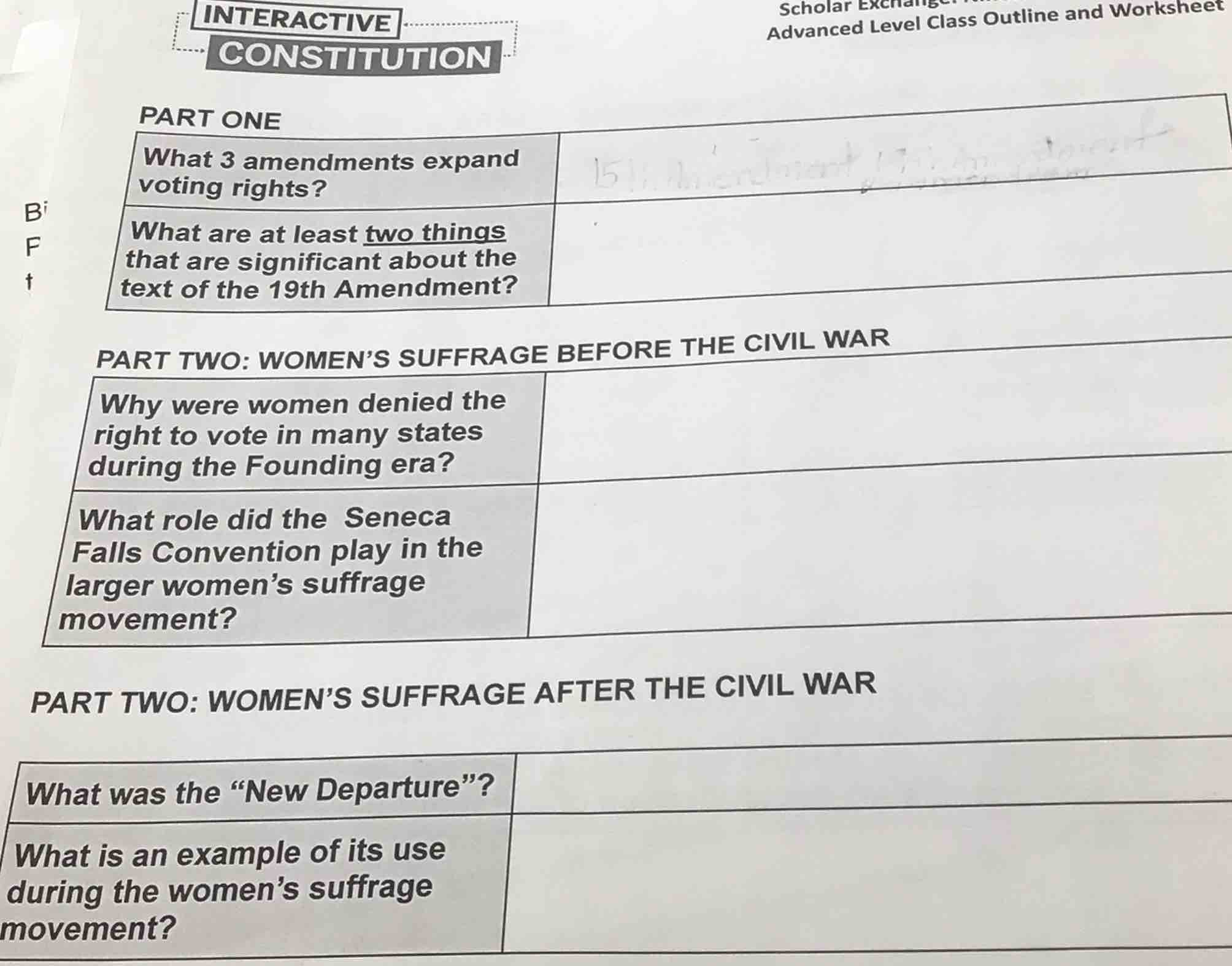
interactive constitution
scholar exchang
advanced level class outline and worksheet
part one
what 3 amendments expand voting rights?
what are at least two things that are significant about the text of the 19th amendment?
part two: womens suffrage before the civil war
why were women denied the right to vote in many states during the founding era?
what role did the seneca falls convention play in the larger womens suffrage movement?
part two: womens suffrage after the civil war
what was the
ew departure\?
what is an example of its use during the womens suffrage movement?
- For voting rights amendments: These three amendments successively removed major demographic barriers to voting in the U.S.
- For 19th Amendment significance: It codified a key gender equality milestone and used broad, universal language.
- For Founding Era voting denial: Gendered norms and limited legal standing excluded women.
- For Seneca Falls Convention: It launched organized national suffrage advocacy.
- For "New Departure": It was a legal strategy to leverage existing constitutional text.
- For "New Departure" example: Suffragists tested the strategy via direct voting attempts.

Snap & solve any problem in the app
Get step-by-step solutions on Sovi AI
Photo-based solutions with guided steps
Explore more problems and detailed explanations
- What 3 amendments expand voting rights?
15th Amendment (prohibits racial voting discrimination), 19th Amendment (prohibits gender-based voting discrimination), 26th Amendment (lowered the voting age to 18)
- What are at least two things that are significant about the text of the 19th Amendment?
- It prohibits the U.S. or any state from denying voting rights based on sex, establishing a federal standard for gender equality in voting.
- Its broad, universal wording avoids narrow exceptions, creating a clear legal foundation for women's suffrage nationwide.
- Why were women denied the right to vote in many states during the Founding era?
Women were seen as having a "domestic sphere" role rather than political standing, and early state voting laws restricted suffrage to white male property owners, excluding women by default.
- What role did the Seneca Falls Convention play in the larger women’s suffrage movement?
It was the first organized national women's rights convention in the U.S., issuing the Declaration of Sentiments that framed women's suffrage as a core demand and launched a coordinated, national suffrage movement.
- What was the “New Departure”?
A post-Civil War legal strategy by suffragists that argued the 14th and 15th Amendments (which granted citizenship and equal protection, and prohibited racial voting discrimination) already guaranteed women the right to vote, without needing a new constitutional amendment.
- What is an example of its use during the women’s suffrage movement?
Susan B. Anthony and other suffragists attempted to register and vote in the 1872 presidential election, arguing their right under the 14th Amendment. Anthony was arrested, tried, and convicted, bringing national attention to the suffrage cause.