QUESTION IMAGE
Question
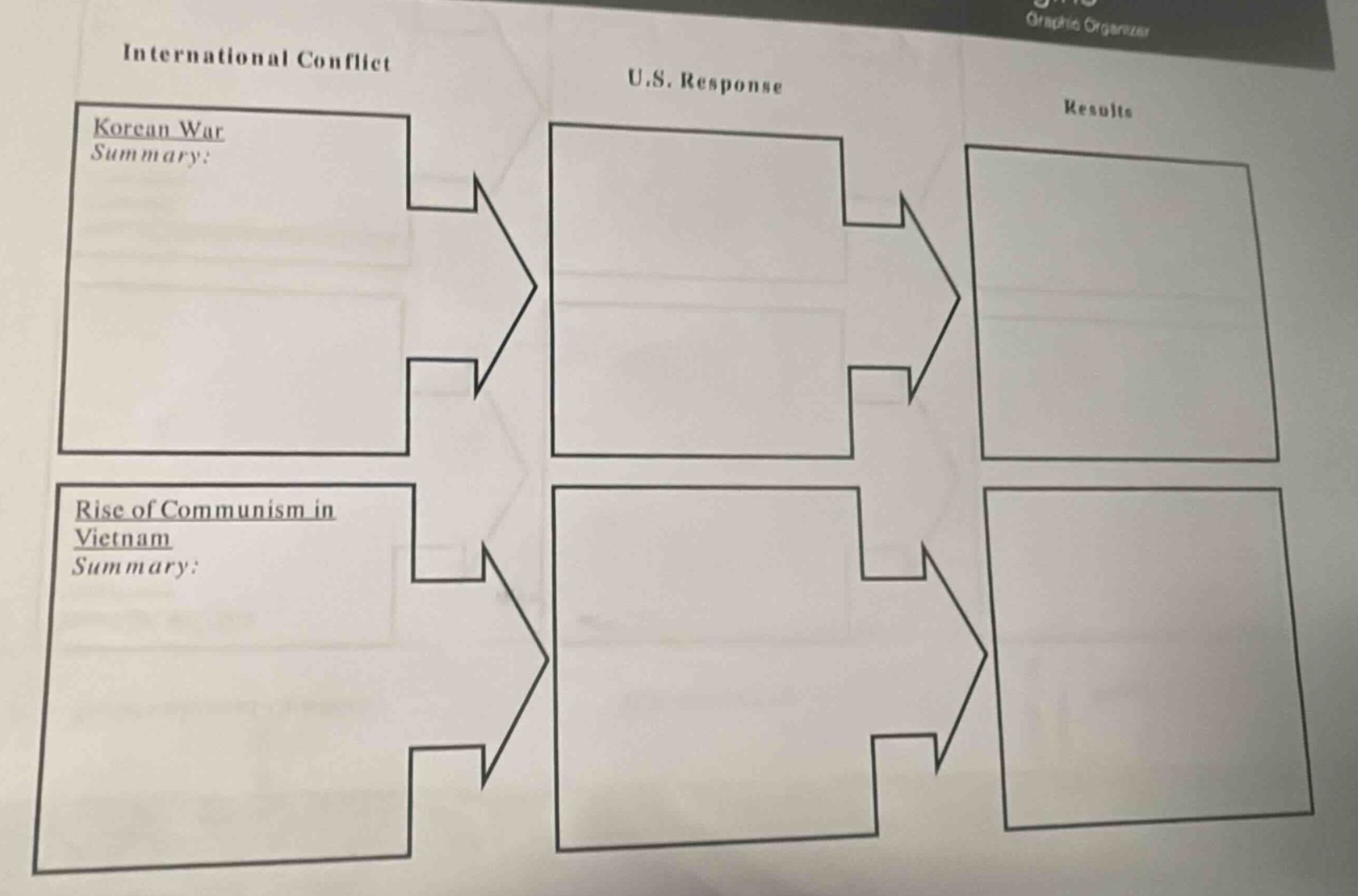
international conflict
korean war
summary:
u.s. response
results
rise of communism in
vietnam
summary:
Brief Explanations
Korean War Section:
- International Conflict Summary: In 1950, North Korea (backed by the USSR and China) invaded South Korea, aiming to unify the peninsula under communist rule. The conflict was a proxy war of the Cold War, driven by competing ideological and geopolitical interests.
- U.S. Response: The U.S. led a United Nations coalition to defend South Korea, under the Truman Doctrine of containing communism. It deployed ground, air, and naval forces, with General Douglas MacArthur commanding the UN troops initially.
- Results: A 1953 armistice ended active fighting, splitting Korea along the 38th parallel. No formal peace treaty was signed, leaving the two Koreas technically at war. South Korea remained a U.S. ally, and the conflict solidified U.S. Cold War containment policy in Asia.
Rise of Communism in Vietnam Section:
- International Conflict Summary: After WWII, Vietnamese nationalists led by Ho Chi Minh (a communist) fought first French colonial rule, then South Vietnamese forces backed by the U.S. The conflict stemmed from anti-colonial sentiment and Cold War rivalry, as North Vietnam sought to unify the country under communism.
- U.S. Response: The U.S. provided military aid to South Vietnam starting in the 1950s, escalated to direct troop deployment in the 1960s (peaking at 500,000 troops in 1968) under the domino theory, which argued that allowing Vietnam to fall to communism would spread the ideology across Southeast Asia.
- Results: The U.S. withdrew troops by 1973, and North Vietnam captured Saigon in 1975, unifying Vietnam under communist rule. The war led to massive U.S. casualties, domestic social unrest in the U.S., and a shift in U.S. foreign policy away from direct ground interventions in Southeast Asia.

Snap & solve any problem in the app
Get step-by-step solutions on Sovi AI
Photo-based solutions with guided steps
Explore more problems and detailed explanations
Korean War
- International Conflict Summary: In 1950, communist North Korea invaded U.S.-backed South Korea, sparking a Cold War proxy war to unify the Korean peninsula.
- U.S. Response: Led a UN military coalition to defend South Korea, deploying large ground/air forces under the containment policy.
- Results: 1953 armistice split Korea at the 38th parallel; no formal peace treaty, leaving the two nations technically at war.
Rise of Communism in Vietnam
- International Conflict Summary: Post-WWII, communist-led Viet Minh fought French colonial rule, then South Vietnam; North Vietnam sought to unify the country under communism, fueled by anti-colonial and Cold War tensions.
- U.S. Response: Provided escalating military aid and troop deployments (1960s peak) based on the domino theory to contain communism.
- Results: U.S. withdrew in 1973; North Vietnam seized Saigon in 1975, unifying Vietnam as a communist state.