QUESTION IMAGE
Question
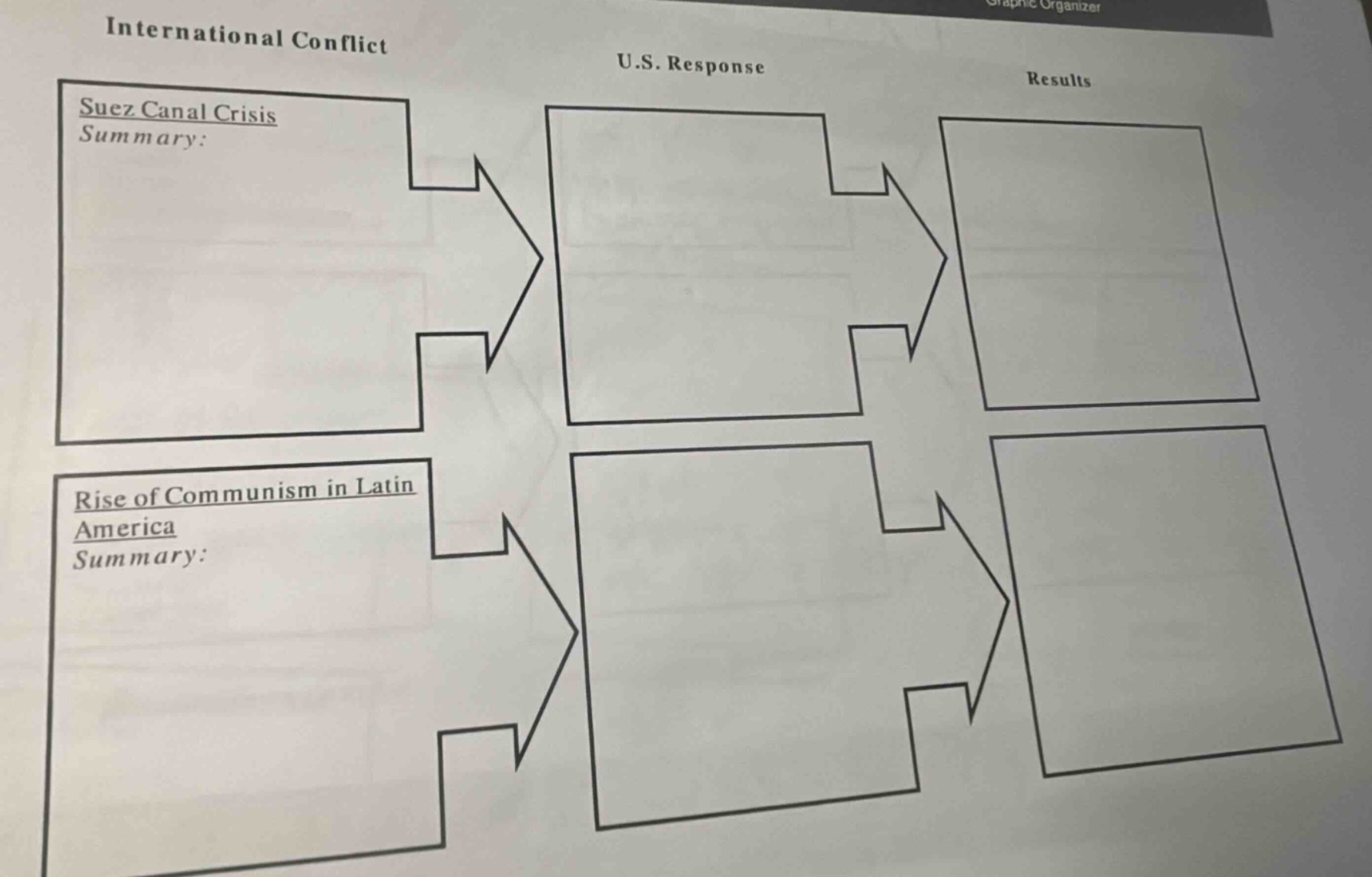
international conflict
suez canal crisis
summary:
u.s. response
results
rise of communism in latin america
summary:
Brief Explanations
Suez Canal Crisis
- Summary: In 1956, Egyptian President Nasser nationalized the Suez Canal, which was previously controlled by British and French interests. In response, Israel, Britain, and France launched a military invasion of Egypt to retake the canal, sparking an international crisis.
- U.S. Response: The U.S. opposed the invasion, fearing it would destabilize the Middle East and push Arab nations toward the Soviet Union. The U.S. used economic pressure (threatening to sell British pound reserves and cut aid) to force the invading powers to withdraw.
- Results: The invading forces withdrew in 1957, and Egypt retained control of the Suez Canal. The crisis elevated Nasser's status in the Arab world, weakened British and French global influence, and solidified U.S. dominance in Western foreign policy.
Rise of Communism in Latin America
- Summary: Starting in the mid-20th century, several Latin American nations saw the growth of communist and left-wing movements, often fueled by economic inequality, U.S.-backed authoritarian regimes, and influence from the Soviet Union and Cuba (after the 1959 Cuban Revolution). Key examples include the Cuban Revolution, the rise of communist parties in Chile (leading to Salvador Allende's election in 1970), and guerrilla movements across the region.
- U.S. Response: The U.S. adopted a hardline anti-communist policy under the Monroe Doctrine and Cold War containment. Actions included supporting military coups (e.g., the 1973 coup against Allende in Chile), funding anti-communist guerrillas (e.g., the Contras in Nicaragua), imposing economic sanctions, and providing military aid to authoritarian regimes.
- Results: Many communist and left-wing governments were overthrown, leading to decades of authoritarian rule in some nations. The U.S. interventions caused widespread political instability, human rights abuses, and anti-American sentiment across Latin America. Cuba remained a communist state and a symbol of resistance to U.S. influence in the region.

Snap & solve any problem in the app
Get step-by-step solutions on Sovi AI
Photo-based solutions with guided steps
Explore more problems and detailed explanations
Suez Canal Crisis
- Summary: 1956 Egyptian nationalization of the Suez Canal led to a military invasion by Israel, Britain, and France, triggering a global crisis.
- U.S. Response: Used economic pressure to force the invading nations to withdraw troops.
- Results: Egypt retained canal control; British/French global influence declined, U.S. Middle East influence grew.
Rise of Communism in Latin America
- Summary: Mid-20th century growth of left-wing/communist movements, driven by inequality, U.S.-backed authoritarianism, and Cuban/Soviet influence.
- U.S. Response: Deployed containment policies: supported coups, funded anti-communist forces, imposed sanctions.
- Results: Widespread political instability, human rights abuses, and lasting anti-American sentiment; Cuba remained communist.