QUESTION IMAGE
Question
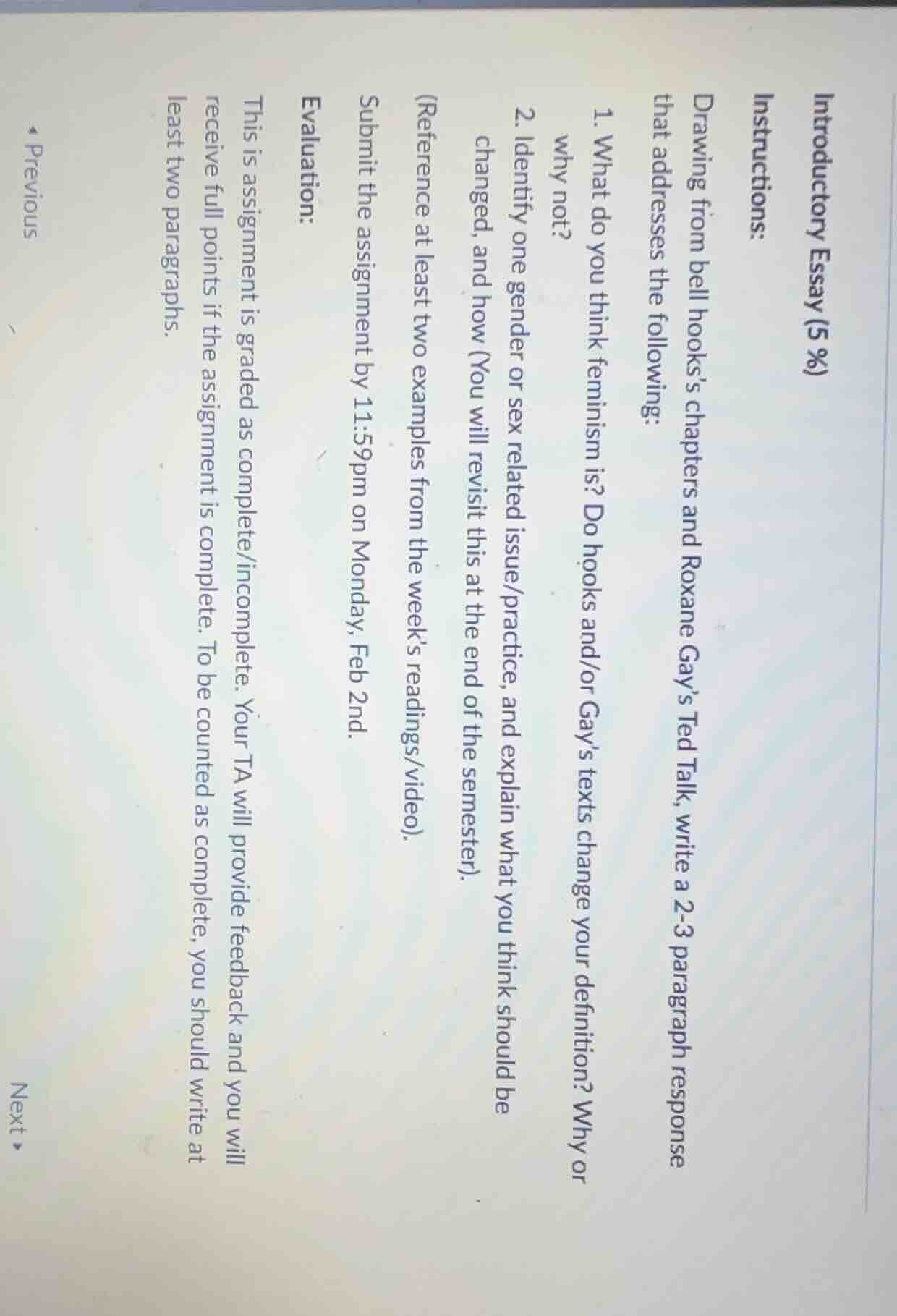
introductory essay (5%)
instructions:
drawing from bell hooks’s chapters and roxane gay’s ted talk, write a 2 - 3 paragraph response that addresses the following:
- what do you think feminism is? do hooks and/or gay’s texts change your definition? why or why not?
- identify one gender or sex related issue/practice, and explain what you think should be changed, and how (you will revisit this at the end of the semester).
(reference at least two examples from the week’s readings/video).
submit the assignment by 11:59pm on monday, feb 2nd.
evaluation:
this is assignment is graded as complete/incomplete. your ta will provide feedback and you will receive full points if the assignment is complete. to be counted as complete, you should write at least two paragraphs.
- For the first question, start with a baseline definition of feminism (e.g., advocacy for gender equality), then analyze how bell hooks' framing of feminism as a movement to end all systems of oppression (not just gender) and Roxane Gay's exploration of intersectional, lived experiences of misogyny (like in her discussion of body politics and sexual violence) expand this definition. Explain that these texts shift the focus from a one-size-fits-all gender equality to a more inclusive, intersectional approach that centers marginalized voices, which revises a narrower initial definition.
- For the second question, select an issue like the gendered pay gap. Using hooks' critique of capitalist systems reinforcing gender exploitation, explain that the pay gap should be addressed not just by equal pay laws, but by challenging the capitalist structures that devalue care work (disproportionately done by women). Using Gay's discussion of intersectionality, note that the pay gap is wider for Black and Indigenous women, so solutions must center these groups—for example, implementing pay transparency laws with targeted equity audits for marginalized female employees, rather than universal policies that ignore racial disparities.

Snap & solve any problem in the app
Get step-by-step solutions on Sovi AI
Photo-based solutions with guided steps
Explore more problems and detailed explanations
Response to Question 1:
Feminism, at its core, is a movement to secure political, social, and economic equality across genders. bell hooks and Roxane Gay’s work deeply expands this definition, moving it beyond a narrow focus on middle-class white women’s issues. hooks redefines feminism as a struggle to dismantle all interconnected systems of oppression—capitalism, racism, and sexism—arguing that gender inequality cannot be solved without addressing how these systems reinforce one another. This changes my initial definition because it frames feminism as a collective, inclusive fight, not just a gender-specific one. Roxane Gay’s work further refines this by centering lived, intersectional experiences: her discussion of sexual violence, body shaming, and the ways marginalized women (especially Black women) face compounded misogyny shows that feminism must center those most harmed by systemic inequity to be meaningful. Without this intersectional lens, a definition of feminism fails to address the full scope of gendered harm.
Response to Question 2:
One critical gender-related issue is the failure to address the intersectional nature of gender-based sexual violence, which should be reoriented to center marginalized survivors. Currently, mainstream anti-violence efforts often prioritize the experiences of white, cisgender, middle-class women, ignoring how Black, Indigenous, and queer survivors face barriers to justice (like police bias, lack of culturally competent support services, and societal dismissal of their trauma). Drawing from bell hooks’ critique of systemic oppression, this issue persists because anti-violence movements have not challenged the racist and heteronormative structures that enable this disparity. To fix this, support services must be led by and designed for marginalized survivors: for example, creating community-led crisis centers staffed by people with shared cultural identities, as opposed to centralized, one-size-fits-all government services. Roxane Gay’s exploration of her own sexual trauma and the societal silence around Black women’s experiences underscores this need—survivors’ voices, especially those from marginalized groups, must guide policy and support, rather than institutional or dominant cultural narratives. This shift would ensure that anti-violence work addresses the root causes of disparities, not just their surface-level symptoms.