QUESTION IMAGE
Question
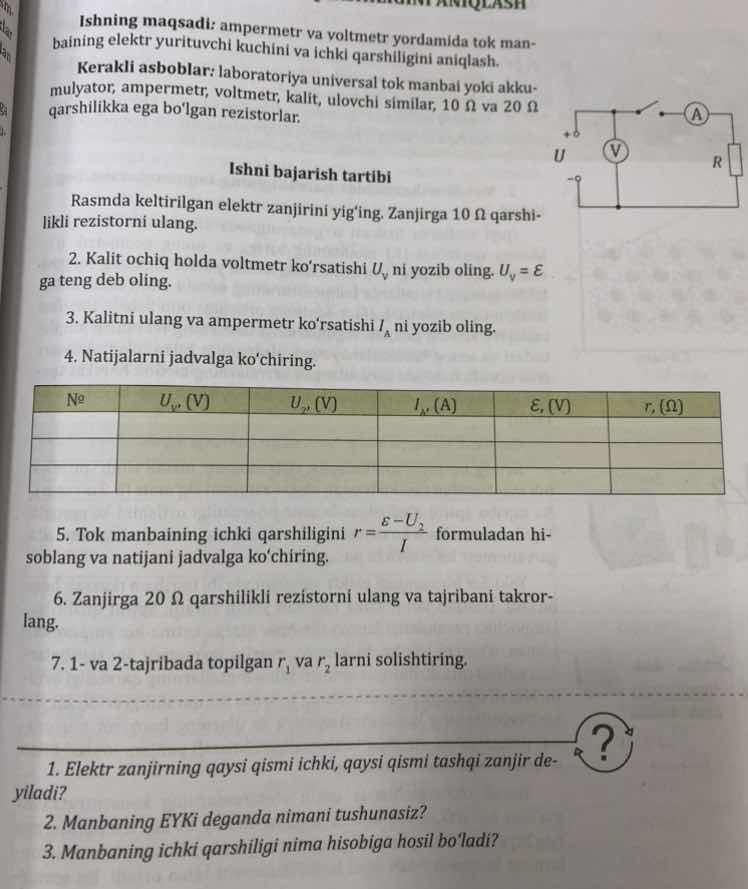
ishning maqsadi: ampermetr va voltmetr yordamida tok manbaining elektr yurittuvchi kuchi va ichki qarshiligini aniqlash.
kerakli asboblar: laboratoriya universalligini toldiruvchi tok manbai yoki akkumulyator; ampermetr; voltmetr; kalit, ulovchi simlar, 10 ω va 20 ω qarshilikka ega bolgan rezistorlar.
ishni bajarish tartibi
rasmda keltirilgan elektr zanjirini yiging. zanjirga 10 ω qarshilikli rezistorni ulang.
- kalit ochiq holda voltmetr korsatishi ( u_v ) ni yozib olng. ( u_v = varepsilon ) ga teng deb olng.
- kalitni ulang va ampermetr korsatishi ( i_a ) ni yozib olng.
- natijalarni jadvalga kochiring.
| № | ( u_{v1} ) (v) | ( u_{v2} ) (v) | ( i_{a} ) (a) | ( varepsilon ) (v) | ( r ) (ω) |
|---|---|---|---|---|---|
- tok manbaining ichki qarshiligini ( r = \frac{varepsilon - u_2}{i} ) formuladan hisoblang va natijani jadvalga kochiring.
- zanjirga 20 ω qarshilikli rezistorni ulang va tajribani takrorlang.
- 1- va 2-tajribada topilgan ( r_1 ) va ( r_2 ) larni solishtiring.
- elektr zanjirning qaysi qismi ichki, qaysi qismi tashqi zanjir deyiladi?
- manbanning eyki deganda nimani tushunasiz?
- manbanning ichki qarshiligi nima hisobiga hosil boladi?
Question 1:
In an electric circuit, the internal part (ichki zanjir) is the part of the circuit that is within the electromotive force (emf) source (like a battery), including its internal resistance. The external part (tashqi zanjir) is the part of the circuit outside the emf source, which includes components like resistors, ammeters, switches, etc., that are connected to the source. So, the internal circuit is the part with the emf source's internal resistance (inside the battery), and the external circuit is the part with the load resistor \( R \), ammeter, switch, etc., as shown in the diagram (resistor \( R \), ammeter \( A \), switch, and the connections outside the voltage source's internal part).
"EYKi" likely refers to "elektr yurituvchi kuchi" (electromotive force, emf) in Uzbek. The electromotive force (emf, \( \varepsilon \)) of a source is the work done per unit charge to move charge around the circuit (including the internal circuit), or it is the potential difference across the source when no current is drawn (open - circuit voltage, as seen when the switch is open and \( U_v=\varepsilon \) in step 2 of the procedure). It drives the electric current in the circuit.
The internal resistance (\( r \)) of a source (like a battery) is formed due to the resistance that charge carriers encounter as they move through the material of the source itself. In a battery, for example, the electrolyte and the electrodes have some resistance. When current flows through the source, the charge carriers (like ions in a battery) collide with the atoms or molecules of the source's material. These collisions impede the flow of charge, and this opposition to the flow of current within the source is what we call internal resistance. Factors such as the material of the electrodes, the concentration of the electrolyte (in a chemical battery), the temperature, and the physical dimensions (like length and cross - sectional area of the conducting path within the source) can affect the magnitude of the internal resistance.

Snap & solve any problem in the app
Get step-by-step solutions on Sovi AI
Photo-based solutions with guided steps
Explore more problems and detailed explanations
- Ichki zanjir: The part of the circuit inside the electromotive force (emf) source (e.g., battery), including its internal resistance. In the given circuit, it corresponds to the part of the voltage source \( U \) that has its internal resistance (not shown separately but inherent to the source).
- Tashqi zanjir: The part of the circuit outside the emf source, which includes the resistor \( R \), ammeter \( A \), switch, and the connecting wires between them (the part with \( R \), \( A \), switch, and the external connections of the voltage source \( U \)).