QUESTION IMAGE
Question
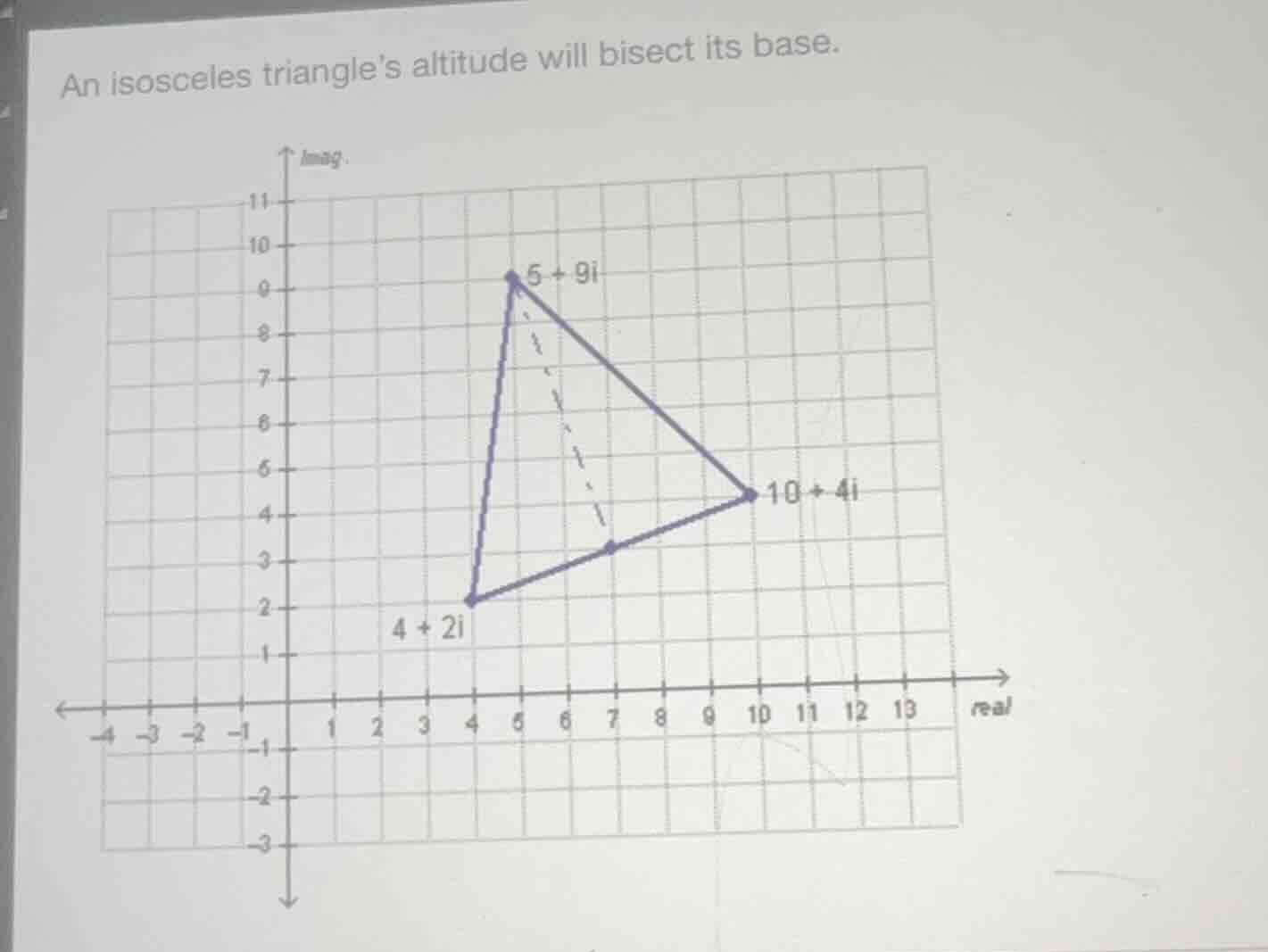
an isosceles triangles altitude will bisect its base.
Step1: Verify triangle is isosceles
Calculate side lengths using distance formula for complex numbers $d=\sqrt{(x_2-x_1)^2+(y_2-y_1)^2}$:
- Length of side between $4+2i$ and $5+9i$:
$\sqrt{(5-4)^2+(9-2)^2}=\sqrt{1+49}=\sqrt{50}$
- Length of side between $10+4i$ and $5+9i$:
$\sqrt{(5-10)^2+(9-4)^2}=\sqrt{25+25}=\sqrt{50}$
- Length of side between $4+2i$ and $10+4i$:
$\sqrt{(10-4)^2+(4-2)^2}=\sqrt{36+4}=\sqrt{40}$
Since two sides are equal, it is isosceles with base $4+2i$ to $10+4i$.
Step2: Find midpoint of the base
Midpoint formula for complex numbers: $\frac{z_1+z_2}{2}$
$\frac{(4+2i)+(10+4i)}{2}=\frac{14+6i}{2}=7+3i$
Step3: Confirm altitude bisects base
The dashed altitude from $5+9i$ meets the base at $7+3i$, which is the midpoint, so the altitude bisects the base.

Snap & solve any problem in the app
Get step-by-step solutions on Sovi AI
Photo-based solutions with guided steps
Explore more problems and detailed explanations
The midpoint of the base (segment between $4+2i$ and $10+4i$) is $7+3i$, confirming the altitude from $5+9i$ bisects the base, so the statement "An isosceles triangle's altitude will bisect its base" is verified for this triangle.