QUESTION IMAGE
Question
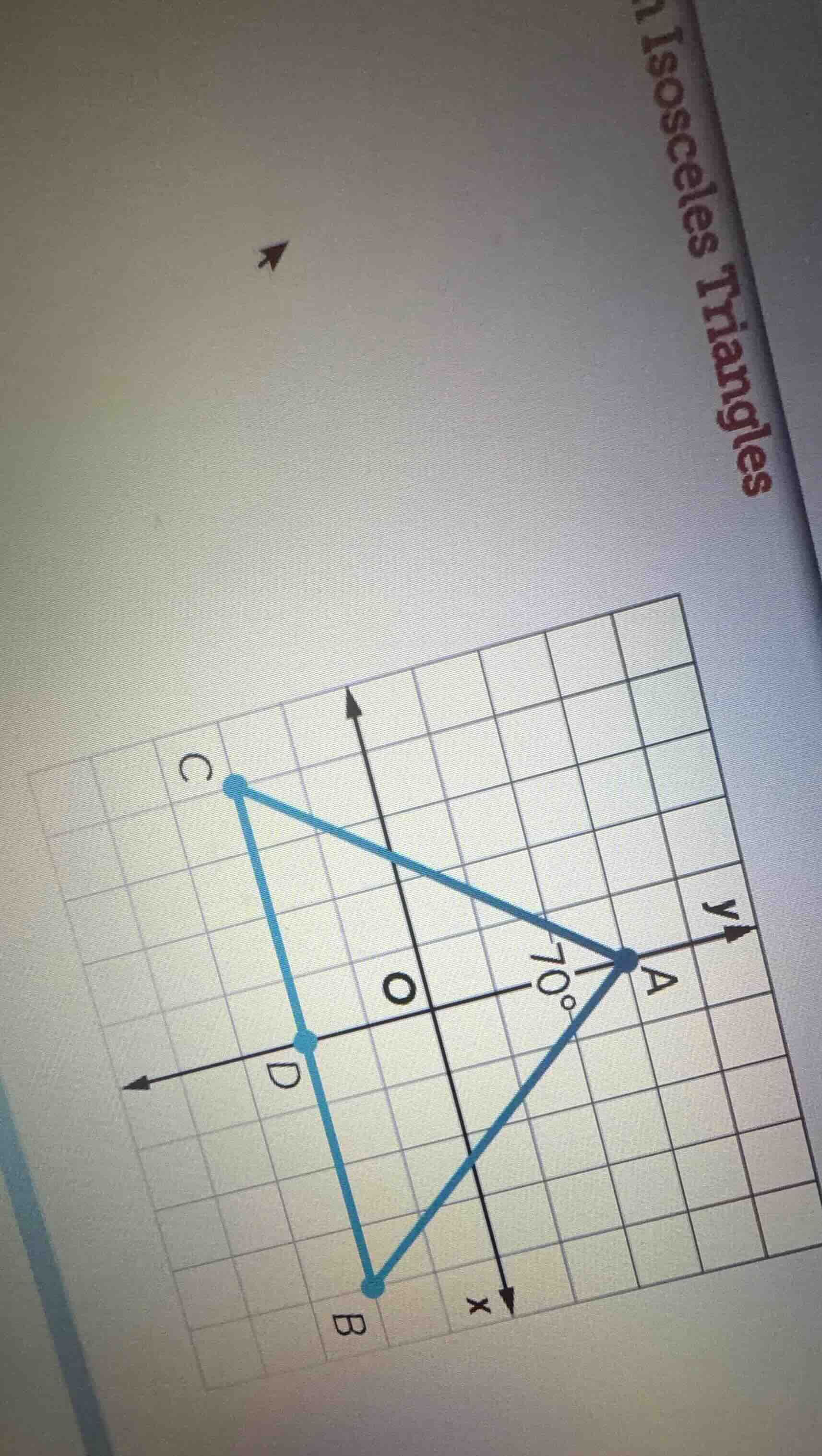
isosceles triangles (image of a coordinate grid with a blue triangle labeled a, b, c, d and a 70° angle at a)
To solve for the angle or side in this isosceles triangle problem, we can use the properties of isosceles triangles (two equal sides and two equal angles) and coordinate geometry. Let's assume we need to find an angle or side length.
Step 1: Identify the isosceles triangle
From the diagram, triangle \( ABC \) (or \( ABD \), \( ACD \)) appears isosceles. Let's check the coordinates (assuming grid units). Let's assume point \( A \) is at \( (x_1, y_1) \), \( B \) at \( (x_2, y_2) \), \( C \) at \( (x_3, y_3) \), and \( D \) at \( (x_4, y_4) \).
Step 2: Use the angle given
We know angle at \( A \) is \( 70^\circ \). If \( \triangle ABC \) is isosceles, say \( AC = AB \), then the base angles are equal. The sum of angles in a triangle is \( 180^\circ \).
Step 3: Calculate the unknown angle
If \( \angle CAB = 70^\circ \) and \( AC = AB \), then the base angles \( \angle ABC \) and \( \angle ACB \) are equal. Let each be \( x \). Then:
\[
70^\circ + x + x = 180^\circ
\]
\[
2x = 180^\circ - 70^\circ = 110^\circ
\]
\[
x = \frac{110^\circ}{2} = 55^\circ
\]
Step 4: Verify with coordinates (optional)
Using the grid, we can calculate the lengths of \( AC \), \( AB \), \( BC \) using the distance formula \( d = \sqrt{(x_2 - x_1)^2 + (y_2 - y_1)^2} \). If two sides are equal, the triangle is isosceles.
For example, if \( A \) is at \( (2, 1) \), \( B \) at \( (-2, -3) \), \( C \) at \( (-2, 1) \), then:
- \( AC \): distance from \( (2,1) \) to \( (-2,1) \) is \( \sqrt{(-2 - 2)^2 + (1 - 1)^2} = \sqrt{16 + 0} = 4 \)
- \( AB \): distance from \( (2,1) \) to \( (-2,-3) \) is \( \sqrt{(-2 - 2)^2 + (-3 - 1)^2} = \sqrt{16 + 16} = \sqrt{32} = 4\sqrt{2} \) (Wait, maybe my coordinate assumption is wrong. Let's recheck the diagram.)
Looking at the diagram, \( CD \) and \( DB \) are vertical, so \( CD = DB \), making \( D \) the midpoint of \( CB \). So \( AD \) is the perpendicular bisector, implying \( AC = AB \), so \( \triangle ABC \) is isosceles with \( AC = AB \).
Thus, the base angles are \( 55^\circ \) each.

Snap & solve any problem in the app
Get step-by-step solutions on Sovi AI
Photo-based solutions with guided steps
Explore more problems and detailed explanations
The measure of each base angle is \( \boxed{55^\circ} \) (assuming the triangle is isosceles with \( AC = AB \)).