QUESTION IMAGE
Question
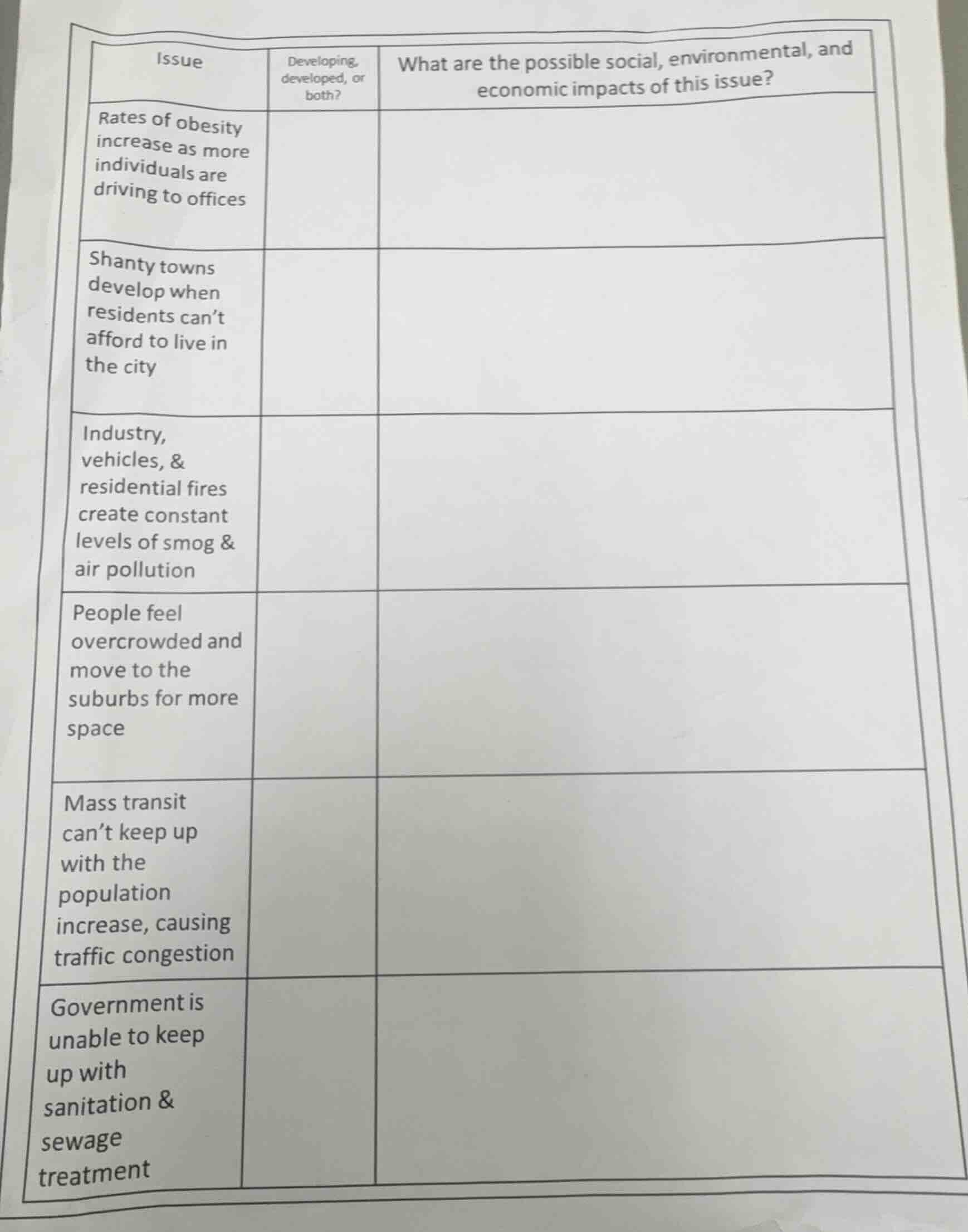
issue | developing, developed, or both? | what are the possible social, environmental, and economic impacts of this issue?
rates of obesity increase as more individuals are driving to offices | |
shanty towns develop when residents can’t afford to live in the city | |
industry, vehicles, & residential fires create constant levels of smog & air pollution | |
people feel overcrowded and move to the suburbs for more space | |
mass transit can’t keep up with the population increase, causing traffic congestion | |
government is unable to keep up with sanitation & sewage treatment | |
For each issue, first identify if it applies to developing, developed, or both regions, then outline social, environmental, and economic impacts:
- Obesity from driving to offices: Common in developed regions (high car access) and some developing urban areas. Social: Higher chronic disease rates, reduced community interaction. Environmental: Increased carbon emissions from more cars. Economic: Rising healthcare costs, lost workplace productivity.
- Shanty towns from unaffordable city housing: Primarily developing regions. Social: Overcrowding, limited access to education/healthcare, higher crime risk. Environmental: Unsanitary conditions, deforestation for informal housing, pollution from waste. Economic: Strained public services, informal economy reliance, reduced property tax revenue for cities.
- Smog/air pollution from industry/vehicles/fires: Both developed and developing regions. Social: Respiratory illnesses, reduced quality of life, higher mortality rates. Environmental: Acid rain, ecosystem damage, reduced air quality. Economic: Healthcare costs, lost labor hours, damage to agricultural crops.
- Suburban migration from overcrowding: Both developed and developing urban areas. Social: Urban sprawl, reduced public transit use, social isolation. Environmental: Habitat loss, increased carbon emissions from longer commutes, more land use for housing. Economic: Higher infrastructure costs for suburbs, decline in urban business activity.
- Traffic congestion from insufficient mass transit: Both developed and developing regions. Social: Increased stress, longer commute times, reduced access to services. Environmental: Higher vehicle emissions, noise pollution. Economic: Lost productivity from delayed commutes, increased fuel costs, higher transportation-related business expenses.
- Inadequate sanitation/sewage treatment: Primarily developing regions, some underserved developed areas. Social: Waterborne illnesses, poor hygiene, higher disease transmission. Environmental: Water pollution, ecosystem degradation from untreated waste. Economic: Healthcare costs, lost productivity, damage to fishing/tourism industries.

Snap & solve any problem in the app
Get step-by-step solutions on Sovi AI
Photo-based solutions with guided steps
Explore more problems and detailed explanations
| Issue | Developing, developed, or both? | What are the possible social, environmental, and economic impacts of this issue? |
|---|---|---|
| Shanty towns develop when residents can’t afford to live in the city | Developing | Social: Limited access to healthcare/education, elevated crime risk. <br> Environmental: Unsanitary waste disposal, deforestation for housing. <br> Economic: Strained public services, reliance on informal low-wage work. |
| Industry, vehicles, & residential fires create constant levels of smog & air pollution | Both | Social: Respiratory illnesses, higher mortality rates. <br> Environmental: Acid rain, ecosystem damage. <br> Economic: Healthcare costs, reduced agricultural crop yields. |
| People feel overcrowded and move to the suburbs for more space | Both | Social: Urban sprawl, social isolation. <br> Environmental: Habitat loss, higher commute-related emissions. <br> Economic: Higher suburban infrastructure costs, urban business decline. |
| Mass transit can’t keep up with the population increase, causing traffic congestion | Both | Social: Commute-related stress, limited service access. <br> Environmental: Elevated vehicle emissions, noise pollution. <br> Economic: Lost work productivity, increased fuel expenses. |
| Government is unable to keep up with sanitation & sewage treatment | Developing (some underserved developed areas) | Social: Waterborne disease outbreaks, poor hygiene. <br> Environmental: Waterway pollution, ecosystem degradation. <br> Economic: Healthcare costs, damaged fishing/tourism industries. |