QUESTION IMAGE
Question
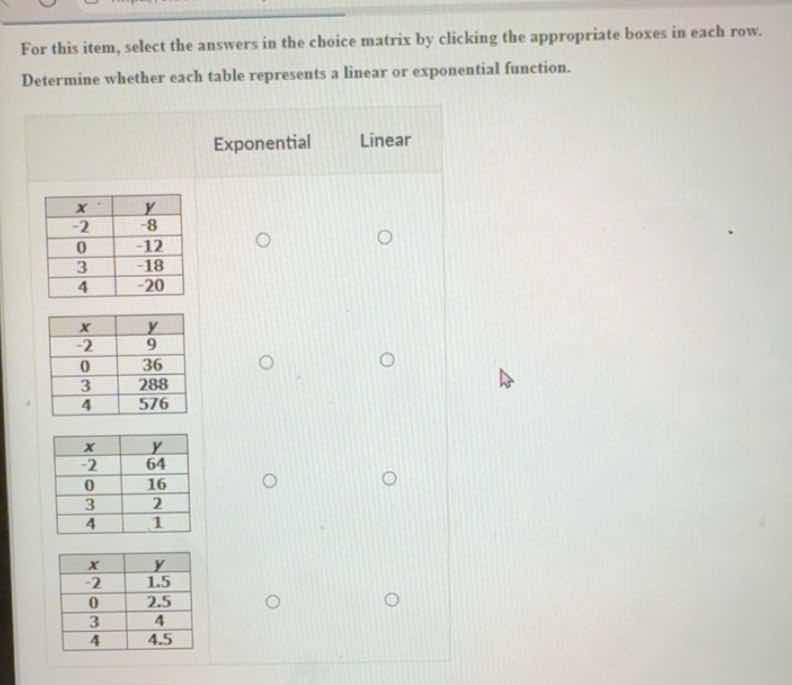
for this item, select the answers in the choice matrix by clicking the appropriate boxes in each row. determine whether each table represents a linear or exponential function. exponential linear \
\
\
\
Step1: Test first table for linearity
Check constant $\Delta y$:
$\Delta y_1 = -12 - (-8) = -4$
$\Delta y_2 = -18 - (-12) = -6$
$\Delta y_3 = -20 - (-18) = -2$
Wait, recalculate slope between points:
Slope $m_1 = \frac{-12 - (-8)}{0 - (-2)} = \frac{-4}{2} = -2$
Slope $m_2 = \frac{-18 - (-12)}{3 - 0} = \frac{-6}{3} = -2$
Slope $m_3 = \frac{-20 - (-18)}{4 - 3} = \frac{-2}{1} = -2$
Constant slope confirms linear.
Step2: Test second table for exponentiality
Check constant ratio of $y$:
$\frac{36}{9} = 4$
$\frac{288}{36} = 8$
Wait, check ratio for equal $\Delta x$:
From $x=-2$ to $x=0$ ($\Delta x=2$), ratio $4=2^2$; from $x=0$ to $x=3$ ($\Delta x=3$), ratio $8=2^3$; from $x=3$ to $x=4$ ($\Delta x=1$), ratio $\frac{576}{288}=2=2^1$.
Constant base ratio of 2 per $\Delta x=1$, so exponential.
Step3: Test third table for exponentiality
Check constant ratio of $y$:
$\frac{16}{64} = \frac{1}{4}$
$\frac{2}{16} = \frac{1}{8}$
Wait, for $\Delta x=2$ (x=-2 to 0): ratio $\frac{1}{4}=(\frac{1}{2})^2$; $\Delta x=3$ (x=0 to 3): ratio $\frac{2}{16}=\frac{1}{8}=(\frac{1}{2})^3$; $\Delta x=1$ (x=3 to 4): ratio $\frac{1}{2}=(\frac{1}{2})^1$.
Constant base ratio of $\frac{1}{2}$ per $\Delta x=1$, so exponential.
Step4: Test fourth table for linearity
Check constant slope:
Slope $m_1 = \frac{2.5 - 1.5}{0 - (-2)} = \frac{1}{2} = 0.5$
Slope $m_2 = \frac{4 - 2.5}{3 - 0} = \frac{1.5}{3} = 0.5$
Slope $m_3 = \frac{4.5 - 4}{4 - 3} = \frac{0.5}{1} = 0.5$
Constant slope confirms linear.

Snap & solve any problem in the app
Get step-by-step solutions on Sovi AI
Photo-based solutions with guided steps
Explore more problems and detailed explanations
- First table: Linear
- Second table: Exponential
- Third table: Exponential
- Fourth table: Linear