QUESTION IMAGE
Question
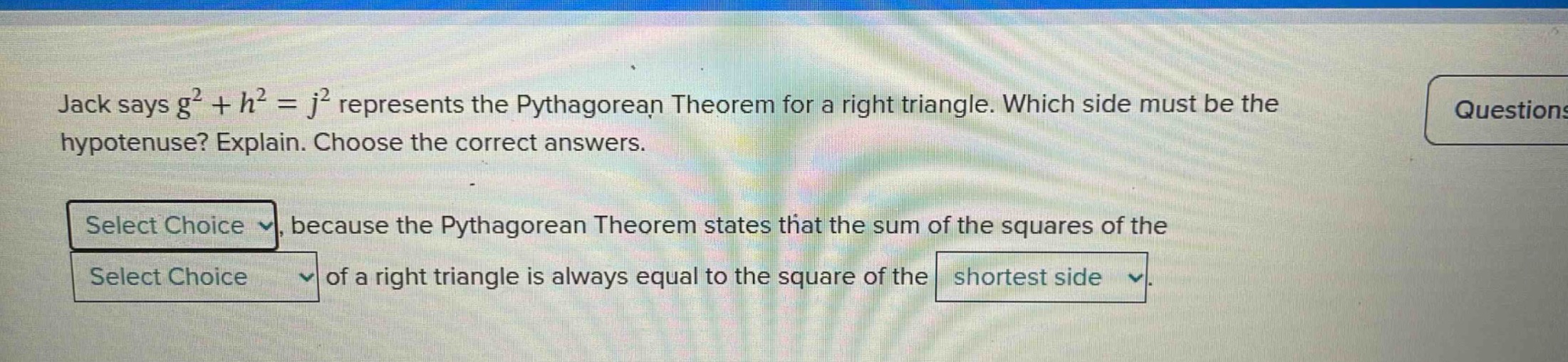
jack says $g^2 + h^2 = j^2$ represents the pythagorean theorem for a right triangle. which side must be the hypotenuse? explain. choose the correct answers. select choice, because the pythagorean theorem states that the sum of the squares of the select choice of a right triangle is always equal to the square of the shortest side.
Step1: Recall Pythagorean Theorem
The Pythagorean Theorem states that for a right triangle, if \(a\) and \(b\) are the lengths of the two legs (the sides forming the right angle) and \(c\) is the length of the hypotenuse (the side opposite the right angle), then \(a^{2}+b^{2}=c^{2}\). The hypotenuse is the longest side of the right triangle, and it is the side whose square is equal to the sum of the squares of the other two sides.
Step2: Analyze the given formula \(g^{2}+h^{2}=j^{2}\)
Comparing \(g^{2}+h^{2}=j^{2}\) with the standard form \(a^{2}+b^{2}=c^{2}\) of the Pythagorean Theorem, we can see that \(j\) corresponds to \(c\) (the hypotenuse) and \(g\) and \(h\) correspond to \(a\) and \(b\) (the legs). So the side \(j\) must be the hypotenuse because the sum of the squares of the legs (\(g\) and \(h\)) is equal to the square of \(j\), and by the Pythagorean Theorem, the hypotenuse is the side for which its square is equal to the sum of the squares of the other two sides (the legs). Also, the Pythagorean Theorem states that the sum of the squares of the legs of a right triangle is always equal to the square of the hypotenuse (not the shortest side, the hypotenuse is the longest side).

Snap & solve any problem in the app
Get step-by-step solutions on Sovi AI
Photo-based solutions with guided steps
Explore more problems and detailed explanations
First "Select Choice": \(j\)
Second "Select Choice": legs
Third "Select Choice": hypotenuse
(Explanation: The Pythagorean Theorem is \(a^{2}+b^{2}=c^{2}\) where \(c\) is the hypotenuse (longest side) and \(a,b\) are legs. In \(g^{2}+h^{2}=j^{2}\), \(j\) is the hypotenuse as it's the side whose square equals the sum of the squares of the other two (legs \(g,h\)). The theorem says sum of squares of legs equals square of hypotenuse (not shortest side, hypotenuse is longest).)