QUESTION IMAGE
Question
- ( jklm ) is a rhombus. theorem 6.3c
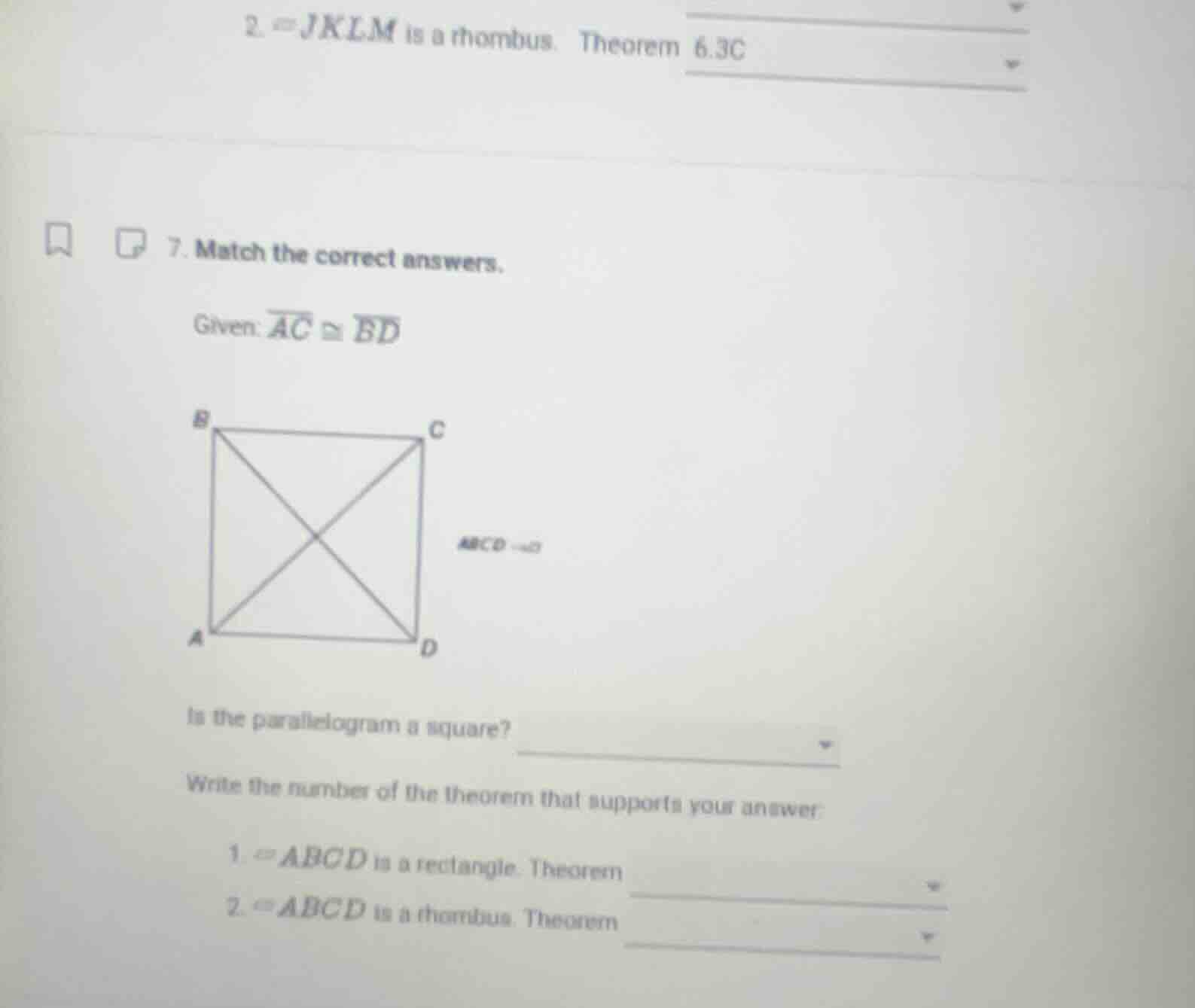
- match the correct answers.
given: ( overline{ac} cong overline{bd} )
image of parallelogram ( abcd ) with diagonals ( ac ) and ( bd )
is the parallelogram a square?
write the number of the theorem that supports your answer
- ( abcd ) is a rectangle. theorem
- ( abcd ) is a rhombus. theorem
Step1: Recall properties of parallelograms, rectangles, rhombuses, and squares
A parallelogram has opposite sides equal and parallel. A rectangle is a parallelogram with congruent diagonals. A rhombus is a parallelogram with all sides congruent. A square is a parallelogram that is both a rectangle and a rhombus (i.e., has congruent diagonals and all sides congruent).
Given that \( \overline{AC} \cong \overline{BD} \) (diagonals are congruent) and \( ABCD \) is a parallelogram. First, a parallelogram with congruent diagonals is a rectangle (Theorem for rectangle: if a parallelogram has congruent diagonals, it is a rectangle). Now, we also need to check if it's a rhombus. But from the diagram, if we assume it's a parallelogram with congruent diagonals (so rectangle) and if we consider the sides, but the key here is: To be a square, a parallelogram must be both a rectangle (congruent diagonals) and a rhombus (all sides congruent). But the question first: "Is the parallelogram a square?" Wait, no, wait the given is \( \overline{AC} \cong \overline{BD} \), so first, for the first part: "Is the parallelogram a square?" Wait, maybe the diagram is a parallelogram (let's assume \( ABCD \) is a parallelogram). Wait, the first match: Given \( \overline{AC} \cong \overline{BD} \), so a parallelogram with congruent diagonals is a rectangle (Theorem 1: \( \parallelogram ABCD \) is a rectangle). Then, if a parallelogram is a rhombus (all sides equal) and a rectangle (congruent diagonals), it's a square. But the question "Is the parallelogram a square?" – wait, maybe the diagram is a rhombus? Wait, no, the given is \( \overline{AC} \cong \overline{BD} \). Wait, let's re-express:
- For the first dropdown: "Is the parallelogram a square?" – If the parallelogram is both a rectangle (diagonals congruent) and a rhombus (all sides equal), then yes. But from the given \( \overline{AC} \cong \overline{BD} \), we know it's a rectangle. If we also know it's a rhombus (from the diagram, maybe it's a rhombus with congruent diagonals), then it's a square. But maybe the first part: the theorem for rectangle is "If a parallelogram has congruent diagonals, then it is a rectangle" (Theorem 1), and the theorem for rhombus with congruent diagonals being square: A rhombus with congruent diagonals is a square. But the question is to match:
Wait, the problem is "Match the correct answers". The first part: Given \( \overline{AC} \cong \overline{BD} \), so \( ABCD \) is a parallelogram with congruent diagonals, so it's a rectangle (Theorem 1: \( \parallelogram ABCD \) is a rectangle). Then, if a parallelogram is a rhombus (Theorem 2: \( \parallelogram ABCD \) is a rhombus) and a rectangle, it's a square. But the question "Is the parallelogram a square?" – if it's a rhombus (all sides equal) and a rectangle (congruent diagonals), then yes. But maybe the first match:
Wait, let's structure:
- Given \( \overline{AC} \cong \overline{BD} \), so \( ABCD \) (parallelogram) has congruent diagonals → so it's a rectangle (Theorem 1: \( \parallelogram ABCD \) is a rectangle).
- Then, if \( ABCD \) is a rhombus (Theorem 2: \( \parallelogram ABCD \) is a rhombus) and a rectangle, then it's a square.
But the question "Is the parallelogram a square?" – if it's both a rectangle (from diagonals) and a rhombus (from sides), then yes. But maybe the diagram is a rhombus with congruent diagonals, so it's a square.
But the main matches:
- \( \parallelogram ABCD \) is a rectangle. Theorem: If a parallelogram has congruent diagonals, it is a rectangle. So this matches with the given…

Snap & solve any problem in the app
Get step-by-step solutions on Sovi AI
Photo-based solutions with guided steps
Explore more problems and detailed explanations
- Is the parallelogram a square? Yes (assuming it's a rhombus with congruent diagonals).
- Theorem for rectangle: 1. \( \parallelogram ABCD \) is a rectangle. Theorem (matches \( \overline{AC} \cong \overline{BD} \)).
- Theorem for rhombus: 2. \( \parallelogram ABCD \) is a rhombus. Theorem (if it's a rhombus, which the diagram suggests).
(Note: The exact answer depends on the diagram's implicit properties, but based on diagonals congruent, it's a rectangle, and if it's a rhombus, then a square.)