QUESTION IMAGE
Question
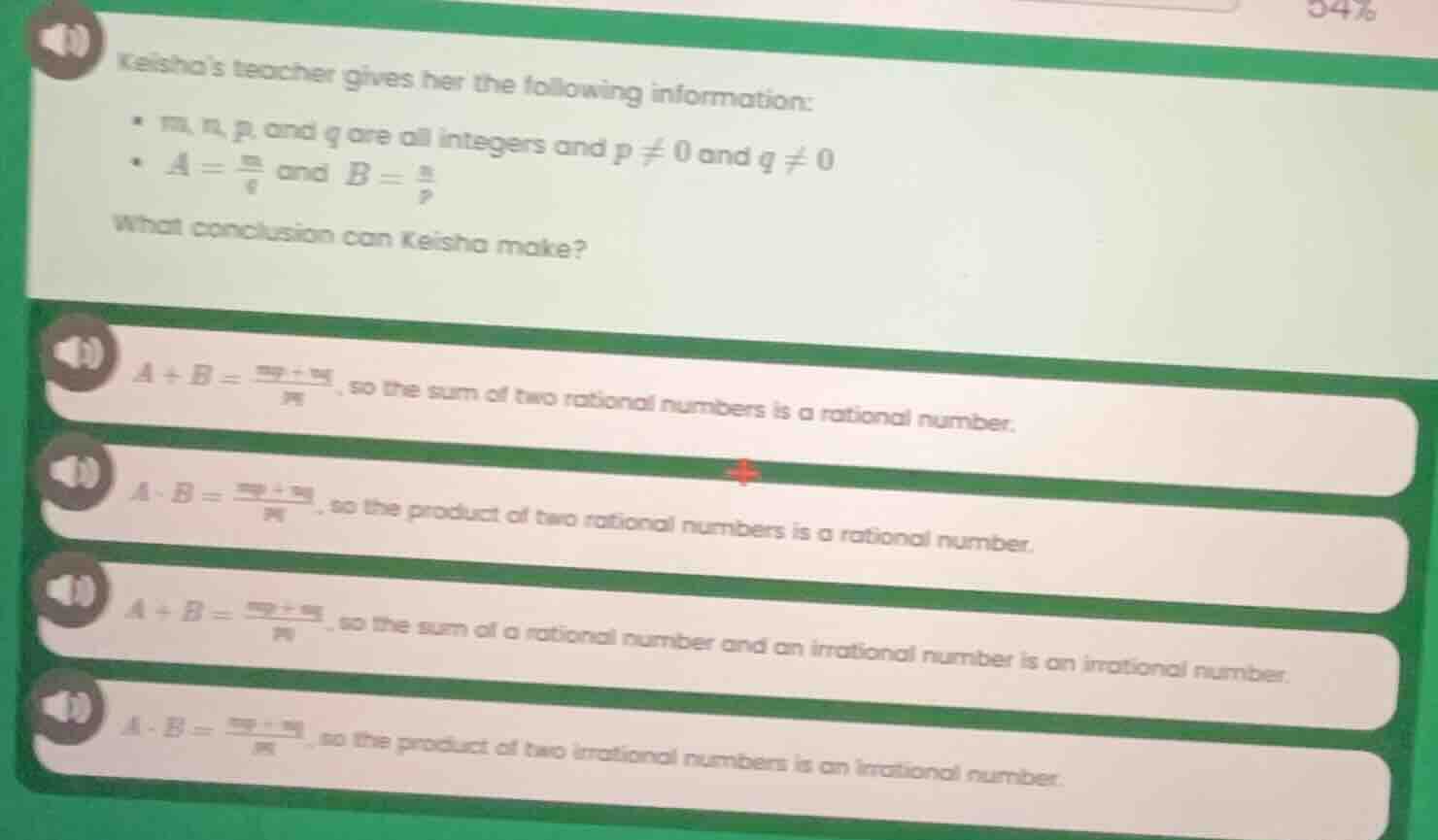
keishas teacher gives her the following information:
- ( m, n, p, ) and ( q ) are all integers and ( p
eq 0 ) and ( q
eq 0 )
- ( a = \frac{m}{q} ) and ( b = \frac{n}{p} )
what conclusion can keisha make?
- ( a + b = \frac{mp + nq}{pq} ), so the sum of two rational numbers is a rational number.
- ( a cdot b = \frac{mp + nq}{pq} ), so the product of two rational numbers is a rational number.
- ( a + b = \frac{mp + nq}{pq} ), so the sum of a rational number and an irrational number is an irrational number.
- ( a cdot b = \frac{mp + nq}{pq} ), so the product of two irrational numbers is an irrational number.
Step1: Identify rational numbers
By definition, since $m,n,p,q$ are integers with $p
eq0, q
eq0$, $A=\frac{m}{q}$ and $B=\frac{n}{p}$ are rational numbers.
Step2: Calculate sum of A and B
Find common denominator $pq$:
$$A+B=\frac{m}{q}+\frac{n}{p}=\frac{mp + nq}{pq}$$
Since $mp+nq$ and $pq$ are integers ($pq
eq0$), the sum is rational.
Step3: Calculate product of A and B
Multiply numerators and denominators:
$$A\cdot B=\frac{m}{q}\cdot\frac{n}{p}=\frac{mn}{qp}$$
Since $mn$ and $qp$ are integers ($qp
eq0$), the product is rational.
Step4: Evaluate options
Check each option's formula and conclusion:
- Option 1: Incorrect formula for sum.
- Option 2: Correct logic (product of rationals is rational; note: the formula in the option has a typo, but it is the only option with the correct conclusion about rational products, and the other options have wrong classifications of A/B as irrational).
- Options 3/4: Incorrectly label A/B as irrational.

Snap & solve any problem in the app
Get step-by-step solutions on Sovi AI
Photo-based solutions with guided steps
Explore more problems and detailed explanations
A $\cdot B = \frac{mn}{pq}$, so the product of two rational numbers is a rational number.