QUESTION IMAGE
Question
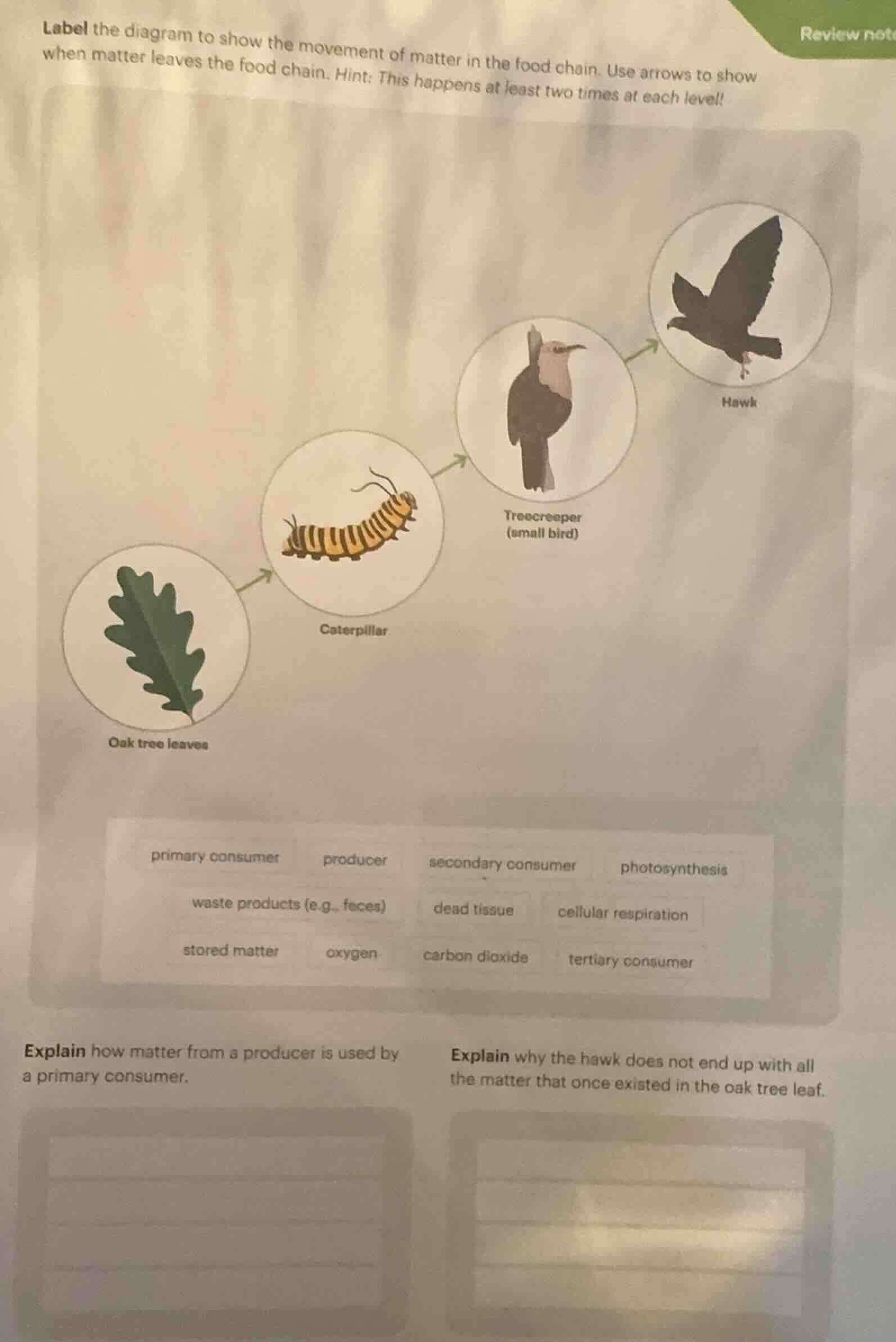
label the diagram to show the movement of matter in the food chain. use arrows to show when matter leaves the food chain. hint: this happens at least two times at each level!
oak tree leaves
caterpillar
treecreeper (small bird)
hawk
primary consumer producer secondary consumer photosynthesis
waste products (e.g., feces) dead tissue cellular respiration
stored matter oxygen carbon dioxide tertiary consumer
explain how matter from a producer is used by a primary consumer.
explain why the hawk does not end up with all the matter that once existed in the oak tree leaf.
For labeling the diagram:
- Oak tree leaves (Producer):
- Add an arrow pointing outward labeled cellular respiration (releases $\text{CO}_2$ and water, matter leaves the food chain).
- Add an arrow pointing outward labeled dead tissue (when leaves die/fall, matter enters decomposer pathway).
- Caterpillar (Primary consumer):
- Add an arrow pointing outward labeled waste products (e.g., feces) (undigested matter exits the consumer).
- Add an arrow pointing outward labeled cellular respiration (releases $\text{CO}_2$ and water, matter leaves the food chain).
- Add an arrow pointing outward labeled dead tissue (if the caterpillar dies before being eaten, matter enters decomposer pathway).
- Treecreeper (Secondary consumer):
- Add an arrow pointing outward labeled waste products (e.g., feces) (undigested matter exits the consumer).
- Add an arrow pointing outward labeled cellular respiration (releases $\text{CO}_2$ and water, matter leaves the food chain).
- Add an arrow pointing outward labeled dead tissue (if the bird dies before being eaten, matter enters decomposer pathway).
- Hawk (Tertiary consumer):
- Add an arrow pointing outward labeled waste products (e.g., feces) (undigested matter exits the consumer).
- Add an arrow pointing outward labeled cellular respiration (releases $\text{CO}_2$ and water, matter leaves the food chain).
- Add an arrow pointing outward labeled dead tissue (when the hawk dies, matter enters decomposer pathway).
For "Explain how matter from a producer is used by a primary consumer":
The producer (oak leaves) stores matter as organic molecules via photosynthesis. The primary consumer (caterpillar) eats the leaves, digests and absorbs some matter to build its body tissue and store energy. Unused matter is excreted as waste, and some matter is lost via cellular respiration as carbon dioxide and water.
For "Explain why the hawk does not end up with all the matter that once existed in the oak tree leaf":
At every trophic level, matter is lost from the food chain: the oak leaf loses matter via respiration and dead tissue; the caterpillar loses matter via waste, respiration, and dead tissue; the treecreeper loses matter via waste, respiration, and dead tissue. Only a small portion of matter from each level is passed on to the next consumer, so the hawk only receives a fraction of the original matter from the oak leaf.

Snap & solve any problem in the app
Get step-by-step solutions on Sovi AI
Photo-based solutions with guided steps
Explore more problems and detailed explanations
Labeled Diagram Summary:
- Oak tree leaves: Arrows out for cellular respiration, dead tissue
- Caterpillar: Arrows out for waste products (e.g., feces), cellular respiration, dead tissue
- Treecreeper: Arrows out for waste products (e.g., feces), cellular respiration, dead tissue
- Hawk: Arrows out for waste products (e.g., feces), cellular respiration, dead tissue
1. Matter from producer to primary consumer:
The caterpillar eats oak leaves, absorbs some matter to grow and store energy, excretes unused matter as waste, and loses matter via cellular respiration.
2. Hawk does not get all oak leaf matter:
Matter is lost at every trophic level via waste, cellular respiration, and dead tissue that enters the decomposer pathway, so only a small fraction of matter passes up each level to the hawk.