QUESTION IMAGE
Question
a. label your generations
b. carriers are not indicated on this pedigree. ii-3 is heterozygous
there are no carriers in the third
generation. there are only two “” in
this pedigree.
c. label all of the organisms
genotypes using any variable you
like. no fill-in lines have been
provided.
d half - shade your carriers.
e. given how many offspring ii - 2 and
ii - 3 had, do you think there is a high
likelihood or a low likelihood that
ii - 2 is heterozygous?
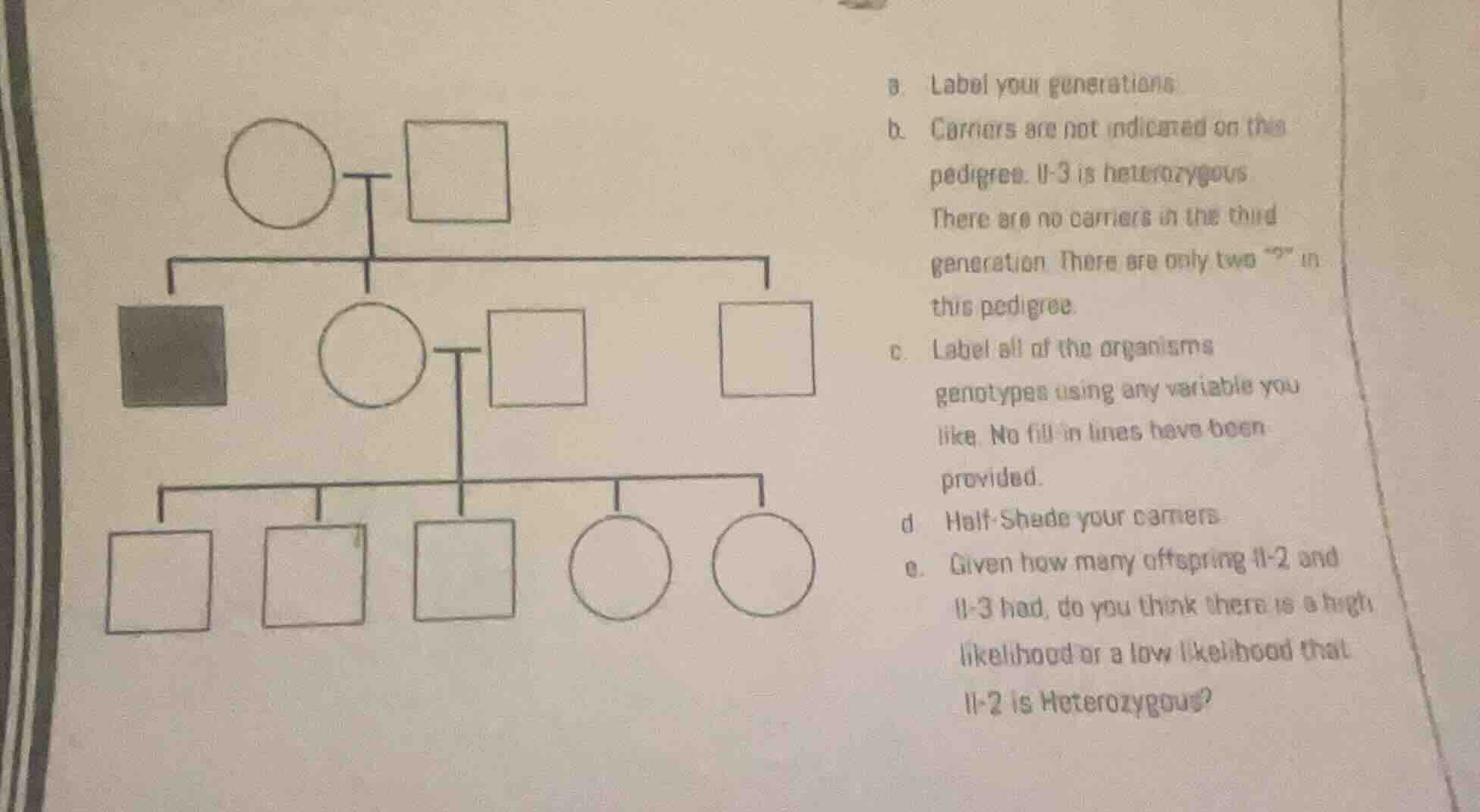
a. Label your generations
- The top - most generation (with the first - pair of parents) is Generation I (I - 1: female, I - 2: male).
- The middle generation (their children and the next - pair of parents) is Generation II (II - 1: affected male, II - 2: female, II - 3: male, II - 4: male).
- The bottom - most generation (children of II - 2 and II - 3) is Generation III (III - 1: male, III - 2: male, III - 3: male, III - 4: female, III - 5: female).
b. Carriers are not indicated on this pedigree. II - 3 is heterozygous. There are no carriers in the third generation. There are only two “?” in this pedigree.
- From the problem statement, we know II - 3 is heterozygous. Since there are no carriers in the third generation, let's assume the trait is recessive (because if it were dominant, heterozygous parents would likely have affected offspring if the other parent was not a carrier, but here the third generation has no affected individuals). The two “?” are likely related to the genotype determination of II - 2 and maybe I - 1 or I - 2, but since II - 3 is heterozygous (let's say genotype $Aa$) and the third generation has no carriers (so all third - generation individuals are either $AA$ or $aa$, but since no one is affected, maybe all are $AA$), then II - 2's genotype is in question. Also, I - 1 (female) and I - 2 (male) have an affected son (II - 1), so I - 1 must be a carrier (but the problem says carriers are not indicated, so maybe one of the “?” is for I - 1's genotype and one for II - 2's genotype).
c. Label all of the organisms' genotypes using any variable you like.
Let's use the letter $A$ for the dominant allele and $a$ for the recessive allele.
- Generation I:
- I - 1 (female, circle): Since she has an affected son (II - 1, $aa$), she must be a carrier (heterozygous) if the trait is recessive. But the problem says carriers are not indicated, but we can still assign genotypes. Let's assume the trait is recessive. So I - 1: $Aa$, I - 2: $AA$ (because II - 3 is heterozygous $Aa$, so I - 2 could be $AA$ and I - 1 $Aa$ to pass on $a$ to II - 1 and $A$ to II - 3).
- Generation II:
- II - 1 (affected male, shaded square): $aa$ (recessive homozygous).
- II - 2 (female, circle): Let's assume she is $AA$ (since the third generation has no carriers, if she were $Aa$ and II - 3 is $Aa$, there would be a chance of $aa$ (affected) or $Aa$ (carrier) in the third generation, but there are no carriers).
- II - 3 (male, square): $Aa$ (given as heterozygous).
- II - 4 (male, square): $AA$ (since I - 1 is $Aa$ and I - 2 is $AA$, the possible genotypes for their sons are $AA$ or $Aa$, and since there are no carriers in the third generation, II - 4 is likely $AA$).
- Generation III:
- III - 1 (male, square): $AA$ (no carrier, so homozygous dominant).
- III - 2 (male, square): $AA$.
- III - 3 (male, square): $AA$.
- III - 4 (female, circle): $AA$.
- III - 5 (female, circle): $AA$.
d. Half - Shade your carriers.
- If we consider the carriers, I - 1 (female, circle) is a carrier ($Aa$) and II - 3 (male, square) is heterozygous ($Aa$). So we half - shade I - 1 (circle) and II - 3 (square) to indicate they are carriers.
e. Given how many offspring II - 2 and II - 3 had, do you think there is a high likelihood or a low likelihood that II - 2 is Heterozygous?
- II - 2 and II - 3 have 5 offspring (third generation, all non - affected and non - carriers). If II - 2 were heterozygous ($Aa$) and II - 3 is heterozygous ($Aa$), the probability of having a non - affected, non - carrier ($AA$) offspring i…

Snap & solve any problem in the app
Get step-by-step solutions on Sovi AI
Photo-based solutions with guided steps
Explore more problems and detailed explanations
s:
a. Generations labeled as I, II, III as above.
b. The two “?” are likely for the genotypes of I - 1 and II - 2 (or other relevant individuals) as explained.
c. Genotypes labeled as above (e.g., I - 1: $Aa$, I - 2: $AA$, II - 1: $aa$, II - 2: $AA$, II - 3: $Aa$, II - 4: $AA$, III - 1: $AA$, III - 2: $AA$, III - 3: $AA$, III - 4: $AA$, III - 5: $AA$).
d. Half - shaded I - 1 (circle) and II - 3 (square).
e. Low likelihood.