QUESTION IMAGE
Question
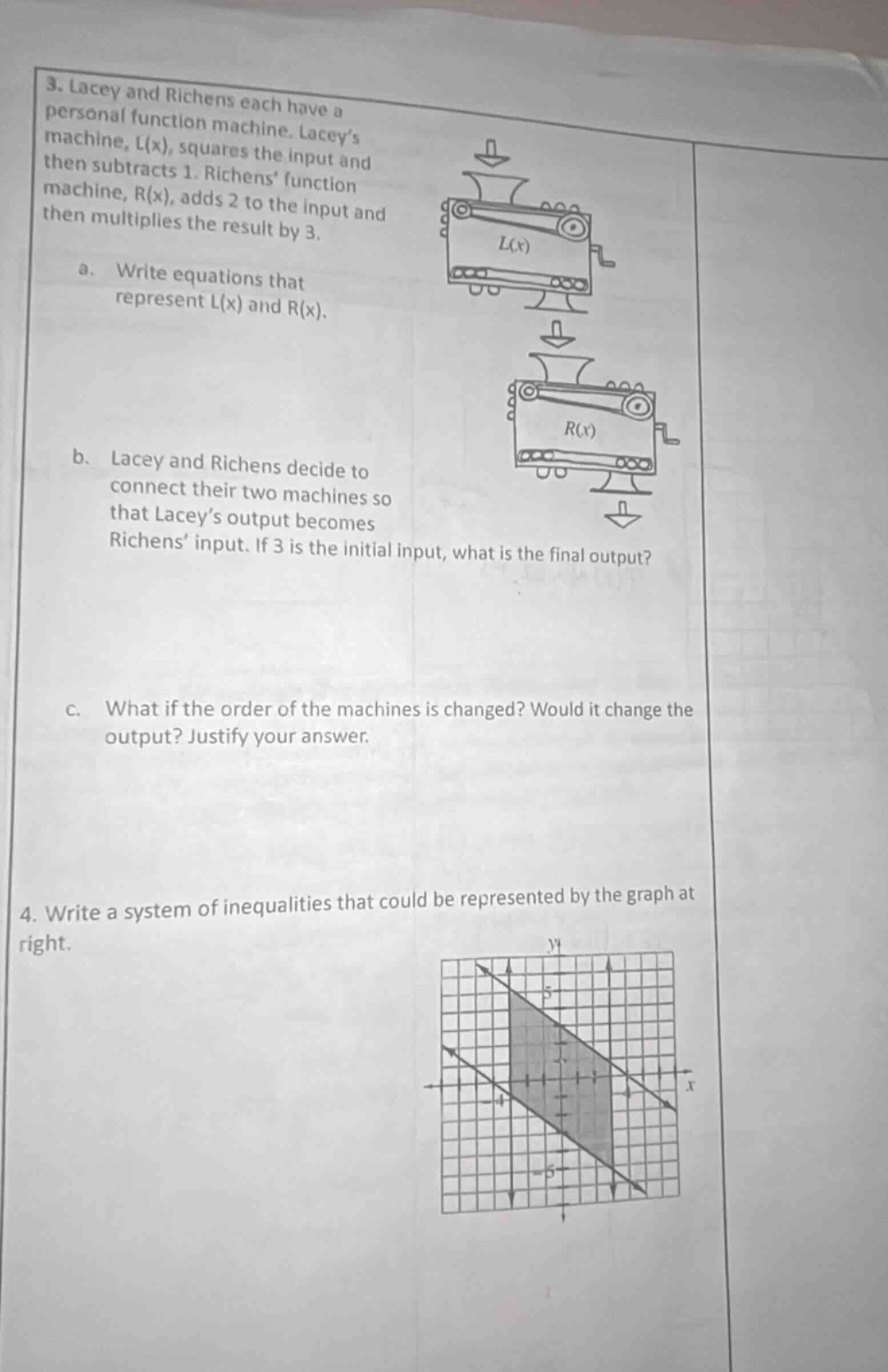
- lacey and richens each have a personal function machine. lacey’s machine, ( l(x) ), squares the input and then subtracts 1. richens’ function machine, ( r(x) ), adds 2 to the input and then multiplies the result by 3.
a. write equations that represent ( l(x) ) and ( r(x) ).
b. lacey and richens decide to connect their two machines so that lacey’s output becomes richens’ input. if 3 is the initial input, what is the final output?
c. what if the order of the machines is changed? would it change the output? justify your answer.
- write a system of inequalities that could be represented by the graph at right.
For Question 3:
Step1: Define L(x)
Squaring input then subtract 1:
$L(x) = x^2 - 1$
Step1: Define R(x)
Add 2 to input, multiply by 3:
$R(x) = 3(x + 2)$
---
Step1: Calculate L(3)
Substitute $x=3$ into $L(x)$:
$L(3) = 3^2 - 1 = 9 - 1 = 8$
Step2: Calculate R(8)
Substitute $x=8$ into $R(x)$:
$R(8) = 3(8 + 2) = 3(10) = 30$
---
Step1: Calculate $R(L(x))$ (original order)
$R(L(x)) = 3((x^2 - 1) + 2) = 3(x^2 + 1) = 3x^2 + 3$
Step2: Calculate $L(R(x))$ (reversed order)
$L(R(x)) = (3(x+2))^2 - 1 = 9(x+2)^2 - 1 = 9(x^2 +4x +4) -1 = 9x^2 +36x +35$
Step3: Compare the two functions
$3x^2 + 3
eq 9x^2 +36x +35$ for all $x$. Test with $x=3$:
$L(R(3)) = 9(3)^2 +36(3)+35 = 81 +108 +35 = 224
eq 30$
Step1: Find equations of boundary lines
First line (upper): passes through $(0,6)$ and $(6,0)$. Slope $m=\frac{0-6}{6-0}=-1$. Equation: $y = -x + 6$
Second line (lower): passes through $(0,-4)$ and $(5,-9)$. Slope $m=\frac{-9+4}{5-0}=-1$. Equation: $y = -x - 4$
Step2: Determine inequality direction
The shaded region is between the two lines, below the upper line and above the lower line. Both lines are solid, so inequalities use $\leq$ and $\geq$.

Snap & solve any problem in the app
Get step-by-step solutions on Sovi AI
Photo-based solutions with guided steps
Explore more problems and detailed explanations
a. $L(x) = x^2 - 1$, $R(x) = 3(x + 2)$
b. 30
c. Yes, it changes the output. The composite functions $R(L(x)) = 3x^2 + 3$ and $L(R(x)) = 9x^2 + 36x + 35$ are not equivalent, and testing with $x=3$ gives outputs 30 and 224 respectively, which are different.
---