QUESTION IMAGE
Question
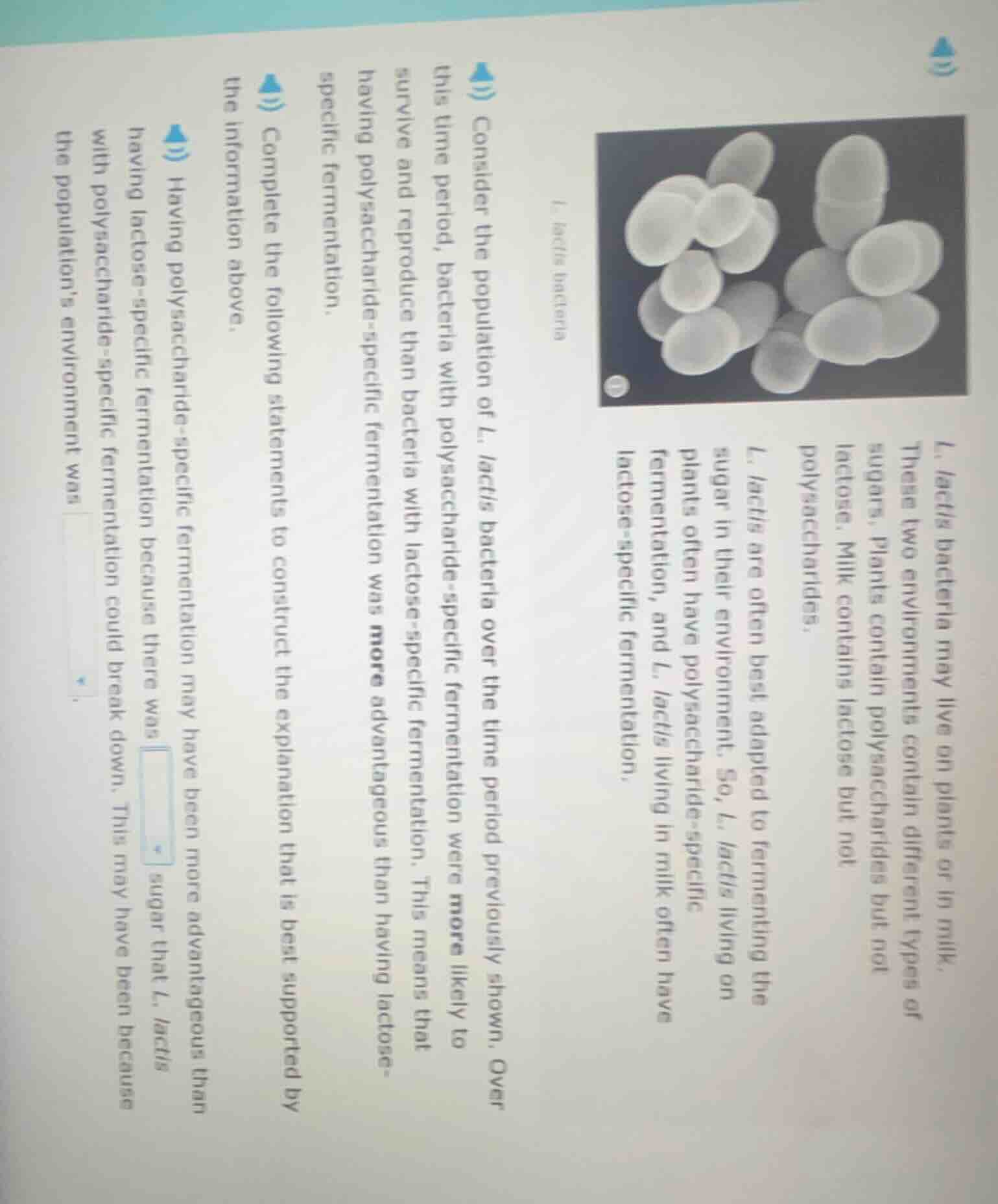
- lactis bacteria
l. lactis bacteria may live on plants or in milk. these two environments contain different types of sugars. plants contain polysaccharides but not lactose. milk contains lactose but not polysaccharides.
l. lactis are often best adapted to fermenting the sugar in their environment. so, l. lactis living on plants often have polysaccharide - specific fermentation, and l. lactis living in milk often have lactose - specific fermentation.
consider the population of l. lactis bacteria over the time period previously shown. over this time period, bacteria with polysaccharide - specific fermentation were more likely to survive and reproduce than bacteria with lactose - specific fermentation. this means that having polysaccharide - specific fermentation was more advantageous than having lactose - specific fermentation.
complete the following statements to construct the explanation that is best supported by the information above.
having polysaccharide - specific fermentation may have been more advantageous than having lactose - specific fermentation because there was blank sugar that l. lactis with polysaccharide - specific fermentation could break down. this may have been because the populations environment was blank.
The statements are completed based on the provided environmental details: L. lactis on plants have access to polysaccharides, making polysaccharide-specific fermentation advantageous, while those in milk rely on lactose.

Snap & solve any problem in the app
Get step-by-step solutions on Sovi AI
Photo-based solutions with guided steps
Explore more problems and detailed explanations
- Having polysaccharide-specific fermentation may have been more advantageous than having lactose-specific fermentation because there was polysaccharide sugar that L. lactis with polysaccharide-specific fermentation could break down. This may have been because the population's environment was plants.