QUESTION IMAGE
Question
learn
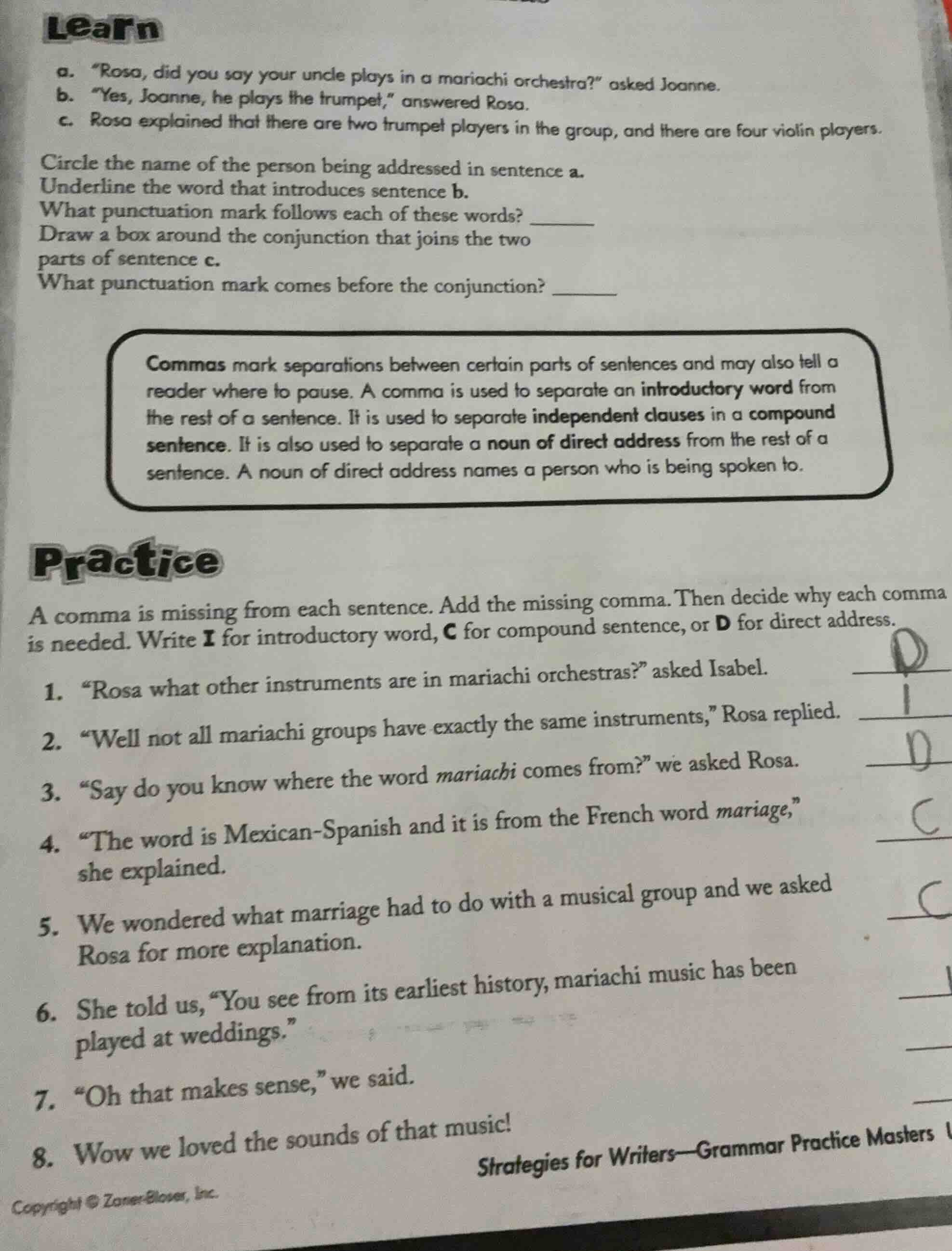
a. “rosa, did you say your uncle plays in a mariachi orchestra?” asked joanne.
b. “yes, joanne, he plays the trumpet,” answered rosa.
c. rosa explained that there are two trumpet players in the group, and there are four violin players.
circle the name of the person being addressed in sentence a.
underline the word that introduces sentence b.
what punctuation mark follows each of these words? ______
draw a box around the conjunction that joins the two
parts of sentence c.
what punctuation mark comes before the conjunction? ______
commas mark separations between certain parts of sentences and may also tell a
reader where to pause. a comma is used to separate an introductory word from
the rest of a sentence. it is used to separate independent clauses in a compound
sentence. it is also used to separate a noun of direct address from the rest of a
sentence. a noun of direct address names a person who is being spoken to.
practice
a comma is missing from each sentence. add the missing comma. then decide why each comma
is needed. write i for introductory word, c for compound sentence, or d for direct address.
- “rosa what other instruments are in mariachi orchestras?” asked isabel.
- “well not all mariachi groups have exactly the same instruments,” rosa replied.
- “say do you know where the word mariachi comes from?” we asked rosa.
- “the word is mexican - spanish and it is from the french word mariage,”
she explained.
- we wondered what marriage had to do with a musical group and we asked
rosa for more explanation.
- she told us, “you see from its earliest history, mariachi music has been
played at weddings.”
- “oh that makes sense,” we said.
- wow we loved the sounds of that music!
strategies for writers—grammar practice masters
copyright © zaner - bloser, inc.
First, address the "Learn" section:
- In sentence a, the person being addressed is Rosa.
- In sentence b, the word introducing the quoted speech is "answered".
- Words used to introduce quoted speech (like "asked", "answered") are followed by a period.
- In sentence c, the conjunction joining the two independent clauses is "and".
- A comma comes before the conjunction in a compound sentence like sentence c.
For the "Practice" section, add commas and label the reason:
- Add a comma after "Rosa" (direct address to Rosa).
- Add a comma after "Well" (introductory word).
- Add a comma after "Say" (introductory word).
- Add a comma before "and" (joins two independent clauses in a compound sentence).
- Add a comma before "and" (joins two independent clauses in a compound sentence).
- Add a comma after "see" (introductory phrase/word in quoted speech).
- Add a comma after "Oh" (introductory word).
- Add a comma after "Wow" (introductory word).

Snap & solve any problem in the app
Get step-by-step solutions on Sovi AI
Photo-based solutions with guided steps
Explore more problems and detailed explanations
Learn Section:
- Circled name: Rosa
- Underlined word: answered
- Punctuation mark: Period (.)
- Boxed conjunction: and
- Punctuation before conjunction: Comma (,)
Practice Section:
- "Rosa, what other instruments are in mariachi orchestras?" asked Isabel. (D)
- "Well, not all mariachi groups have exactly the same instruments," Rosa replied. (I)
- "Say, do you know where the word mariachi comes from?" we asked Rosa. (I)
- "The word is Mexican-Spanish, and it is from the French word mariage," she explained. (C)
- We wondered what marriage had to do with a musical group, and we asked Rosa for more explanation. (C)
- She told us, "You see, from its earliest history, mariachi music has been played at weddings." (I)
- "Oh, that makes sense," we said. (I)
- Wow, we loved the sounds of that music! (I)