QUESTION IMAGE
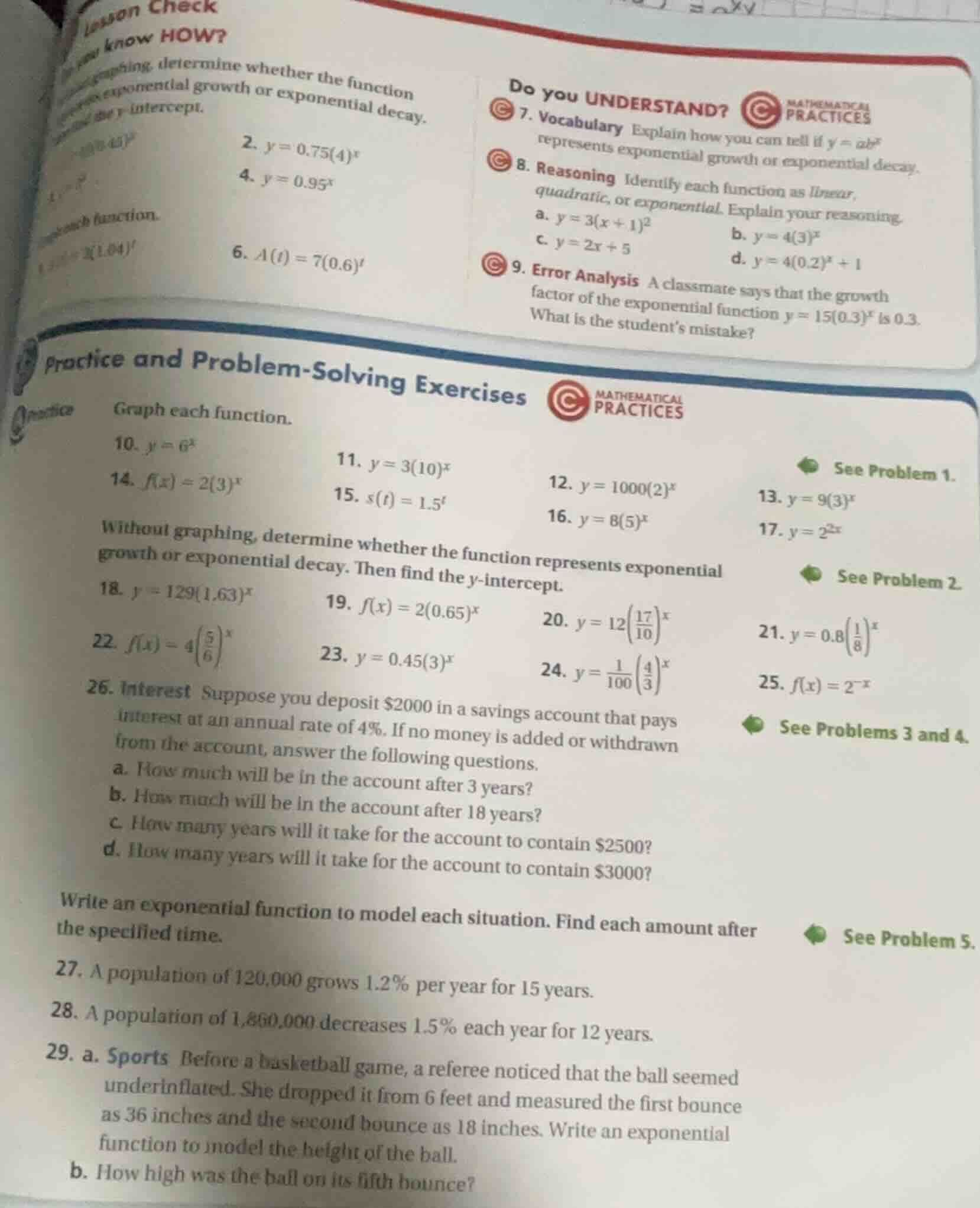
Question
lesson check
you know how?
graphing, determine whether the function
exponential growth or exponential decay.
the y - intercept.
- $y = 0.75(4)^x$
- $y = 0.95^x$
function.
- $a(t)=7(0.6)^t$
do you understand?
mathematical
practices
- vocabulary explain how you can tell if $y = ab^x$ represents exponential growth or exponential decay.
- reasoning identify each function as linear, quadratic, or exponential. explain your reasoning.
a. $y = 3(x + 1)^2$
b. $y = 4(3)^x$
c. $y = 2x + 5$
d. $y = 4(0.2)^x+1$
- error analysis a classmate says that the growth factor of the exponential function $y = 15(0.3)^x$ is 0.3. what is the student’s mistake?
practice and problem - solving exercises
mathematical
practices
graph each function.
- $y = 6^x$
- $y = 3(10)^x$
- $y = 1000(2)^x$
- $y = 9(3)^x$
- $f(x)=2(3)^x$
- $s(t)=1.5^t$
- $y = 8(5)^x$
- $y = 2^{2x}$
without graphing, determine whether the function represents exponential growth or exponential decay. then find the y - intercept.
- $y = 129(1.63)^x$
- $f(x)=2(0.65)^x$
- $y = 12(\frac{17}{10})^x$
- $y = 0.8(\frac{1}{8})^x$
- $f(x)=4(\frac{5}{6})^x$
- $y = 0.45(3)^x$
- $y=\frac{1}{100}(\frac{4}{3})^x$
- $f(x)=2^{-x}$
- interest suppose you deposit $2000 in a savings account that pays interest at an annual rate of 4%. if no money is added or withdrawn from the account, answer the following questions.
a. how much will be in the account after 3 years?
b. how much will be in the account after 18 years?
c. how many years will it take for the account to contain $2500?
d. how many years will it take for the account to contain $3000?
write an exponential function to model each situation. find each amount after the specified time.
- a population of 120,000 grows 1.2% per year for 15 years.
- a population of 1,860,000 decreases 1.5% each year for 12 years.
- a. sports before a basketball game, a referee noticed that the ball seemed underinflated. she dropped it from 6 feet and measured the first bounce as 36 inches and the second bounce as 18 inches. write an exponential function to model the height of the ball.
b. how high was the ball on its fifth bounce?
To solve these problems, we'll focus on a few representative ones, like problem 26a (interest calculation) and problem 18 (exponential growth/decay and y - intercept).
Problem 26a: Interest Calculation
The formula for compound interest (which is an exponential growth model) is $A = P(1 + r)^{t}$, where:
- $P$ is the principal amount (initial deposit),
- $r$ is the annual interest rate (in decimal form),
- $t$ is the number of years,
- $A$ is the amount of money in the account after $t$ years.
Step 1: Identify the values
We know that $P=\$2000$, $r = 4\%=0.04$, and $t = 3$ years.
Step 2: Substitute into the formula
Substitute the values into the formula $A=P(1 + r)^{t}$. So we have $A = 2000(1 + 0.04)^{3}$.
First, calculate $(1 + 0.04)=1.04$. Then, $(1.04)^{3}=1.04\times1.04\times1.04 = 1.124864$.
Now, multiply this by the principal: $A=2000\times1.124864=\$2249.728\approx\$2249.73$
Problem 18: Exponential Growth/Decay and y - intercept
The general form of an exponential function is $y = ab^{x}$, where:
- If $b>1$, the function represents exponential growth.
- If $0 < b<1$, the function represents exponential decay.
- The y - intercept is found by setting $x = 0$. When $x = 0$, $y=a\times b^{0}=a$ (since $b^{0}=1$ for any non - zero $b$).
For the function $y = 129(1.63)^{x}$:
Step 1: Determine growth or decay
We look at the value of $b$. Here, $b = 1.63$. Since $1.63>1$, the function represents exponential growth.
Step 2: Find the y - intercept
Set $x = 0$ in the function $y = 129(1.63)^{x}$. Then $y=129\times(1.63)^{0}$. Since any non - zero number to the power of 0 is 1, $y = 129\times1=129$. So the y - intercept is 129.
Problem 19: Exponential Growth/Decay and y - intercept
For the function $f(x)=2(0.65)^{x}$:
Step 1: Determine growth or decay
We look at the value of $b$. Here, $b = 0.65$. Since $0<0.65 < 1$, the function represents exponential decay.
Step 2: Find the y - intercept
Set $x = 0$ in the function $f(x)=2(0.65)^{x}$. Then $f(0)=2\times(0.65)^{0}$. Since $(0.65)^{0}=1$, $f(0)=2\times1 = 2$. So the y - intercept is 2.
Problem 27: Population Growth Model
The formula for exponential population growth is $P(t)=P_{0}(1 + r)^{t}$, where:
- $P_{0}$ is the initial population,
- $r$ is the annual growth rate (in decimal form),
- $t$ is the number of years.
Step 1: Identify the values
We know that $P_{0}=120000$, $r = 1.2\%=0.012$, and $t = 15$ years.
Step 2: Substitute into the formula
Substitute the values into the formula $P(t)=P_{0}(1 + r)^{t}$. So $P(15)=120000(1 + 0.012)^{15}$.
First, calculate $(1 + 0.012)=1.012$. Then, $(1.012)^{15}\approx1.195928$.
Now, multiply this by the initial population: $P(15)=120000\times1.195928 = 143511.36$
Problem 29a: Exponential Function for Bounce Height
The initial height of the ball is $h_{0}=6$ feet $ = 72$ inches (since 1 foot = 12 inches). After the first bounce, the height is 36 inches, and after the second bounce, it is 18 inches.
We can see that the height of the ball after each bounce forms a geometric sequence (exponential decay model). The general form of the exponential function for the height of the ball after $n$ bounces is $h(n)=h_{0}\times b^{n}$, where $h_{0}$ is the initial height before the first bounce, and $b$ is the common ratio (the factor by which the height decreases after each bounce).
Step 1: Find the common ratio $b$
To find $b$, we divide the height after the first bounce by the initial height (or the height after the second bounce by the height after the first bounce).
The initial heig…

Snap & solve any problem in the app
Get step-by-step solutions on Sovi AI
Photo-based solutions with guided steps
Explore more problems and detailed explanations
s:
- 26a: $\$2249.73$
- 18: Exponential growth, y - intercept = 129
- 19: Exponential decay, y - intercept = 2
- 27: $143511.36$ (population after 15 years)
- 29a: $h(n)=72(0.5)^{n}$ (or equivalent)
- 29b: $2.25$ inches