QUESTION IMAGE
Question
lesson 1.1 checkpoint
complete the previous problems, check your solutions, then complete the lesson checkpoint below.
complete the lesson reflection above by circling your current understanding of the learning goals.
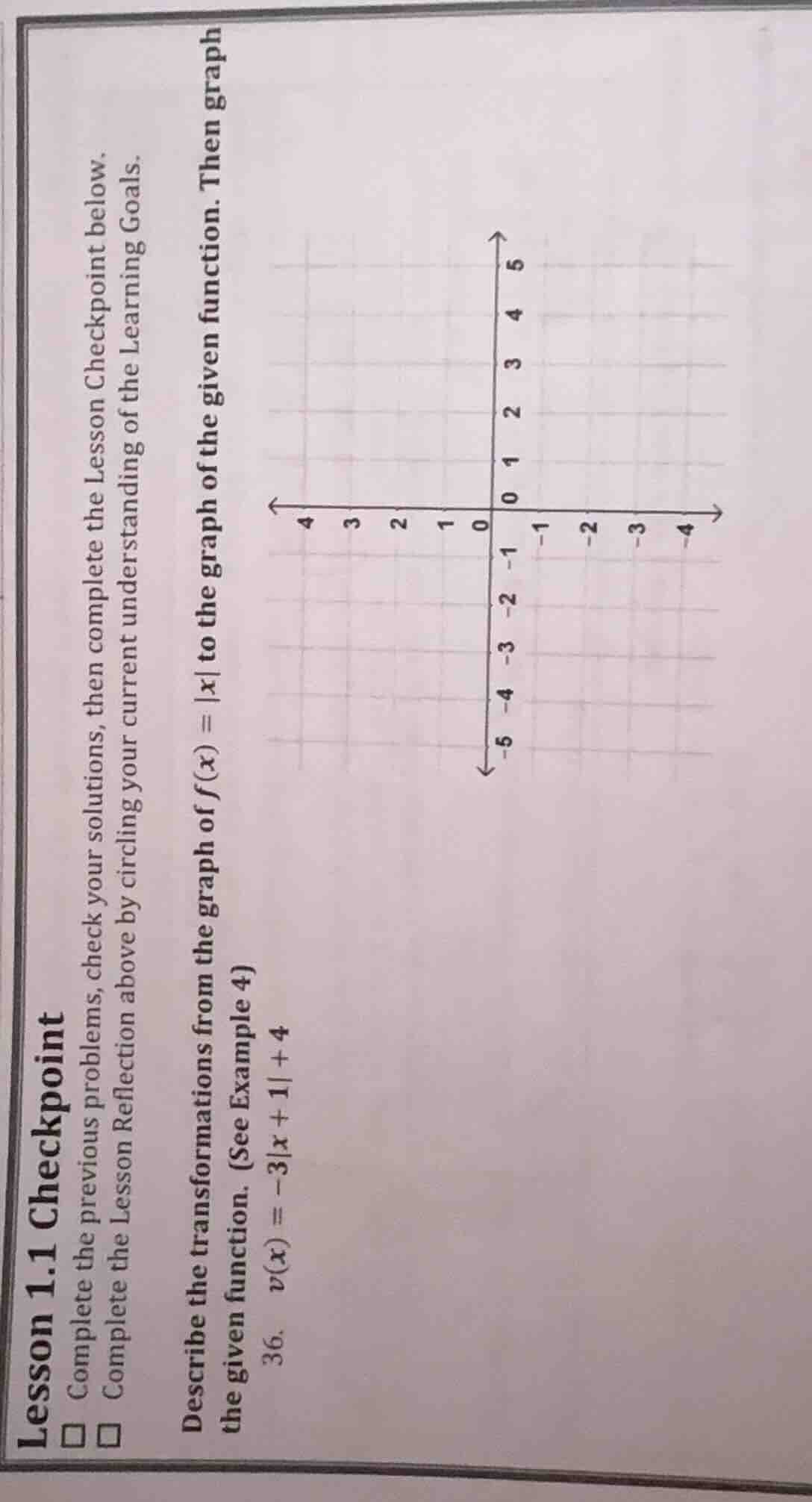
describe the transformations from the graph of ( f(x) = |x| ) to the graph of the given function. then graph the given function. (see example 4)
- ( v(x) = -3|x + 1| + 4 )
Step1: Recall Transformations of Absolute Value Functions
The parent function is \( f(x) = |x| \). The general form of a transformed absolute value function is \( v(x)=a|x - h|+k \), where:
- \( a \) determines vertical stretch/compression and reflection.
- \( h \) determines horizontal shift (opposite sign: \( h>0 \) shifts right, \( h<0 \) shifts left).
- \( k \) determines vertical shift (\( k>0 \) shifts up, \( k<0 \) shifts down).
Step2: Analyze \( v(x)=-3|x + 1|+4 \)
- For the coefficient \( a=-3 \):
- The absolute value of \( a \) is \( | - 3|=3 \), so there is a vertical stretch by a factor of 3.
- The negative sign of \( a \) means there is a reflection over the \( x \)-axis.
- For the horizontal shift (\( h \)): In the form \( |x - h| \), our function has \( |x+1|=|x-(-1)| \), so \( h = - 1 \). This means the graph is shifted 1 unit to the left.
- For the vertical shift (\( k \)): The \( + 4 \) at the end means the graph is shifted 4 units up.

Snap & solve any problem in the app
Get step-by-step solutions on Sovi AI
Photo-based solutions with guided steps
Explore more problems and detailed explanations
To obtain the graph of \( v(x)=-3|x + 1|+4 \) from \( f(x)=|x| \):
- Reflect the graph of \( f(x)=|x| \) over the \( x \)-axis.
- Vertically stretch the reflected graph by a factor of 3.
- Shift the stretched graph 1 unit to the left.
- Shift the shifted graph 4 units up.
For graphing:
- Start with the vertex of \( f(x)=|x| \) at \( (0,0) \).
- After reflection and stretch, the vertex before horizontal/vertical shift is still related, but with the transformations: the new vertex of \( v(x) \) is at \( (-1,4) \) (from \( h=-1,k = 4 \), and the reflection/stretch affects the slope). The left side (for \( x<-1 \)) will have a slope of \( 3 \) (since \( a=-3 \), the slope of \( |x| \) for \( x<0 \) is \( - 1 \), after reflection it's \( 1 \), after stretch by 3 it's \( 3 \), but wait, actually for \( v(x)=-3|x + 1|+4 \), when \( x<-1 \), \( |x + 1|=-(x + 1) \), so \( v(x)=-3(-(x + 1))+4=3(x + 1)+4=3x+3 + 4=3x + 7 \), slope \( 3 \); when \( x\geq - 1 \), \( |x + 1|=x + 1 \), so \( v(x)=-3(x + 1)+4=-3x-3 + 4=-3x + 1 \), slope \( - 3 \). Plot the vertex at \( (-1,4) \), then use the slopes to draw the two rays (left ray with slope \( 3 \), right ray with slope \( - 3 \)).