QUESTION IMAGE
Question
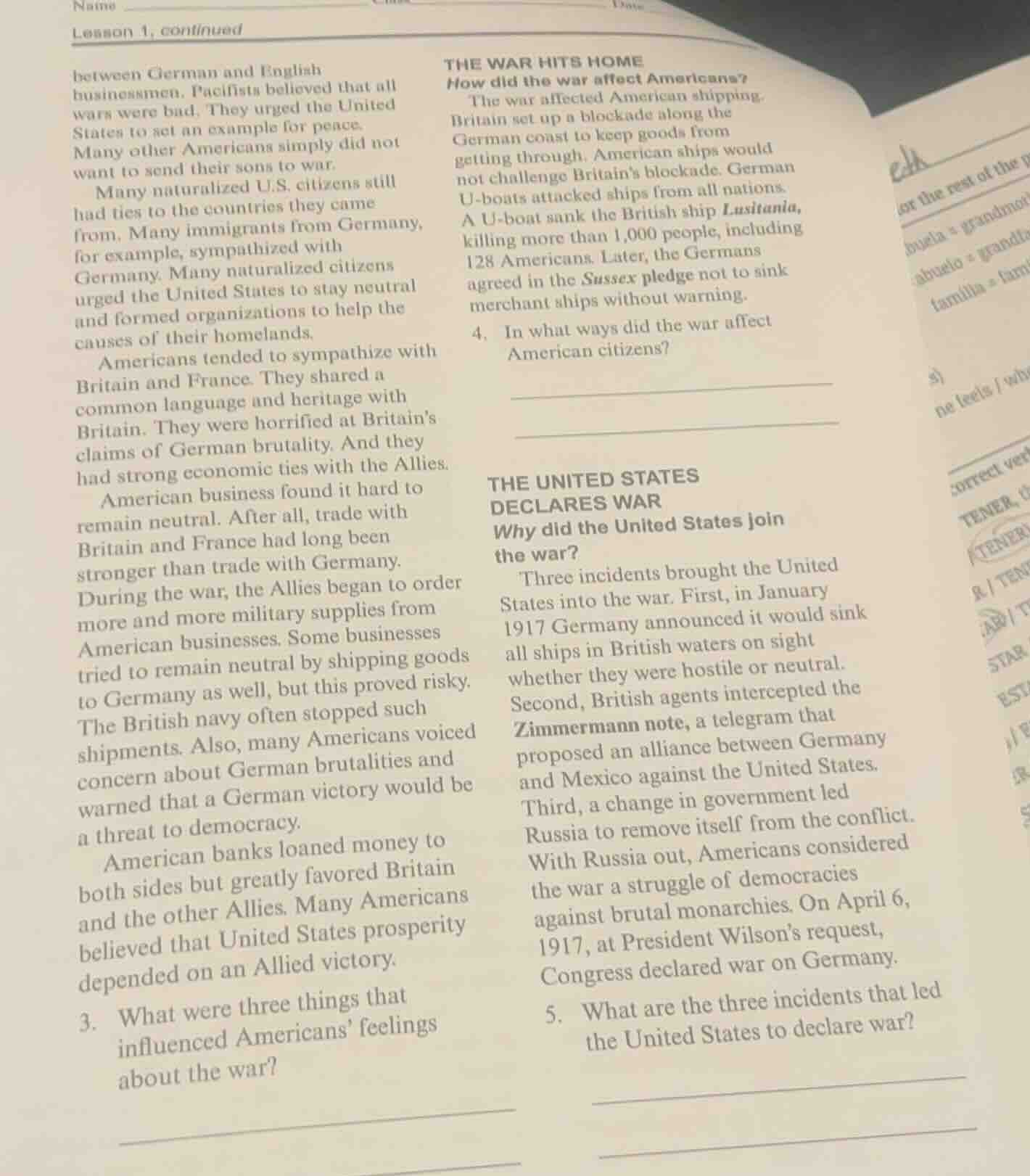
lesson 1, continuedbetween german and englishbusinessmen. pacifists believed that allwars were bad. they urged the unitedstates to set an example for peace.many other americans simply did notwant to send their sons to war.many naturalized u.s. citizens stillhad ties to the countries they camefrom. many immigrants from germany,for example, sympathized withgermany. many naturalized citizensurged the united states to stay neutraland formed organizations to help thecauses of their homelands.americans tended to sympathize withbritain and france. they shared acommon language and heritage withbritain. they were horrified at britainsclaims of german brutality. and theyhad strong economic ties with the allies.american business found it hard toremain neutral. after all, trade withbritain and france had long beenstronger than trade with germany.during the war, the allies began to ordermore and more military supplies fromamerican businesses. some businessestried to remain neutral by shipping goodsto germany as well, but this proved risky.the british navy often stopped suchshipments. also, many americans voicedconcern about german brutalities andwarned that a german victory would bea threat to democracy.american banks loaned money toboth sides but greatly favored britainand the other allies. many americansbelieved that united states prosperitydepended on an allied victory.3. what were three things thatinfluenced americans feelingsabout the war?the war hits homehow did the war affect americans?the war affected american shipping.britain set up a blockade along thegerman coast to keep goods fromgetting through. american ships wouldnot challenge britains blockade. germanu-boats attacked ships from all nations.a u-boat sank the british ship lusitania,killing more than 1,000 people, including128 americans. later, the germansagreed in the sussex pledge not to sinkmerchant ships without warning.4. in what ways did the war affectamerican citizens?the united statesdeclares warwhy did the united states jointhe war?three incidents brought the unitedstates into the war. first, in january1917 germany announced it would sinkall ships in british waters on sightwhether they were hostile or neutral.second, british agents intercepted thezimmermann note, a telegram thatproposed an alliance between germanyand mexico against the united states.third, a change in government ledrussia to remove itself from the conflict.with russia out, americans consideredthe war a struggle of democraciesagainst brutal monarchies. on april 6,1917, at president wilsons request,congress declared war on germany.5. what are the three incidents that ledthe united states to declare war?
For Question 3:
Identified key factors from the text that shaped American attitudes: ties to home countries, cultural/economic links to Allies, and moral/ideological concerns over German actions.
For Question 4:
Extracted impacts on citizens from the text: shipping disruptions due to blockades and U-boat attacks, division among naturalized citizens with homeland ties, and pressure from sympathies for different war sides.
For Question 5:
Pulled the three direct incidents cited that led to U.S. declaration of war from the text.

Snap & solve any problem in the app
Get step-by-step solutions on Sovi AI
Photo-based solutions with guided steps
Explore more problems and detailed explanations
- 1. Ties of naturalized citizens to their home countries (e.g., German immigrants sympathizing with Germany).
- Shared language, heritage, and strong economic ties with Britain and France (Allies).
- Concerns about German brutality and fear that a German victory would threaten democracy.
- 1. American shipping was disrupted by Britain's blockade of Germany and German U-boat attacks (including the sinking of the Lusitania that killed 128 Americans).
- Naturalized U.S. citizens with ties to their home countries were divided, with some sympathizing with Germany and urging neutrality, while others favored the Allies.
- Many Americans faced pressure from their sympathies, either pushing for neutrality or supporting the Allied cause.
- 1. Germany's January 1917 announcement that it would sink all ships in British waters on sight, regardless of if they were hostile or neutral.
- The interception of the Zimmermann note, which revealed Germany's proposal for an alliance with Mexico against the U.S.
- Russia's withdrawal from the conflict after a government change, which framed the war as a fight between democracies and brutal monarchies for Americans.