QUESTION IMAGE
Question
8 lesson
draw conclusions
ss content topics: i.cg.c.1, i.cg.c.2, i.cg.c.3, ii.cg.a.2
ss practices: ssp.1.a, ssp.1.b, ssp.2.a, ssp.2.b, ssp.3.c, ssp.9.a, ssp.9.b, ssp.9.c
1 learn the skill
you have already learned that an inference is a logical guess based on facts or evidence. by combining several inferences to make a judgment, you can draw conclusions. the ability to draw conclusions enables you to develop new ideas about social studies material. in this way, you can gain a deeper understanding of the information you need. you can also call upon your prior knowledge to help you draw conclusions.
as with other areas of the ged® test, questions about drawing conclusions will test your ability to interpret information at various depth of knowledge levels through the use of complex reading skills and thinking skills.
practice the skill
by practicing the skill of drawing conclusions, you will improve your study and test-taking abilities, especially as they relate to the ged® social studies test. study the passage below. then answer the question that follows.
when you read, look for pieces of information about which you can ask questions, such as: how do the people in the line of succession get their positions?
remember that an inference is a puzzle that must be solved using two or more pieces of information. logical guesses can be combined to form a conclusion.
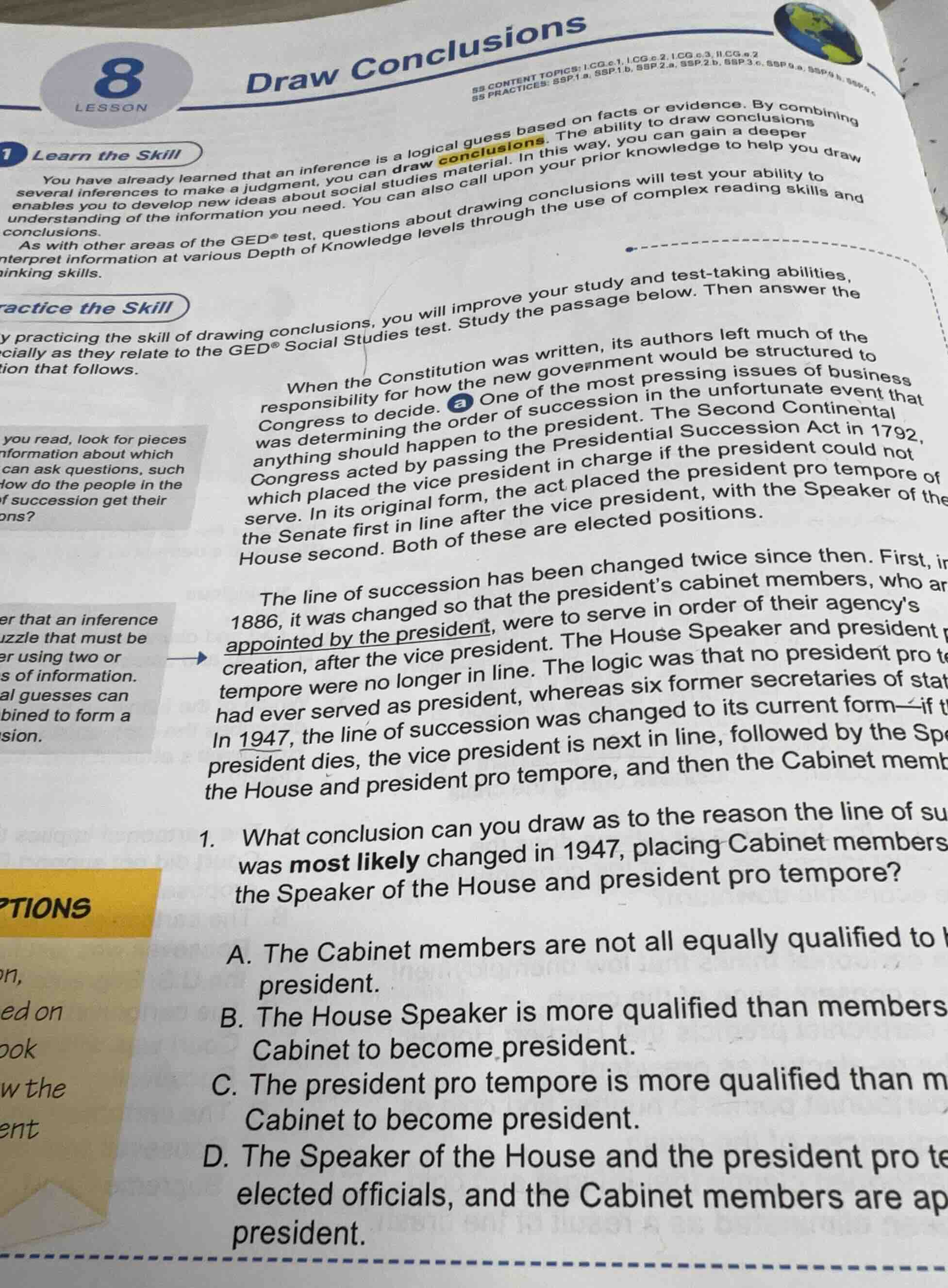
when the constitution was written, its authors left much of the responsibility for how the new government would be structured to congress to decide. a one of the most pressing issues of business was determining the order of succession in the unfortunate event that anything should happen to the president. the second continental congress acted by passing the presidential succession act in 1792, which placed the vice president in charge if the president could not serve. in its original form, the act placed the president pro tempore of the senate first in line after the vice president, with the speaker of the house second. both of these are elected positions.
the line of succession has been changed twice since then. first, in 1886, it was changed so that the presidents cabinet members, who are appointed by the president, were to serve in order of their agencys creation, after the vice president. the house speaker and president pro tempore were no longer in line. the logic was that no president pro tempore had ever served as president, whereas six former secretaries of state had. in 1947, the line of succession was changed to its current form—if the president dies, the vice president is next in line, followed by the speaker of the house and president pro tempore, and then the cabinet members.
- what conclusion can you draw as to the reason the line of succession was most likely changed in 1947, placing cabinet members after the speaker of the house and president pro tempore?
options
a. the cabinet members are not all equally qualified to serve as president.
b. the house speaker is more qualified than members of the cabinet to become president.
c. the president pro tempore is more qualified than members of the cabinet to become president.
d. the speaker of the house and the president pro tempore are elected officials, and the cabinet members are appointed by the president.
The passage notes that the original 1792 succession act used elected positions (president pro tempore of the Senate, Speaker of the House), the 1886 change shifted to appointed Cabinet members, and the 1947 change moved elected positions back ahead of Cabinet members. The conclusion aligns with prioritizing elected officials over appointed ones, which matches option D's point about the difference between elected and appointed roles.

Snap & solve any problem in the app
Get step-by-step solutions on Sovi AI
Photo-based solutions with guided steps
Explore more problems and detailed explanations
D. The Speaker of the House and the president pro tempore are elected officials, and the Cabinet members are appointed by the president.