QUESTION IMAGE
Question
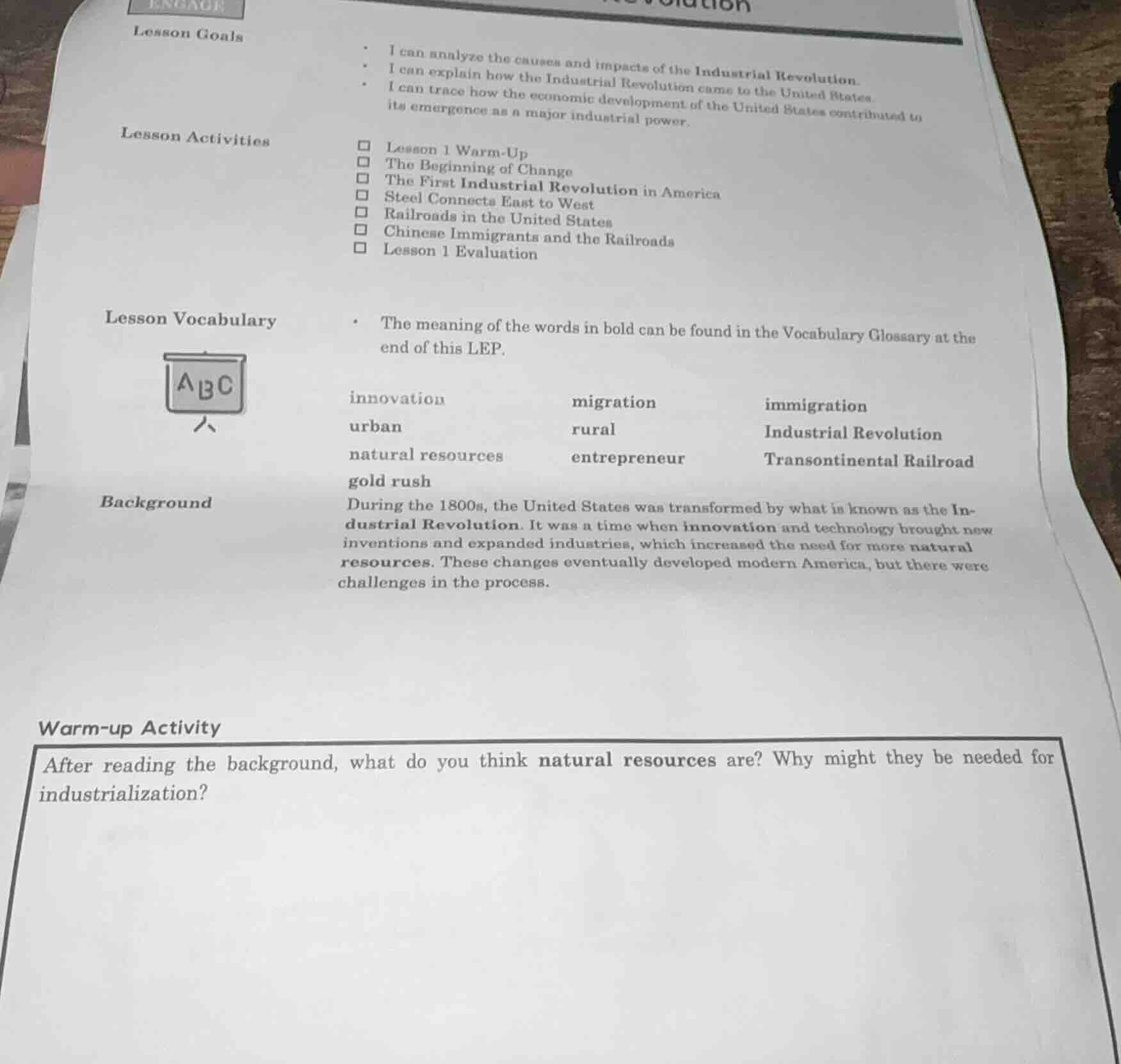
lesson goals- i can analyze the causes and impacts of the industrial revolution.- i can explain how the industrial revolution came to the united states.- i can trace how the economic development of the united states contributed to its emergence as a major industrial power.lesson activities□ lesson 1 warm-up□ the beginning of change□ the first industrial revolution in america□ steel connects east to west□ railroads in the united states□ chinese immigrants and the railroads□ lesson 1 evaluationlesson vocabulary- the meaning of the words in bold can be found in the vocabulary glossary at the end of this lep.innovationmigrationimmigrationurbanruralindustrial revolutionnatural resourcesentrepreneurtransontinental railroadgold rushbackgroundduring the 1800s, the united states was transformed by what is known as the industrial revolution. it was a time when innovation and technology brought new inventions and expanded industries, which increased the need for more natural resources. these changes eventually developed modern america, but there were challenges in the process.warm-up activityafter reading the background, what do you think natural resources are? why might they be needed for industrialization?
Natural resources are materials or substances that occur naturally in the environment, not created by humans. For industrialization, they serve as raw materials for manufacturing goods, sources of energy to power factories and machinery, and inputs to build infrastructure like railroads and factories, which are core to expanding industrial production and economic growth.

Snap & solve any problem in the app
Get step-by-step solutions on Sovi AI
Photo-based solutions with guided steps
Explore more problems and detailed explanations
- Natural resources are naturally occurring materials (e.g., coal, iron, timber, water) from the Earth that are not human-made.
- They are needed for industrialization because:
- They act as raw materials for producing goods (e.g., iron for machinery, timber for construction).
- They provide energy to power industrial equipment (e.g., coal for steam engines).
- They enable the building of critical infrastructure (e.g., resources for railroads, factory buildings) that supports industrial expansion.