QUESTION IMAGE
Question
lesson 7 – new information and predictions on models
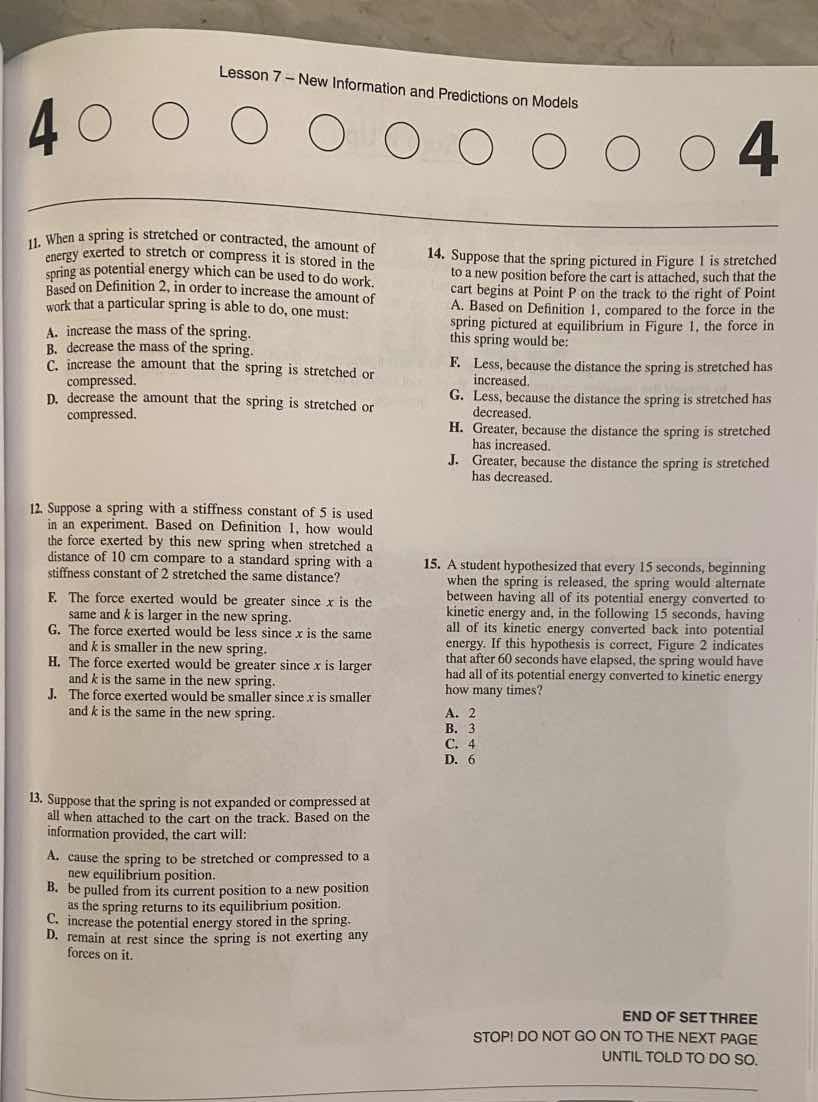
- when a spring is stretched or contracted, the amount of energy exerted to stretch or compress it is stored in the spring as potential energy which can be used to do work. based on definition 2, in order to increase the amount of work that a particular spring is able to do, one must:
a. increase the mass of the spring.
b. decrease the mass of the spring.
c. increase the amount that the spring is stretched or compressed.
d. decrease the amount that the spring is stretched or compressed.
- suppose a spring with a stiffness constant of 5 is used in an experiment. based on definition 1, how would the force exerted by this new spring when stretched a distance of 10 cm compare to a standard spring with a stiffness constant of 2 stretched the same distance?
f. the force exerted would be greater since x is the same and k is larger in the new spring.
g. the force exerted would be less since x is the same and k is smaller in the new spring.
h. the force exerted would be greater since x is larger and k is the same in the new spring.
j. the force exerted would be smaller since x is smaller and k is the same in the new spring.
- suppose that the spring is not expanded or compressed at all when attached to the cart on the track. based on the information provided, the cart will:
a. cause the spring to be stretched or compressed to a new equilibrium position.
b. be pulled from its current position to a new position as the spring returns to its equilibrium position.
c. increase the potential energy stored in the spring.
d. remain at rest since the spring is not exerting any forces on it.
- suppose that the spring pictured in figure 1 is stretched to a new position before the cart is attached, such that the cart begins at point p on the track to the right of point a. based on definition 1, compared to the force in the spring pictured at equilibrium in figure 1, the force in this spring would be:
f. less, because the distance the spring is stretched has increased.
g. less, because the distance the spring is stretched has decreased.
h. greater, because the distance the spring is stretched has increased.
j. greater, because the distance the spring is stretched has decreased.
- a student hypothesized that every 15 seconds, beginning when the spring is released, the spring would alternate between having all of its potential energy converted to kinetic energy and, in the following 15 seconds, having all of its kinetic energy converted back into potential energy. if this hypothesis is correct, figure 2 indicates that after 60 seconds have elapsed, the spring would have had all of its potential energy converted to kinetic energy how many times?
a. 2
b. 3
c. 4
d. 6
end of set three
stop! do not go on to the next page until told to do so.
Step1: Analyze Q11 (PE of spring)
Potential energy of spring: $U=\frac{1}{2}kx^2$. To increase work (equal to $U$), increase $x$.
Step2: Analyze Q12 (Spring force comparison)
Spring force: $F=kx$. $x$ same, $k_{new}=5>k_{standard}=2$. So $F_{new}>F_{standard}$.
Step3: Analyze Q13 (Spring at equilibrium)
If spring is at equilibrium (no stretch/compression), $F=kx=0$. Cart has no net spring force, so it stays at rest.
Step4: Analyze Q14 (Spring force change)
Spring force $F=kx$. New position has larger $x$ (stretched more), so $F$ is greater.
Step5: Analyze Q15 (Energy conversion cycles)
Cycle = 15s (PE→KE) +15s (KE→PE) =30s. 60s total, so $\frac{60}{30}=2$ full cycles. Each cycle has 1 PE→KE conversion, so 2 total.

Snap & solve any problem in the app
Get step-by-step solutions on Sovi AI
Photo-based solutions with guided steps
Explore more problems and detailed explanations
- C. increase the amount that the spring is stretched or compressed.
- F. The force exerted would be greater since x is the same and k is larger in the new spring.
- D. remain at rest since the spring is not exerting any forces on it.
- H. Greater, because the distance the spring is stretched has increased.
- A. 2