QUESTION IMAGE
Question
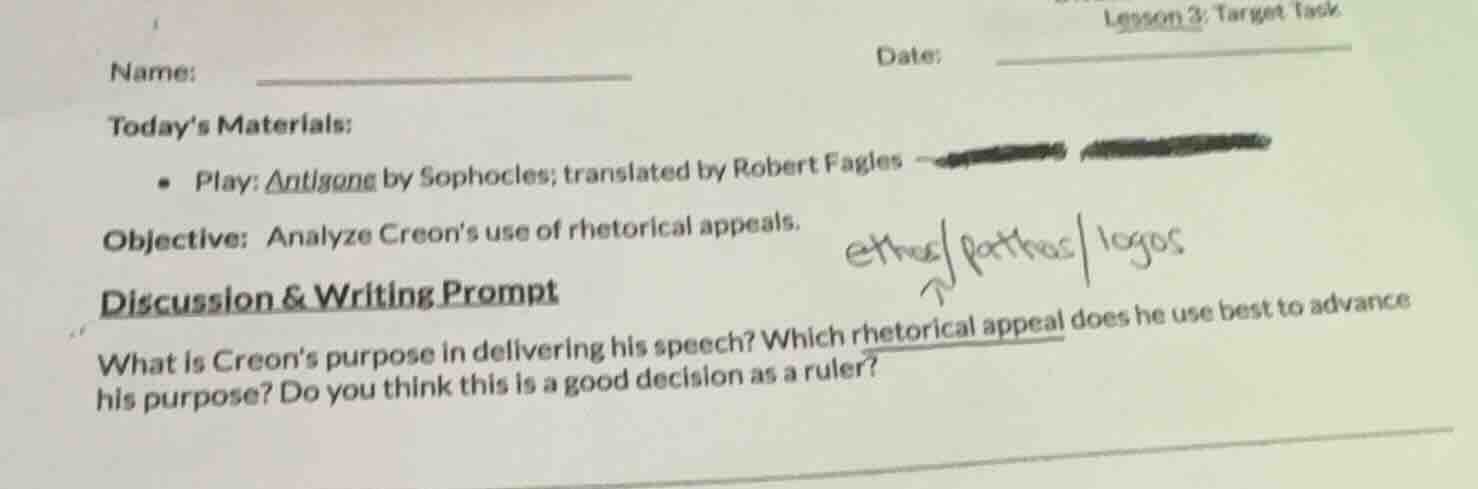
lesson 3: target task
name:
date:
todays materials:
- play: antigone by sophocles; translated by robert fagles
objective: analyze creons use of rhetorical appeals.
discussion & writing prompt
what is creons purpose in delivering his speech? which rhetorical appeal does he use best to advance his purpose? do you think this is a good decision as a ruler?
Brief Explanations
- Creon's Purpose: In "Antigone", Creon's speech aims to assert his authority, justify his edict (prohibiting Polyneices' burial) to the Theban citizens, and establish order after the civil war. He seeks to solidify his rule, emphasize loyalty to the state, and deter rebellion by enforcing strict laws.
- Best Rhetorical Appeal: Creon likely uses logos (logical appeal) most effectively. He argues from the perspective of state stability: Polyneices is a traitor, so his burial would undermine the state’s security and the rule of law. He frames his edict as necessary for the common good, using logical reasoning about civic duty and the consequences of disobedience. Alternatively, he may use ethos (ethical appeal) by positioning himself as a just, responsible ruler acting in the state’s best interest, or pathos (emotional appeal) to stir patriotism or fear of chaos.
- Good Decision as Ruler? This depends on interpretation. If he prioritizes order over compassion (e.g., denying Polyneices burial), it may seem harsh but consistent with his role as a ruler restoring stability. However, his inflexibility later leads to tragedy, suggesting the decision (or its execution) has flaws.

Snap & solve any problem in the app
Get step-by-step solutions on Sovi AI
Photo-based solutions with guided steps
Explore more problems and detailed explanations
- Purpose: Creon’s purpose is to assert his authority, justify his edict (banning Polyneices’ burial) to citizens, and restore order to Thebes after civil war by enforcing strict laws and emphasizing loyalty to the state.
- Best Rhetorical Appeal: Likely logos (logical reasoning) — he argues that Polyneices’ burial would undermine state security and the rule of law, framing his edict as necessary for the common good. (Alternative: ethos (portraying himself as a just ruler) or pathos (stirring fear of chaos/patriotism).)
- Good Decision? Mixed: While strict order may restore stability, his inflexibility (e.g., refusing to reconsider) later causes tragedy, suggesting the decision (or its execution) lacks compassion and adaptability.