QUESTION IMAGE
Question
lesson 5 worksheet
name: allison sanchez period: 1st date: jan 12 2026
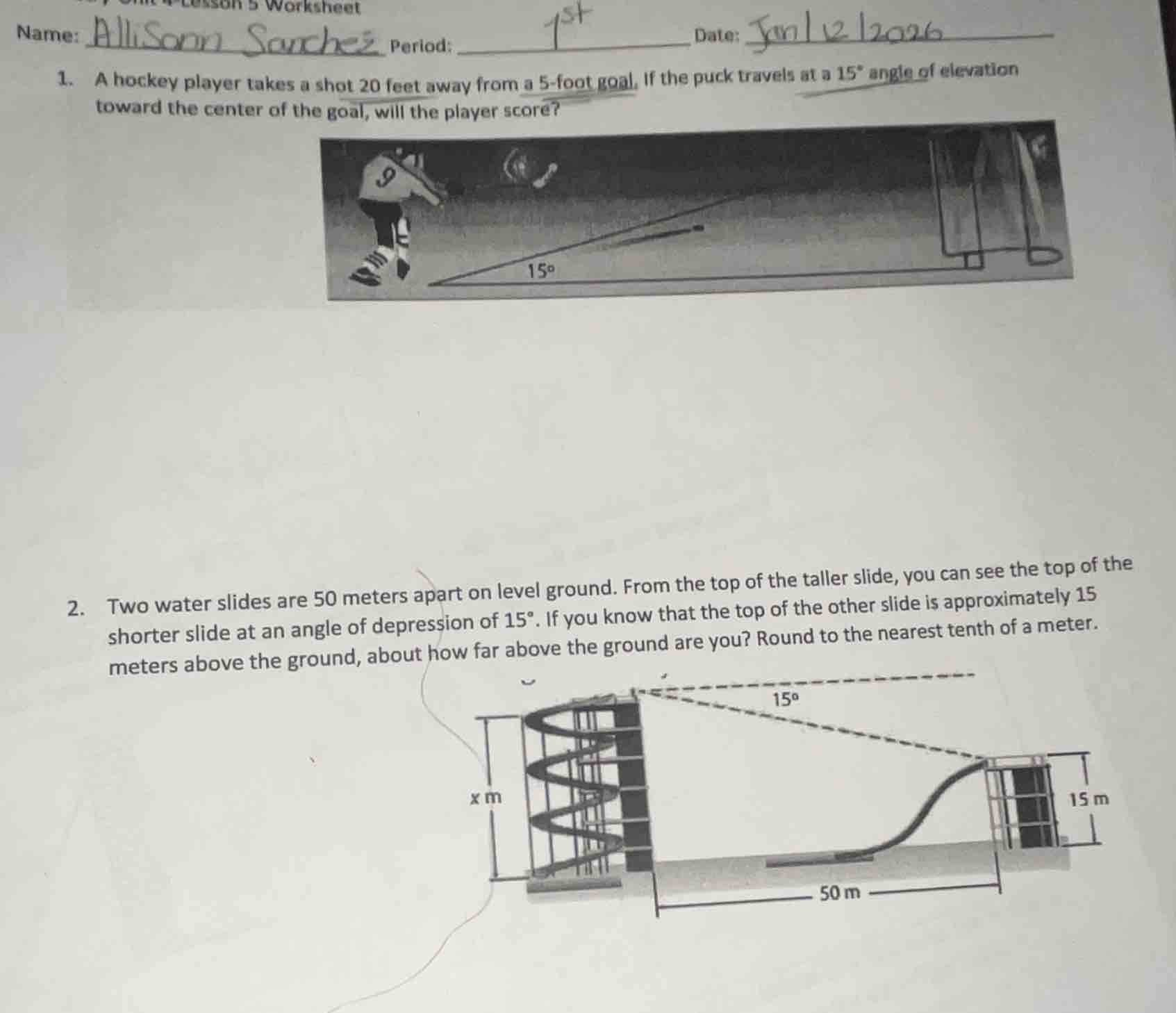
- a hockey player takes a shot 20 feet away from a 5-foot goal. if the puck travels at a 15° angle of elevation toward the center of the goal, will the player score?
image of hockey player, puck, and goal with 15° angle
- two water slides are 50 meters apart on level ground. from the top of the taller slide, you can see the top of the shorter slide at an angle of depression of 15°. if you know that the top of the other slide is approximately 15 meters above the ground, about how far above the ground are you? round to the nearest tenth of a meter.
image of two water slides with 15° angle, 50m distance, and 15m height marked
Problem 1:
Step1: Identify the trigonometric relationship
We have a right triangle where the adjacent side (distance from player to goal) is 20 feet, the angle of elevation is \(15^\circ\), and we need to find the opposite side (height the puck reaches), let's call it \(h\). We use the tangent function: \(\tan(\theta)=\frac{\text{opposite}}{\text{adjacent}}\)
\(\tan(15^\circ)=\frac{h}{20}\)
Step2: Solve for \(h\)
Multiply both sides by 20: \(h = 20\times\tan(15^\circ)\)
We know that \(\tan(15^\circ)\approx0.2679\), so \(h\approx20\times0.2679 = 5.358\) feet
Step3: Compare with goal height
The goal is 5 feet tall. Since \(5.358>5\), the puck will go over the goal? Wait, no—wait, the goal is 5 - foot tall. Wait, the angle is toward the center. Wait, maybe I made a mistake. Wait, the height the puck reaches is about 5.36 feet, which is more than 5 feet. But wait, the goal is 5 feet tall. So if the puck's height is more than 5 feet, will it score? Wait, the goal is a vertical structure. Wait, maybe the question is if the puck's height is at least 5 feet? Wait, no—wait, the goal is 5 feet tall, so if the puck's trajectory height at the goal is more than 5 feet, it would miss? Wait, no, maybe the goal is a 5 - foot tall net, so the puck needs to be at or below 5 feet? Wait, no, the center of the goal—maybe the goal is 5 feet tall, so the height of the puck at the goal line is calculated. If the height is more than 5 feet, it goes over the goal, so no score? Wait, no, maybe I messed up. Wait, let's recalculate. \(\tan(15^\circ)\) is approximately 0.2679, so 200.2679 is approximately 5.36 feet. The goal is 5 feet, so 5.36>5, so the puck goes over the goal, so the player will not score? Wait, no, maybe the goal is a 5 - foot tall net, so the height needs to be ≤5. So since 5.36>5, the puck is above the goal, so no score? Wait, but maybe I made a mistake in the angle. Wait, the angle of elevation is 15 degrees, so the height is opposite side. So \(\tan(15)=\frac{h}{20}\), so \(h = 20\tan(15)\approx5.36\) feet. The goal is 5 feet, so 5.36>5, so the puck is higher than the goal, so it will not score? Wait, but maybe the question is if the height is at least 5 feet? No, the goal is 5 feet tall, so the puck needs to be within the 5 - foot height. So since 5.36>5, the player will not score? Wait, but maybe I made a mistake. Wait, let's check \(\tan(15^\circ)\): \(\tan(15)=\tan(45 - 30)=\frac{\tan45-\tan30}{1 + \tan45\tan30}=\frac{1-\frac{\sqrt{3}}{3}}{1 + 1\times\frac{\sqrt{3}}{3}}=\frac{3-\sqrt{3}}{3 + \sqrt{3}}=\frac{(3 - \sqrt{3})^2}{9 - 3}=\frac{9-6\sqrt{3}+3}{6}=\frac{12 - 6\sqrt{3}}{6}=2-\sqrt{3}\approx2 - 1.732 = 0.2679\), so that's correct. So \(h = 20\times0.2679\approx5.36\) feet. The goal is 5 feet, so 5.36>5, so the puck is above the goal, so the player will not score? Wait, but the question is "will the player score?" So the answer is no? Wait, maybe I messed up the direction. Wait, maybe the angle is such that the height is less than 5? Wait, no, 20tan(15) is about 5.36. So the height is about 5.36 feet, which is more than 5 feet, so the puck goes over the goal, so the player will not score.
Step1: Identify the trigonometric relationship
We have a right triangle where the horizontal distance between the slides is 50 meters (adjacent side), the angle of depression is \(15^\circ\), and the difference in height between the two slides is \(x - 15\) (opposite side, where \(x\) is the height of the taller slide). The angle of depression is equal to the angle of elevation from the shorter slide to the taller slide. So we use \(\tan(15^\circ)=\frac{x - 15}{50}\)
Step2: Solve for \(x\)
Multiply both sides by 50: \(x-15 = 50\times\tan(15^\circ)\)
We know \(\tan(15^\circ)\approx0.2679\), so \(x-15\approx50\times0.2679 = 13.395\)
Add 15 to both sides: \(x\approx13.395 + 15=28.395\approx28.4\) meters

Snap & solve any problem in the app
Get step-by-step solutions on Sovi AI
Photo-based solutions with guided steps
Explore more problems and detailed explanations
No (the puck's height at the goal is approximately 5.36 feet, which is more than 5 feet, so it will not score)