QUESTION IMAGE
Question
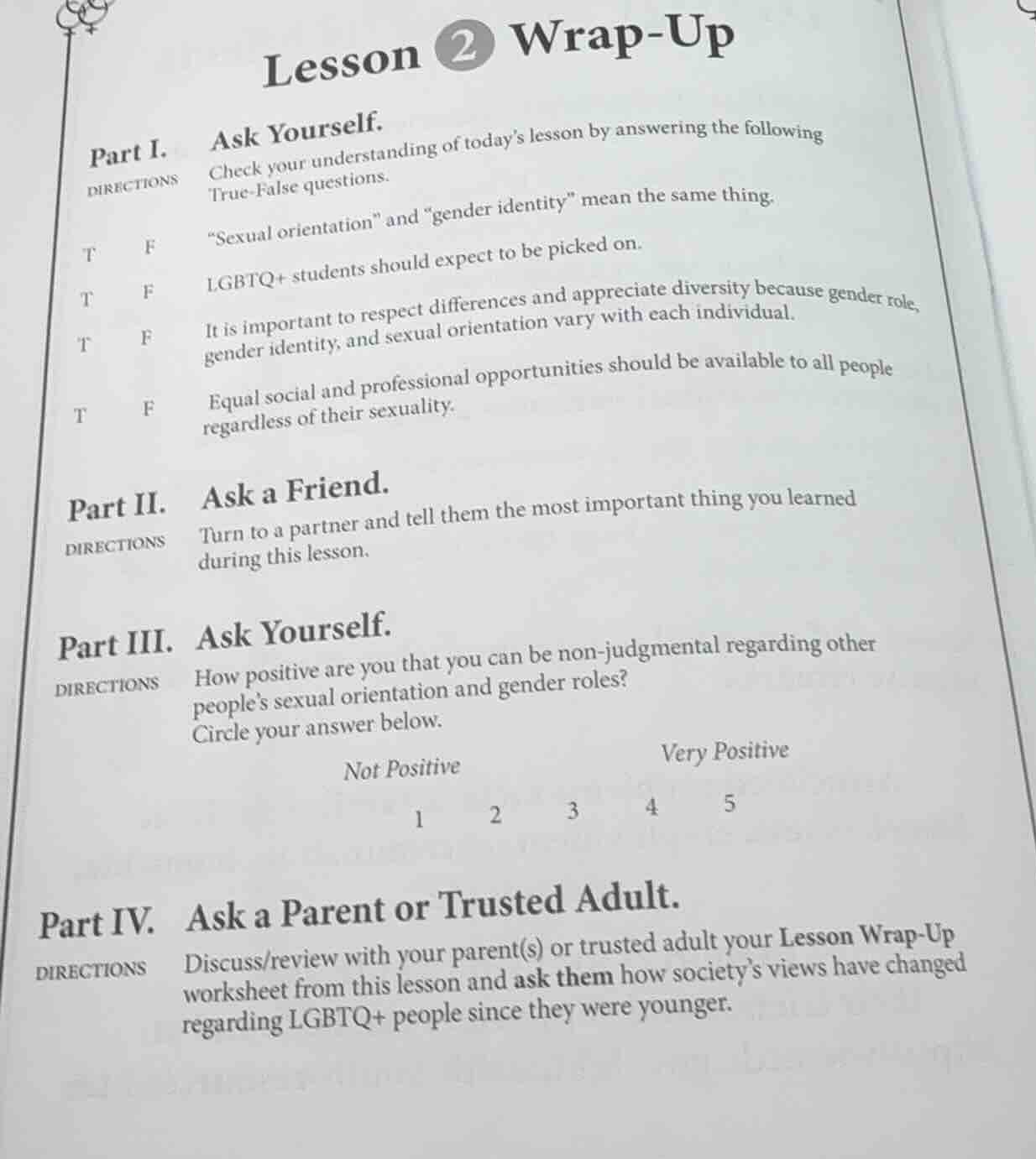
lesson 2 wrap-up
part i. ask yourself.
directions check your understanding of today’s lesson by answering the following true - false questions.
t f “sexual orientation” and “gender identity” mean the same thing.
t f lgbtq+ students should expect to be picked on.
t f it is important to respect differences and appreciate diversity because gender role, gender identity, and sexual orientation vary with each individual.
t f equal social and professional opportunities should be available to all people regardless of their sexuality.
part ii. ask a friend.
directions turn to a partner and tell them the most important thing you learned during this lesson.
part iii. ask yourself.
directions how positive are you that you can be non - judgmental regarding other people’s sexual orientation and gender roles?
circle your answer below.
not positive very positive
1 2 3 4 5
part iv. ask a parent or trusted adult.
directions discuss/review with your parent(s) or trusted adult your lesson wrap - up worksheet from this lesson and ask them how society’s views have changed regarding lgbtq+ people since they were younger.
Part I: True - False Questions
- “Sexual orientation” and “gender identity” mean the same thing.
- Brief Explanations: Sexual orientation refers to a person's romantic or sexual attraction (e.g., gay, straight, bisexual), while gender identity is a person's internal sense of their gender (e.g., male, female, non - binary). They are distinct concepts.
- Answer: F
- LGBTQ+ students should expect to be picked on.
- Brief Explanations: LGBTQ+ students, like all students, should be in a safe environment and should not be expected to face harassment. Schools and society should promote acceptance and safety for all students regardless of their sexual orientation or gender identity.
- Answer: F
- It is important to respect differences and appreciate diversity because gender role, gender identity, and sexual orientation vary with each individual.
- Brief Explanations: Since gender roles, gender identity, and sexual orientation are diverse among individuals, respecting these differences helps create an inclusive and harmonious environment.
- Answer: T
- Equal social and professional opportunities should be available to all people regardless of their sexuality.
- Brief Explanations: In a just society, all people, regardless of their sexual orientation, should have equal access to social and professional opportunities. Discrimination based on sexuality is unfair and goes against the principles of equality.
- Answer: T
Part II: Ask a Friend
This is a practical task. You can, for example, say to your friend: "The most important thing I learned from this lesson is that we should respect the diversity of gender roles, gender identities, and sexual orientations, and that everyone should have equal opportunities regardless of their sexuality."
Part III: Ask Yourself
This is a self - assessment task. You should circle the number that best represents how positive you are that you can be non - judgmental regarding other people's sexual orientation and gender roles. For example, if you are very confident, you might circle 5 (Very Positive), and if you are not confident at all, you might circle 1 (Not Positive).
Part IV: Ask a Parent or Trusted Adult
This is a discussion task. You can start the discussion by saying: "Mom/Dad (or trusted adult), we learned about gender identity, sexual orientation, and respecting diversity in class. I want to know how you think society's views on LGBTQ+ people have changed since you were younger?" Then listen to their response and discuss the topic further.

Snap & solve any problem in the app
Get step-by-step solutions on Sovi AI
Photo-based solutions with guided steps
Explore more problems and detailed explanations
Part I: True - False Questions
- “Sexual orientation” and “gender identity” mean the same thing.
- Brief Explanations: Sexual orientation refers to a person's romantic or sexual attraction (e.g., gay, straight, bisexual), while gender identity is a person's internal sense of their gender (e.g., male, female, non - binary). They are distinct concepts.
- Answer: F
- LGBTQ+ students should expect to be picked on.
- Brief Explanations: LGBTQ+ students, like all students, should be in a safe environment and should not be expected to face harassment. Schools and society should promote acceptance and safety for all students regardless of their sexual orientation or gender identity.
- Answer: F
- It is important to respect differences and appreciate diversity because gender role, gender identity, and sexual orientation vary with each individual.
- Brief Explanations: Since gender roles, gender identity, and sexual orientation are diverse among individuals, respecting these differences helps create an inclusive and harmonious environment.
- Answer: T
- Equal social and professional opportunities should be available to all people regardless of their sexuality.
- Brief Explanations: In a just society, all people, regardless of their sexual orientation, should have equal access to social and professional opportunities. Discrimination based on sexuality is unfair and goes against the principles of equality.
- Answer: T
Part II: Ask a Friend
This is a practical task. You can, for example, say to your friend: "The most important thing I learned from this lesson is that we should respect the diversity of gender roles, gender identities, and sexual orientations, and that everyone should have equal opportunities regardless of their sexuality."
Part III: Ask Yourself
This is a self - assessment task. You should circle the number that best represents how positive you are that you can be non - judgmental regarding other people's sexual orientation and gender roles. For example, if you are very confident, you might circle 5 (Very Positive), and if you are not confident at all, you might circle 1 (Not Positive).
Part IV: Ask a Parent or Trusted Adult
This is a discussion task. You can start the discussion by saying: "Mom/Dad (or trusted adult), we learned about gender identity, sexual orientation, and respecting diversity in class. I want to know how you think society's views on LGBTQ+ people have changed since you were younger?" Then listen to their response and discuss the topic further.