QUESTION IMAGE
Question
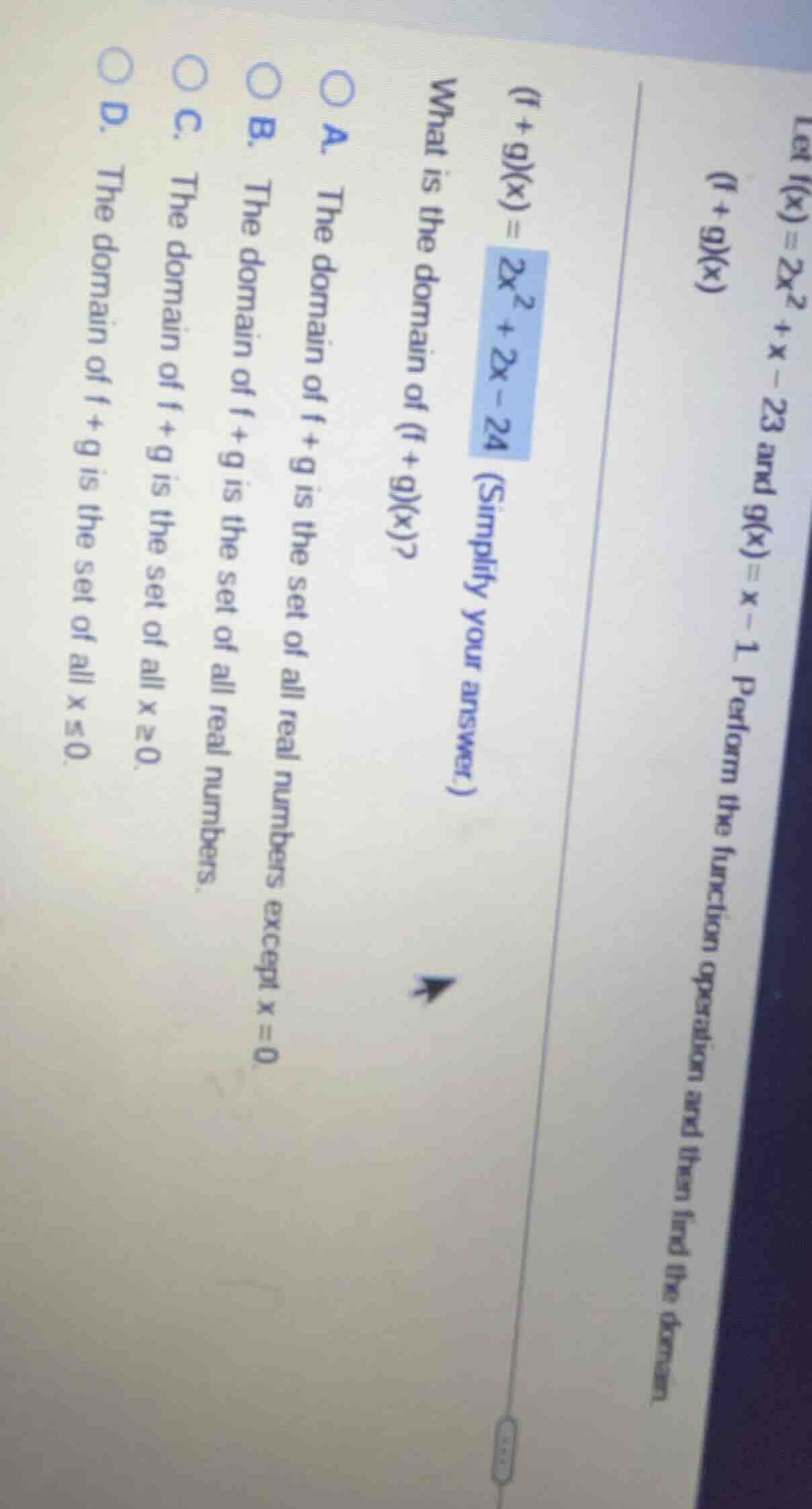
let ( f(x) = 2x^2 + x - 23 ) and ( g(x) = x - 1 ). perform the function operation and then find the domain ( (f + g)(x) )( (f + g)(x) = 2x^2 + 2x - 24 ) (simplify your answer.) what is the domain of ( (f + g)(x) )?
a. the domain of ( f + g ) is the set of all real numbers except ( x = 0 ).
b. the domain of ( f + g ) is the set of all real numbers.
c. the domain of ( f + g ) is the set of all ( x geq 0 ).
d. the domain of ( f + g ) is the set of all ( x leq 0 ).
Step1: Analyze the functions \( f(x) \) and \( g(x) \)
The function \( f(x) = 2x^2 + x - 23 \) is a polynomial function, and \( g(x)=x - 1 \) is also a polynomial function. The sum of two polynomial functions \( (f + g)(x)=f(x)+g(x)=(2x^2 + x - 23)+(x - 1)=2x^2+2x - 24 \) is also a polynomial function.
Step2: Recall the domain of polynomial functions
The domain of a polynomial function (including linear, quadratic, cubic, etc.) is the set of all real numbers because there are no restrictions (like division by zero, square roots of negative numbers, etc.) on the input \( x \) for a polynomial. So the domain of \( (f + g)(x) \) (which is a polynomial) is all real numbers.

Snap & solve any problem in the app
Get step-by-step solutions on Sovi AI
Photo-based solutions with guided steps
Explore more problems and detailed explanations
B. The domain of \( f + g \) is the set of all real numbers.