QUESTION IMAGE
Question
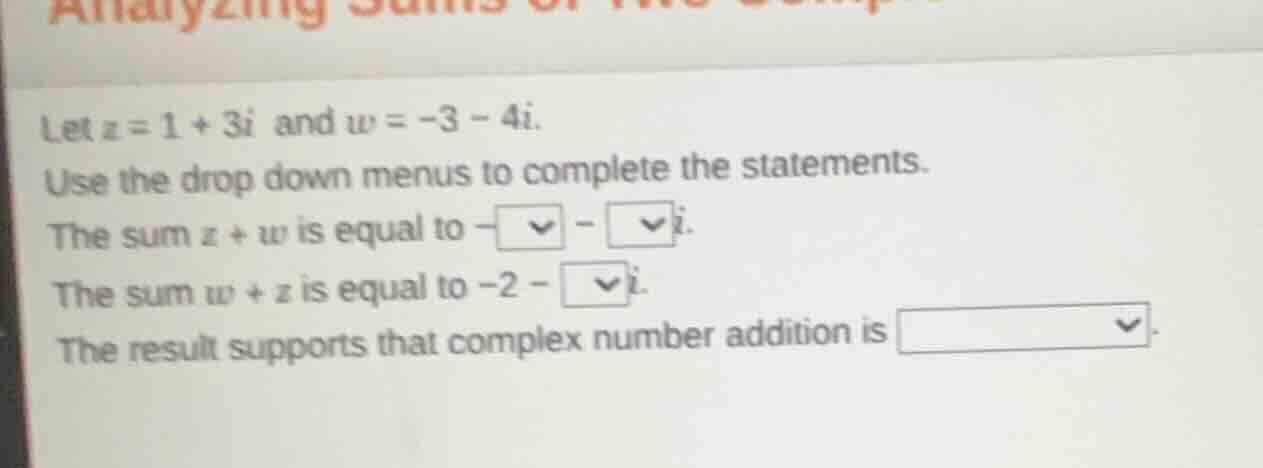
let ( z = 1 + 3i ) and ( w = -3 - 4i ). use the drop down menus to complete the statements. the sum ( z + w ) is equal to (-square - square i). the sum ( w + z ) is equal to (-2 - square i). the result supports that complex number addition is (square).
Step1: Calculate \( z + w \)
To add complex numbers \( z = a + bi \) and \( w = c + di \), we add the real parts and the imaginary parts separately: \( (a + c) + (b + d)i \).
For \( z = 1 + 3i \) and \( w = -3 - 4i \), the real parts are \( 1 + (-3) = -2 \) and the imaginary parts are \( 3 + (-4) = -1 \). So \( z + w = -2 - 1i \).
Step2: Calculate \( w + z \)
Addition of complex numbers is commutative, so \( w + z \) should be the same as \( z + w \). Let's verify: real parts \( -3 + 1 = -2 \), imaginary parts \( -4 + 3 = -1 \). So \( w + z = -2 - 1i \).
Step3: Determine the property
Since \( z + w = w + z \), this shows that complex number addition is commutative.

Snap & solve any problem in the app
Get step-by-step solutions on Sovi AI
Photo-based solutions with guided steps
Explore more problems and detailed explanations
The sum \( z + w \) is equal to \( \boldsymbol{-2 - 1i} \).
The sum \( w + z \) is equal to \( \boldsymbol{-2 - 1i} \).
The result supports that complex number addition is \(\boldsymbol{\text{commutative}}\).