QUESTION IMAGE
Question
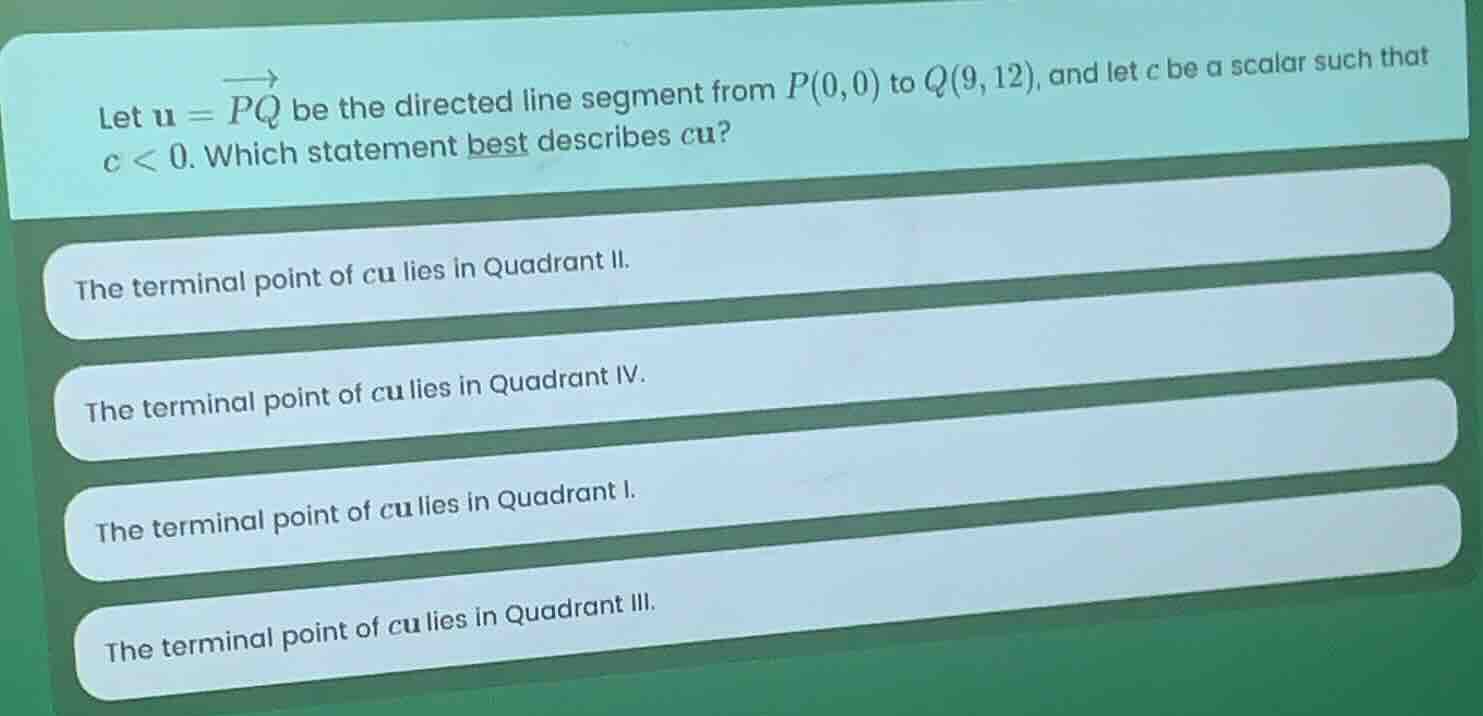
let \\( \mathbf{u} = \overrightarrow{pq} \\) be the directed line segment from \\( p(0,0) \\) to \\( q(9,12) \\), and let \\( c \\) be a scalar such that \\( c < 0 \\). which statement best describes \\( c\mathbf{u} \\)?
the terminal point of \\( c\mathbf{u} \\) lies in quadrant ii.
the terminal point of \\( c\mathbf{u} \\) lies in quadrant iv.
the terminal point of \\( c\mathbf{u} \\) lies in quadrant i.
the terminal point of \\( c\mathbf{u} \\) lies in quadrant iii.
Step1: Find vector \(\vec{u}\)
The vector \(\vec{u}=\overrightarrow{PQ}\) with \(P(0,0)\) and \(Q(9,12)\) is given by \(\vec{u}=\langle9 - 0,12 - 0
angle=\langle9,12
angle\).
Step2: Find scalar multiple \(c\vec{u}\)
When we multiply a vector \(\vec{v}=\langle x,y
angle\) by a scalar \(c\), we get \(c\vec{v}=\langle cx,cy
angle\). Here, \(c\vec{u}=\langle9c,12c
angle\). Since \(c\lt0\), multiplying \(9\) (positive) by \(c\) (negative) gives \(9c\lt0\), and multiplying \(12\) (positive) by \(c\) (negative) gives \(12c\lt0\).
Step3: Determine the quadrant
A point \((x,y)\) lies in Quadrant III if \(x\lt0\) and \(y\lt0\). For \(c\vec{u}=\langle9c,12c
angle\), both \(9c\) and \(12c\) are negative (because \(c\lt0\)), so the terminal point \((9c,12c)\) lies in Quadrant III.

Snap & solve any problem in the app
Get step-by-step solutions on Sovi AI
Photo-based solutions with guided steps
Explore more problems and detailed explanations
The terminal point of \(c\mathbf{u}\) lies in Quadrant III.