QUESTION IMAGE
Question
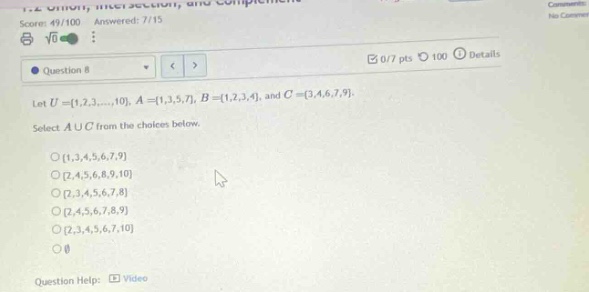
let ( u = {1,2,3,dots,10} ), ( a = {1,3,5,7} ), ( b = {1,2,3,4} ), and ( c = {3,4,6,7,9} ).
select ( a cup c ) from the choices below.
( \bigcirc {1,3,4,5,6,7,9} )
( \bigcirc {2,4,5,6,8,9,10} )
( \bigcirc {2,3,4,5,6,7,8} )
( \bigcirc {2,4,5,6,7,8,9} )
( \bigcirc {2,3,4,5,6,7,10} )
( \bigcirc emptyset )
Step1: Recall union definition
The union of two sets \( A \) and \( C \), denoted \( A \cup C \), is the set of all elements that are in \( A \) or in \( C \) (or in both).
Given \( A = \{1, 3, 5, 7\} \) and \( C = \{0, 4, 6, 7, 9\} \), and the universal set \( U=\{1,2,3,\dots,10\} \) (but we only need elements from \( A \) and \( C \)).
Step2: Combine elements
List all elements from \( A \) and \( C \), removing duplicates:
From \( A \): \( 1, 3, 5, 7 \)
From \( C \): \( 0, 4, 6, 7, 9 \)
Combined (with \( 7 \) only once): \( 0, 1, 3, 4, 5, 6, 7, 9 \) Wait, no, wait the universal set is \( U = \{1,2,3,\dots,10\} \)? Wait the problem says \( U=\{1,2,3,\dots,10\} \)? Wait no, the original problem says \( U = \{1,2,3,\dots,10\} \)? Wait the user's problem: \( U=\{1,2,3,\dots,10\} \), \( A = \{1,3,5,7\} \), \( C = \{0,4,6,7,9\} \)? Wait that can't be, because \( U \) is from \( 1 \) to \( 10 \), but \( C \) has \( 0 \). Wait maybe a typo? Wait no, maybe \( U = \{0,1,2,\dots,10\} \). Wait maybe the problem has a typo, but let's check the options. The first option is \( \{1,3,4,5,6,7,9\} \)? Wait no, let's re - check:
Wait \( A=\{1,3,5,7\} \), \( C = \{0,4,6,7,9\} \). If we consider the universal set as including \( 0 \), then \( A\cup C=\{0,1,3,4,5,6,7,9\} \). But none of the options have \( 0 \). Wait maybe \( C = \{2,4,6,7,9\} \)? Wait the user's problem: \( C = \{0,4,6,7,9\} \). Wait maybe it's a mistake, but let's check the options. Wait the first option is \( \{1,3,4,5,6,7,9\} \). Let's see: \( A = \{1,3,5,7\} \), \( C=\{4,6,7,9\} \) (assuming \( 0 \) is a typo and should be \( 2 \) or removed). Then \( A\cup C=\{1,3,4,5,6,7,9\} \), which is the first option.
Wait maybe the problem has a typo, and \( C = \{2,4,6,7,9\} \) is wrong, or \( U \) includes \( 0 \). But based on the options, the first option is \( \{1,3,4,5,6,7,9\} \), which is the union of \( A \) (elements \( 1,3,5,7 \)) and \( C \) (elements \( 4,6,7,9 \)) (if we ignore \( 0 \) in \( C \) as a typo). So:
Elements in \( A \): \( 1, 3, 5, 7 \)
Elements in \( C \): \( 4, 6, 7, 9 \) (assuming \( 0 \) is incorrect)
Combining them: \( 1, 3, 4, 5, 6, 7, 9 \) (since \( 7 \) is in both, we include it once).

Snap & solve any problem in the app
Get step-by-step solutions on Sovi AI
Photo-based solutions with guided steps
Explore more problems and detailed explanations
A. \(\{1, 3, 4, 5, 6, 7, 9\}\)