QUESTION IMAGE
Question
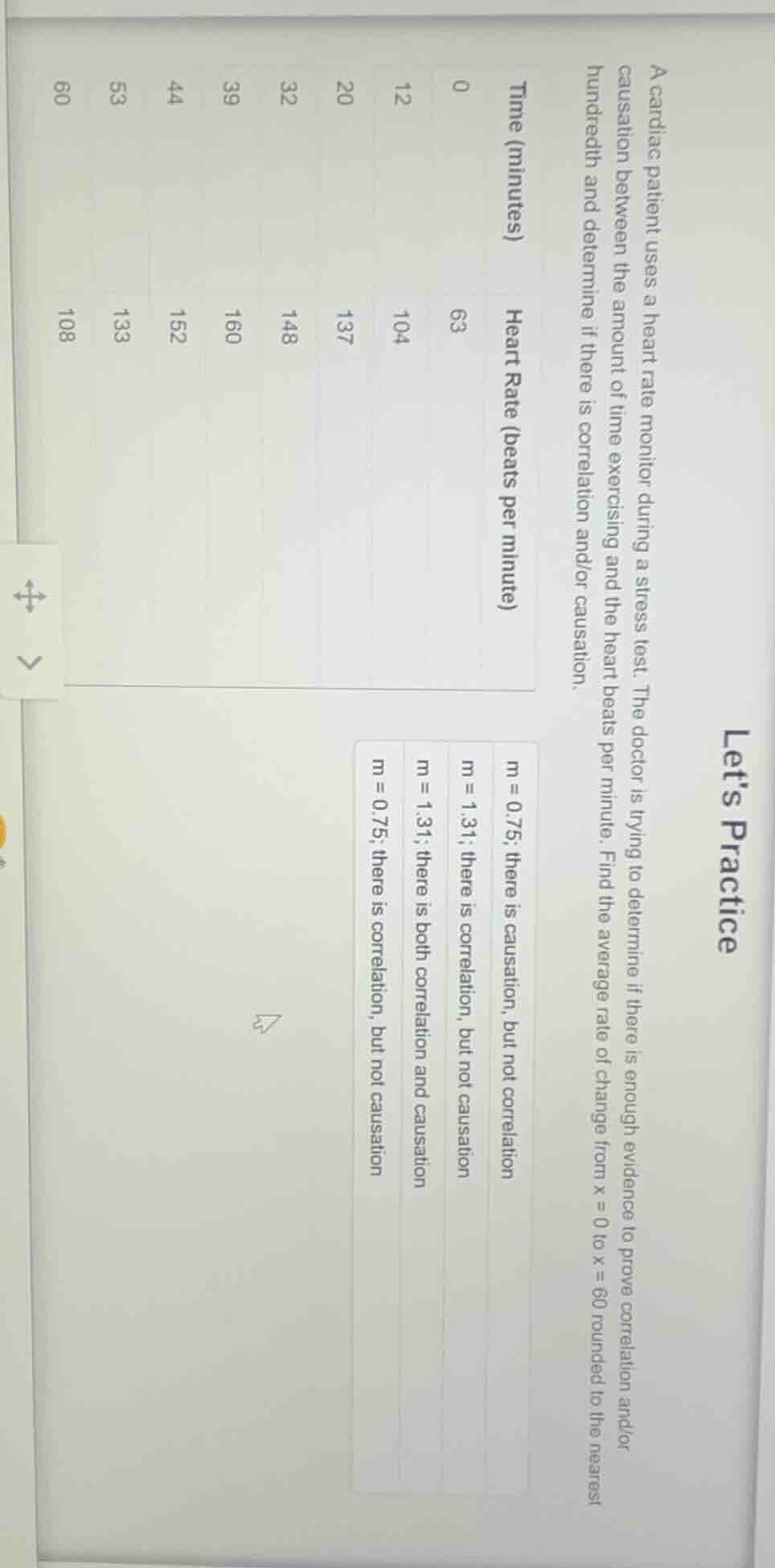
lets practice a cardiac patient uses a heart rate monitor during a stress test. the doctor is trying to determine if there is enough evidence to prove correlation and/or causation between the amount of time exercising and the heart beats per minute. find the average rate of change from x = 0 to x = 60 rounded to the nearest hundredth and determine if there is correlation and/or causation. time (minutes) 0 12 20 32 39 44 53 60 heart rate (beats per minute) 63 104 137 148 160 152 133 108 m = 0.75; there is causation, but not correlation m = 1.31; there is correlation, but not causation m = 1.31; there is both correlation and causation m = 0.75; there is correlation, but not causation
Step1: Define rate of change formula
The average rate of change between $x_1$ and $x_2$ is $\frac{f(x_2)-f(x_1)}{x_2-x_1}$.
Step2: Identify values from table
At $x=0$, $f(0)=63$; at $x=60$, $f(60)=108$.
Step3: Calculate rate of change
$\frac{108 - 63}{60 - 0} = \frac{45}{60} = 0.75$
Step4: Analyze correlation/causation
As exercise time increases, heart rate increases, so there is correlation. Exercising directly causes increased heart rate, so there is causation.

Snap & solve any problem in the app
Get step-by-step solutions on Sovi AI
Photo-based solutions with guided steps
Explore more problems and detailed explanations
m = 0.75; there is both correlation and causation