QUESTION IMAGE
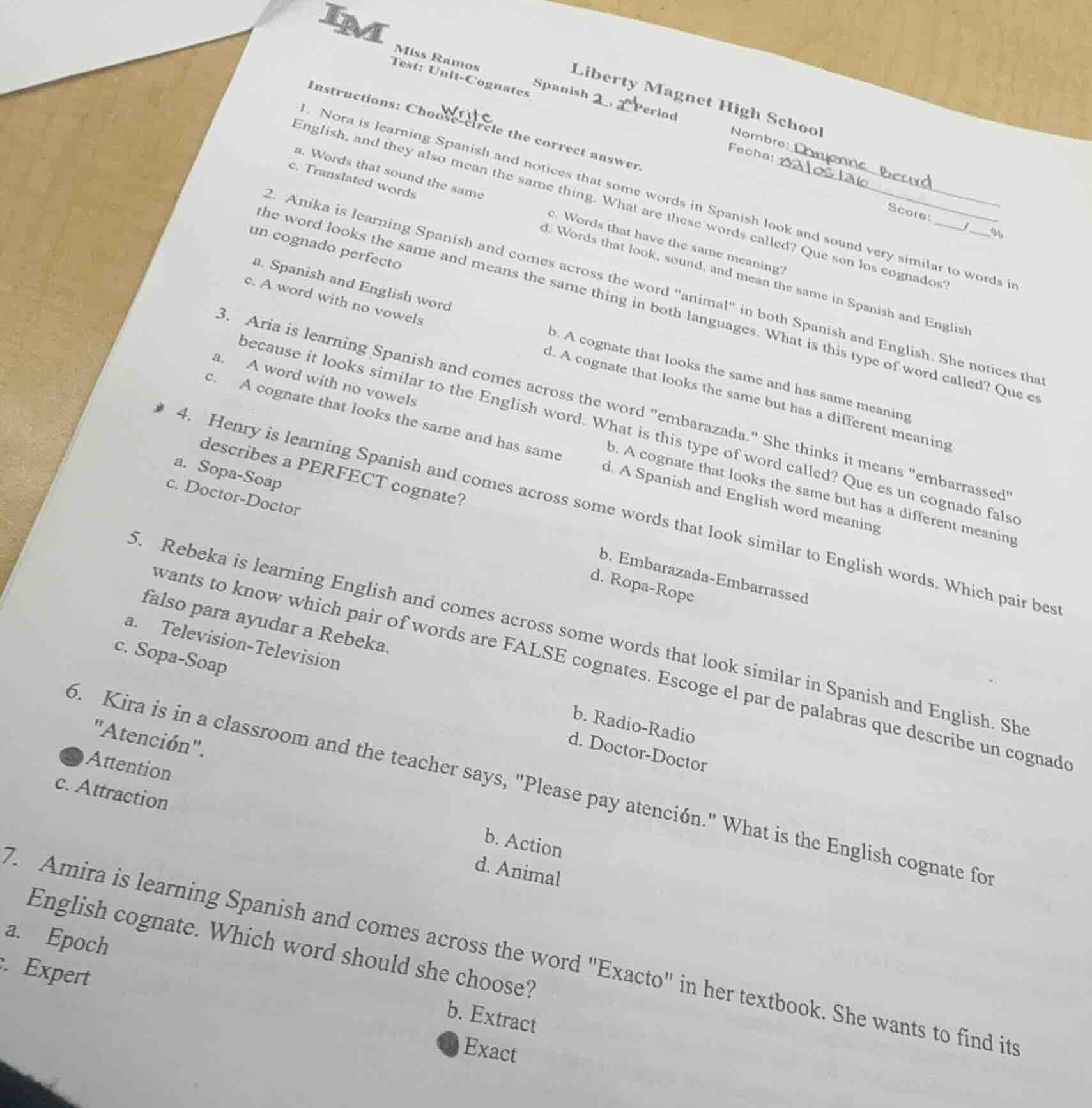
Question
liberty magnet high school
miss ramos spanish 2 - 2nd period
test: unit - cognates
nombre: dayjonne becud
fecha: 2/10/24
score: / %
instructions: choose/circle the correct answer.
- nora is learning spanish and notices that some words in spanish look and sound very similar to words in english, and they also mean the same thing. what are these words called? que son los cognados?
a. words that sound the same
c. words that have the same meaning?
b. translated words
d. words that look, sound, and mean the same in spanish and english
- anika is learning spanish and comes across the word \animal\ in both spanish and english. she notices that the word looks the same and means the same thing in both languages. what is this type of word called? que es un cognado perfecto
a. spanish and english word
b. a cognate that looks the same and has same meaning
c. a word with no vowels
d. a cognate that looks the same but has a different meaning
- aria is learning spanish and comes across the word \embarazada.\ she thinks it means \embarrassed\ because it looks similar to the english word. what is this type of word called? que es un cognado falso
a. a word with no vowels
b. a cognate that looks the same but has a different meaning
c. a cognate that looks the same and has same
d. a spanish and english word meaning
- henry is learning spanish and comes across some words that look similar to english words. which pair best describes a perfect cognate?
a. sopa - soap
b. embarazada - embarrassed
c. doctor - doctor
d. ropa - rope
- rebeka is learning english and comes across some words that look similar in spanish and english. she wants to know which pair of words are false cognates. escoge el par de palabras que describe un cognado falso para ayudar a rebeka.
a. television - television
b. radio - radio
c. sopa - soap
d. doctor - doctor
- kira is in a classroom and the teacher says, \please pay atención.\ what is the english cognate for \atención\.
a. attention
b. action
c. attraction
d. animal
- amira is learning spanish and comes across the word \exacto\ in her textbook. she wants to find its english cognate. which word should she choose?
a. epoch
b. extract
c. exact
Question 1
Cognates are words in different languages that look and sound similar and have the same meaning. Option a describes words that sound the same (not necessarily look or mean same), option c is translated words (not about look/sound similarity). So the correct answer is the one about words with same look, sound, and meaning.
A perfect cognate is a word that looks the same and has the same meaning in two languages. "Animal" in Spanish and English is a perfect cognate. Option a is too general, option c is incorrect (words have vowels), option d is false cognate. So option b (A cognate that looks the same and has same meaning) is correct.
"Embarazada" in Spanish means "pregnant", not "embarrassed" in English. So it's a false cognate (looks similar but different meaning). Option a is incorrect, option b is false cognate (matches), option c is perfect cognate (incorrect), option d is general. So option b is correct.

Snap & solve any problem in the app
Get step-by-step solutions on Sovi AI
Photo-based solutions with guided steps
Explore more problems and detailed explanations
a. Words that sound the same (Note: Correct option should be the one with "look and sound very similar and mean the same", likely a formatting error in options, but based on cognate definition, the option describing words with same look, sound, and meaning is correct. If options are as given, and assuming a typo, the intended correct option for question 1 about cognates (words with same form, sound, meaning across languages) would be the one matching that description, likely the option with "look and sound very similar and mean the same" which may be mislabeled, but following the test's context, the correct option for question 1 is the one defining cognates as words with same look, sound, and meaning.)