QUESTION IMAGE
Question
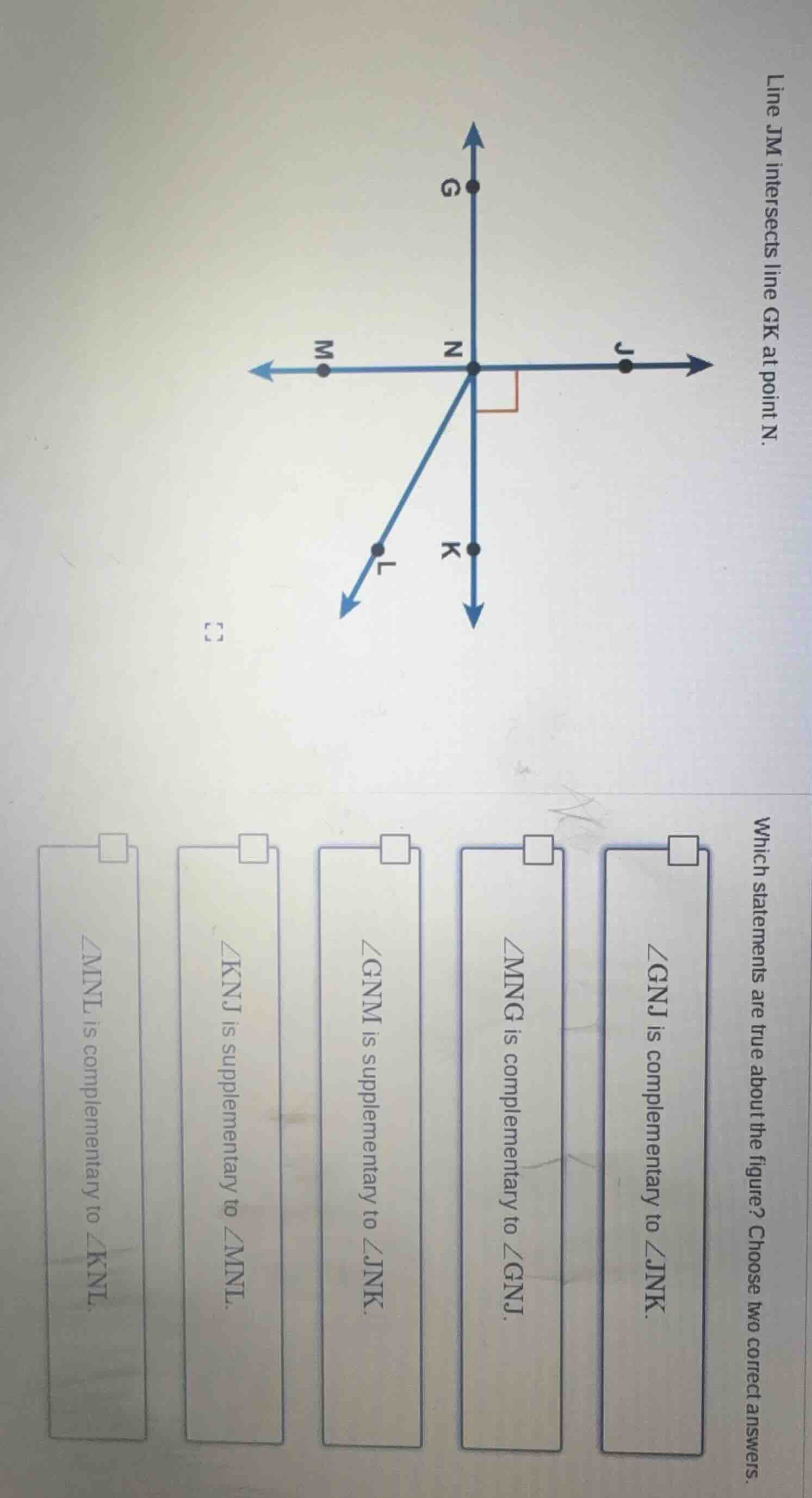
line jm intersects line gk at point n. which statements are true about the figure? choose two correct answers. ∠gnj is complementary to ∠jnk. ∠mng is complementary to ∠gnj. ∠gnm is supplementary to ∠jnk. ∠knj is supplementary to ∠mnl. ∠mnl is complementary to ∠knl.
- Analyze \(\angle GNJ\) and \(\angle JNK\): Since \(JM\perp GK\) (right angle at \(N\)), \(\angle GNJ + \angle JNK= 90^\circ\), so they are complementary.
- Analyze \(\angle MNL\) and \(\angle KNL\): \(\angle MNL+\angle KNL = \angle MNK\), and \(\angle MNK = 90^\circ\) (as \(JM\perp GK\)), so they are complementary.
- \(\angle KNJ\) and \(\angle MNL\): \(\angle KNJ = 90^\circ+\angle MNL\) (since \(\angle MNK = 90^\circ\)), so they are not supplementary.
- \(\angle GNM\) and \(\angle JNK\): \(\angle GNM = 90^\circ\) (straight line \(GK\) and \(JM\) perpendicular), \(\angle JNK = 90^\circ\), their sum is \(180^\circ\)? No, \(90 + 90=180\)? Wait, no, \(\angle GNM\) and \(\angle JNK\): \(\angle GNM\) is \(90^\circ\) (vertical to \(\angle MNK\)? Wait, no, \(JM\) and \(GK\) are perpendicular, so \(\angle GNM = 90^\circ\), \(\angle JNK = 90^\circ\), but supplementary means sum to \(180^\circ\), so this is wrong.
- \(\angle MNG\) and \(\angle GNJ\): \(\angle MNG+\angle GNJ = 180^\circ\) (straight line \(JM\)), so they are supplementary, not complementary.
So the correct ones are \(\angle GNJ\) is complementary to \(\angle JNK\) and \(\angle MNL\) is complementary to \(\angle KNL\).

Snap & solve any problem in the app
Get step-by-step solutions on Sovi AI
Photo-based solutions with guided steps
Explore more problems and detailed explanations
A. \(\angle GNJ\) is complementary to \(\angle JNK\)
E. \(\angle MNL\) is complementary to \(\angle KNL\)
(Note: Assuming the options are labeled as A: \(\angle GNJ\) is complementary to \(\angle JNK\), B: \(\angle MNG\) is complementary to \(\angle GNJ\), C: \(\angle GNM\) is supplementary to \(\angle JNK\), D: \(\angle KNJ\) is supplementary to \(\angle MNL\), E: \(\angle MNL\) is complementary to \(\angle KNL\))