QUESTION IMAGE
Question
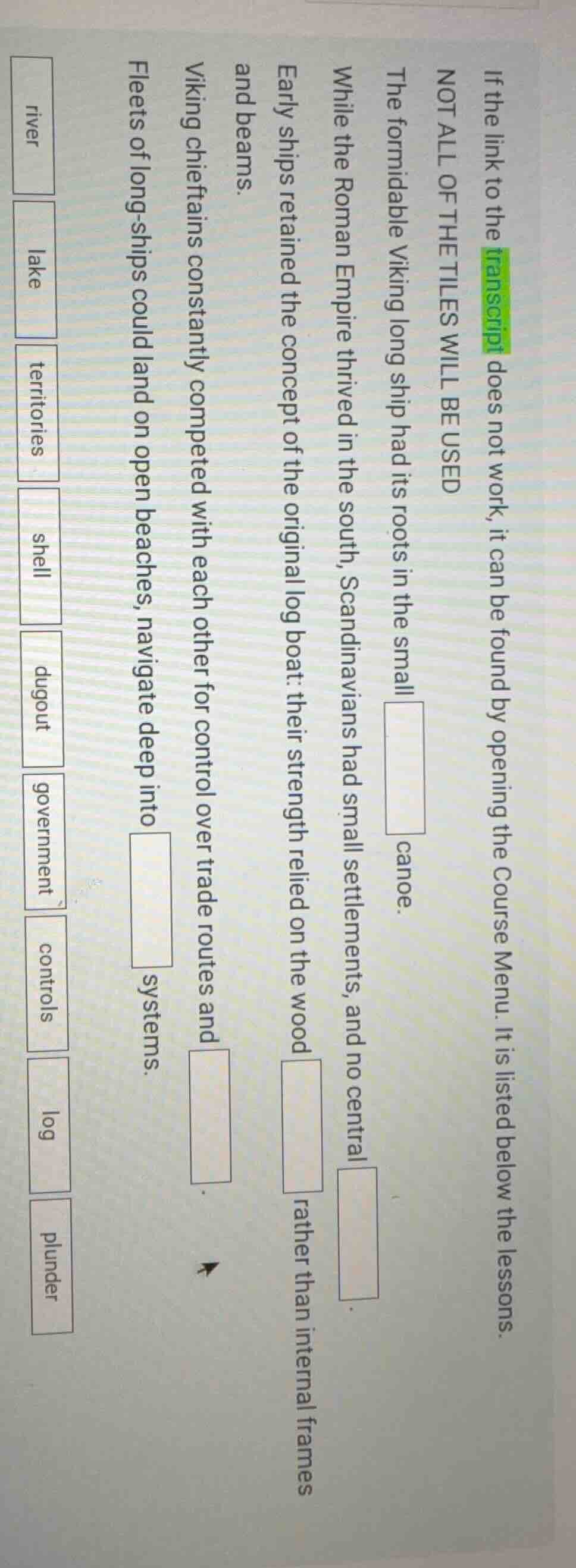
if the link to the transcript does not work, it can be found by opening the course menu. it is listed below the lessons. not all of the tiles will be used the formidable viking long ship had its roots in the small \boxed{} canoe. while the roman empire thrived in the south, scandinavians had small settlements, and no central \boxed{}. early ships retained the concept of the original log boat: their strength relied on the wood \boxed{} rather than internal frames and beams. viking chieftains constantly competed with each other for control over trade routes and \boxed{}. fleets of long-ships could land on open beaches, navigate deep into \boxed{} systems. \boxed{river} \boxed{lake} \boxed{territories} \boxed{shell} \boxed{dugout} \boxed{government} \boxed{controls} \boxed{log} \boxed{plunder}
To solve this fill - in - the - blank problem, we analyze the context of each sentence:
First Blank (after "small")
The sentence is "The formidable Viking long ship had its roots in the small ____ canoe." We know that a dugout canoe is a type of small canoe, so the word "dugout" fits here.
Second Blank (after "central")
The sentence is "While the Roman Empire thrived in the south, Scandinavians had small settlements, and no central ____." A central government is a common concept, and since the Romans had an empire (with a central government) and the Scandinavians didn't, "government" is the appropriate word.
Third Blank (after "wood")
The sentence is "Early ships retained the concept of the original log boat: their strength relied on the wood ____ rather than internal frames and beams." A log boat's strength comes from the log itself, so "log" is the right choice.
Fourth Blank (after "and")
The sentence is "Viking chieftains constantly competed with each other for control over trade routes and ____." "Territories" are what chieftains would compete for along with trade routes, so "territories" fits.
Fifth Blank (after "into")
The sentence is "Fleets of long - ships could land on open beaches, navigate deep into ____ systems." River systems are a common type of water system that ships can navigate into, so "river" is correct.
Filled - in Sentences:
- The formidable Viking long ship had its roots in the small \(\boldsymbol{\text{dugout}}\) canoe.
- While the Roman Empire thrived in the south, Scandinavians had small settlements, and no central \(\boldsymbol{\text{government}}\).
- Early ships retained the concept of the original log boat: their strength relied on the wood \(\boldsymbol{\text{log}}\) rather than internal frames and beams.
- Viking chieftains constantly competed with each other for control over trade routes and \(\boldsymbol{\text{territories}}\).
- Fleets of long - ships could land on open beaches, navigate deep into \(\boldsymbol{\text{river}}\) systems.
So the answers in order are: dugout, government, log, territories, river.

Snap & solve any problem in the app
Get step-by-step solutions on Sovi AI
Photo-based solutions with guided steps
Explore more problems and detailed explanations
To solve this fill - in - the - blank problem, we analyze the context of each sentence:
First Blank (after "small")
The sentence is "The formidable Viking long ship had its roots in the small ____ canoe." We know that a dugout canoe is a type of small canoe, so the word "dugout" fits here.
Second Blank (after "central")
The sentence is "While the Roman Empire thrived in the south, Scandinavians had small settlements, and no central ____." A central government is a common concept, and since the Romans had an empire (with a central government) and the Scandinavians didn't, "government" is the appropriate word.
Third Blank (after "wood")
The sentence is "Early ships retained the concept of the original log boat: their strength relied on the wood ____ rather than internal frames and beams." A log boat's strength comes from the log itself, so "log" is the right choice.
Fourth Blank (after "and")
The sentence is "Viking chieftains constantly competed with each other for control over trade routes and ____." "Territories" are what chieftains would compete for along with trade routes, so "territories" fits.
Fifth Blank (after "into")
The sentence is "Fleets of long - ships could land on open beaches, navigate deep into ____ systems." River systems are a common type of water system that ships can navigate into, so "river" is correct.
Filled - in Sentences:
- The formidable Viking long ship had its roots in the small \(\boldsymbol{\text{dugout}}\) canoe.
- While the Roman Empire thrived in the south, Scandinavians had small settlements, and no central \(\boldsymbol{\text{government}}\).
- Early ships retained the concept of the original log boat: their strength relied on the wood \(\boldsymbol{\text{log}}\) rather than internal frames and beams.
- Viking chieftains constantly competed with each other for control over trade routes and \(\boldsymbol{\text{territories}}\).
- Fleets of long - ships could land on open beaches, navigate deep into \(\boldsymbol{\text{river}}\) systems.
So the answers in order are: dugout, government, log, territories, river.