QUESTION IMAGE
Question
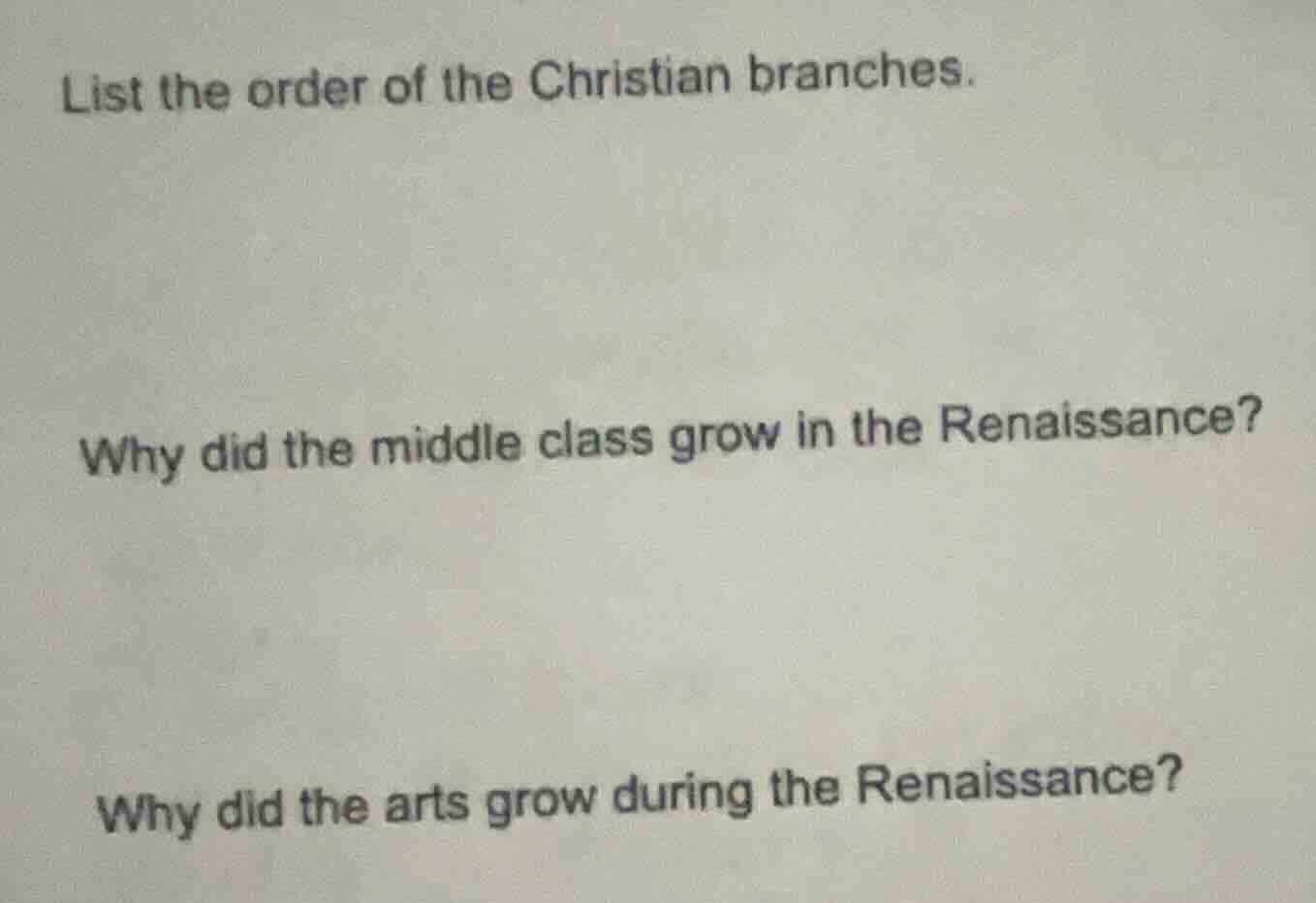
list the order of the christian branches.
why did the middle class grow in the renaissance?
why did the arts grow during the renaissance?
Brief Explanations
- For Christian branches order: Based on historical schisms, the original unified Christianity split first, then subsequent divisions created newer branches.
- For middle class growth: Economic shifts in trade, manufacturing, and urbanization created new wealth and roles outside the traditional feudal hierarchy.
- For Renaissance arts growth: Patronage from wealthy elites, renewed interest in classical antiquity, and humanist ideals focused on individual expression and realism drove artistic development.

Snap & solve any problem in the app
Get step-by-step solutions on Sovi AI
Photo-based solutions with guided steps
Explore more problems and detailed explanations
- Order of Christian branches (by historical emergence):
- Early/Undivided Christianity (c. 1st-11th centuries)
- Eastern Orthodox Christianity (after the Great Schism of 1054)
- Roman Catholic Christianity (after the Great Schism of 1054, formalized as a distinct branch)
- Protestant Christianity (after the Protestant Reformation of the 16th century, with sub-branches forming later)
- The middle class grew in the Renaissance due to:
- Expansion of long-distance trade and new commercial markets, creating wealthy merchants and traders.
- Growth of urban centers and craft guilds, which provided stable, skilled work and upward mobility.
- Decline of feudalism, which reduced the dominance of landed nobility and opened economic opportunities for non-elites.
- The arts grew during the Renaissance because:
- Patronage from wealthy city-states, merchants, and the Church funded artists, architects, and writers.
- Revival of classical Greek and Roman art, philosophy, and humanism inspired new artistic techniques and themes focused on realism, human anatomy, and individualism.
- Advances in technology (like linear perspective, oil paints) allowed artists to create more detailed, lifeworks, driving innovation and interest in artistic creation.