QUESTION IMAGE
Question
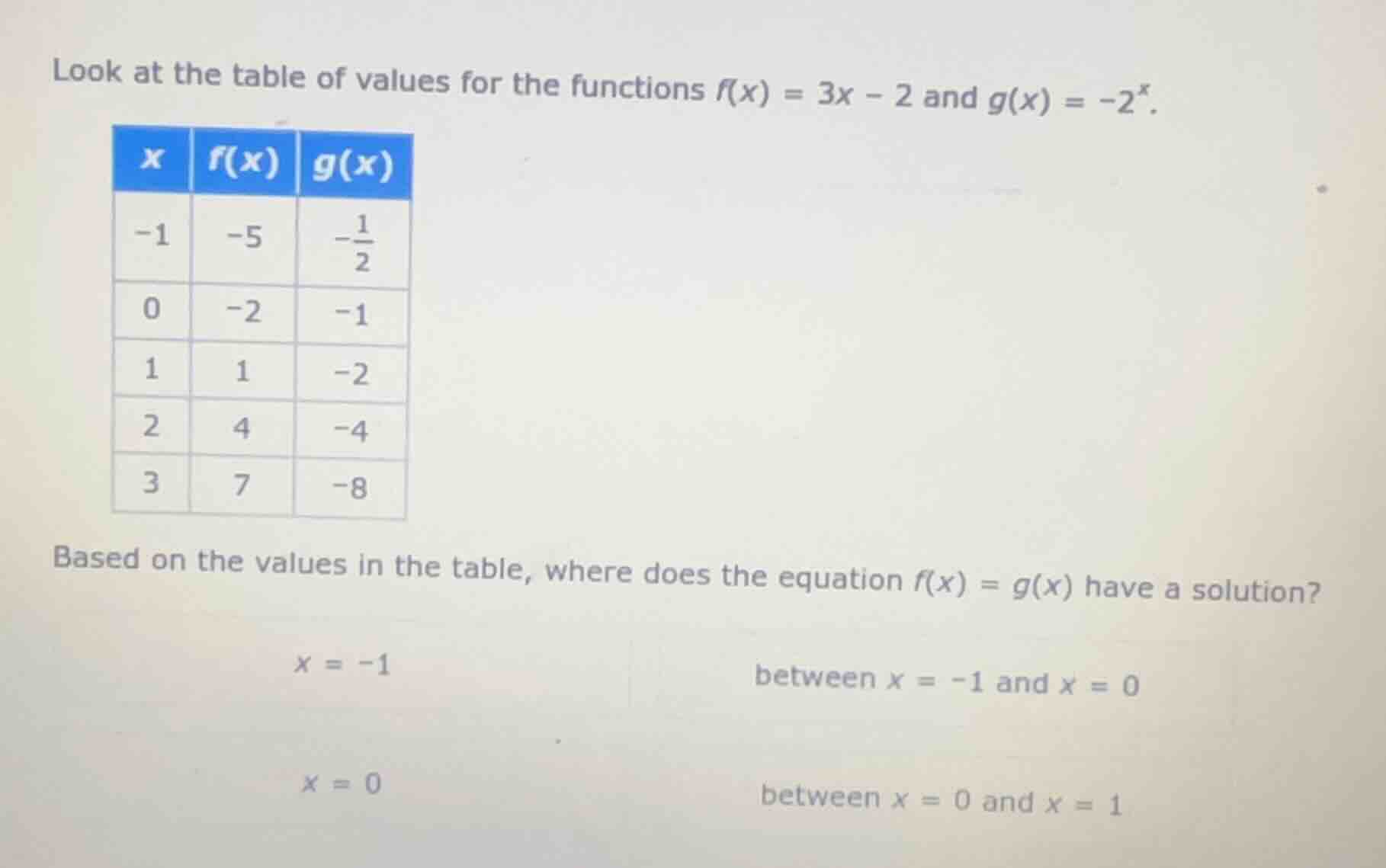
look at the table of values for the functions $f(x) = 3x - 2$ and $g(x) = -2^x$.
| $x$ | $f(x)$ | $g(x)$ |
|---|---|---|
| $0$ | $-2$ | $-1$ |
| $1$ | $1$ | $-2$ |
| $2$ | $4$ | $-4$ |
| $3$ | $7$ | $-8$ |
based on the values in the table, where does the equation $f(x) = g(x)$ have a solution?
$x = -1$ between $x = -1$ and $x = 0$
$x = 0$ between $x = 0$ and $x = 1$
Step1: Check \( x = -1 \)
At \( x = -1 \), \( f(-1) = -5 \) and \( g(-1) = -\frac{1}{2} \). Since \( -5
eq -\frac{1}{2} \), \( x = -1 \) is not a solution.
Step2: Check \( x = 0 \)
At \( x = 0 \), \( f(0) = -2 \) and \( g(0) = -1 \). Since \( -2
eq -1 \), \( x = 0 \) is not a solution.
Step3: Analyze between \( x = -1 \) and \( x = 0 \)
Let \( h(x)=f(x)-g(x)=3x - 2-(-2^{x})=3x - 2 + 2^{x}\).
At \( x=-1 \), \( h(-1)=3(-1)-2 + 2^{-1}=-3 - 2+\frac{1}{2}=-\frac{9}{2}<0 \).
At \( x = 0 \), \( h(0)=3(0)-2 + 2^{0}=-2 + 1=-1<0 \). Wait, maybe better to look at \( f(x) \) and \( g(x) \) values. \( f(-1)=-5 \), \( g(-1)=-\frac{1}{2} \) (so \( f < g \) here). At \( x = 0 \), \( f(0)=-2 \), \( g(0)=-1 \) (so \( f < g \) here? Wait no, \( -2 < -1 \), so \( f(x) < g(x) \) at both. Wait maybe I made a mistake. Wait let's check between \( x = 0 \) and \( x = 1 \).
At \( x = 0 \), \( f(0)=-2 \), \( g(0)=-1 \) (so \( f(x)=-2 \), \( g(x)=-1 \), \( f < g \)). At \( x = 1 \), \( f(1)=1 \), \( g(1)=-2 \) (so \( f(x)=1 \), \( g(x)=-2 \), \( f > g \)). So the function \( f(x)-g(x) \) changes sign between \( x = 0 \) and \( x = 1 \) because \( f(x) \) goes from -2 to 1 (increasing) and \( g(x) \) goes from -1 to -2 (decreasing). So by Intermediate Value Theorem, since \( f(x) \) is linear (increasing) and \( g(x) \) is exponential (decreasing in this case as it's \( -2^{x} \)), between \( x = 0 \) and \( x = 1 \), \( f(x) \) crosses \( g(x) \) because \( f(0) < g(0) \) and \( f(1) > g(1) \). So the solution is between \( x = 0 \) and \( x = 1 \). Wait but earlier when I calculated \( h(x) \) at \( x = 0 \), \( h(0)=-1 \), at \( x = 1 \), \( h(1)=3(1)-2 + 2^{1}=3 - 2+2 = 3>0 \). So \( h(x) \) goes from -1 to 3, so by Intermediate Value Theorem, there is a root between \( x = 0 \) and \( x = 1 \).
Wait but the other interval: between \( x=-1 \) and \( x = 0 \), \( f(x) \) is -5 to -2 (increasing), \( g(x) \) is \( -\frac{1}{2} \) to -1 (decreasing). So \( f(x) \) is still less than \( g(x) \) at both ends. But between \( x = 0 \) and \( x = 1 \), \( f(x) \) goes from -2 to 1 (increasing) and \( g(x) \) goes from -1 to -2 (decreasing), so \( f(x) \) crosses \( g(x) \) here.

Snap & solve any problem in the app
Get step-by-step solutions on Sovi AI
Photo-based solutions with guided steps
Explore more problems and detailed explanations
between \( x = 0 \) and \( x = 1 \)