QUESTION IMAGE
Question
lp 5 day 9-10
evidence of evolution - the fossil record
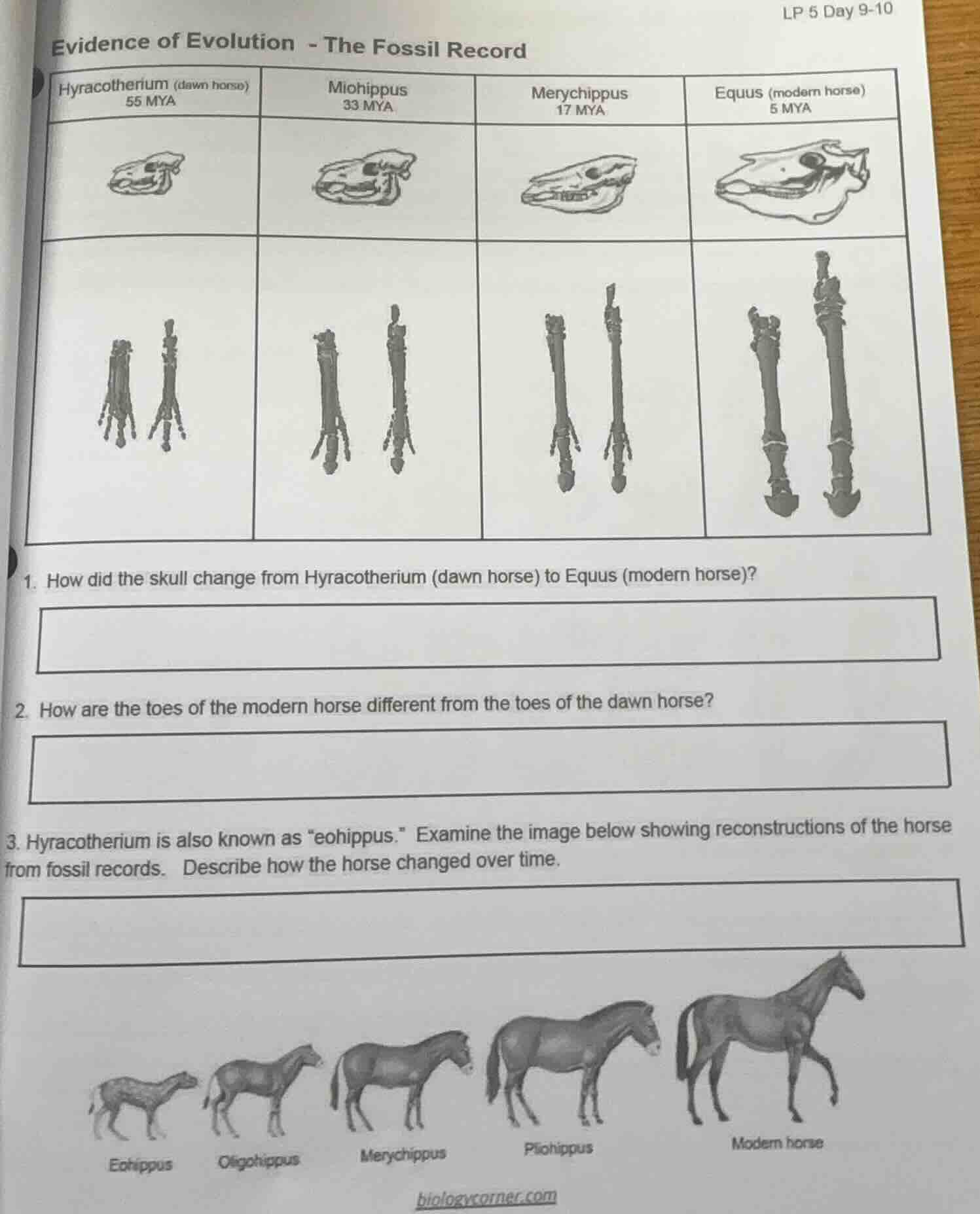
hyracotherium (dawn horse) 55 mya\tmiohippus 33 mya\tmerychippus 17 mya\tequus (modern horse) 5 mya
- how did the skull change from hyracotherium (dawn horse) to equus (modern horse)?
- how are the toes of the modern horse different from the toes of the dawn horse?
- hyracotherium is also known as \eohippus.\ examine the image below showing reconstructions of the horse from fossil records. describe how the horse changed over time.
eohippus\toligohippus\tmerychippus\tpliohippus\tmodern horse
biologycorner.com
Question 1
By observing the skull images, Hyracotherium's skull is small and short. As evolution progresses to Equus, the skull becomes larger, longer, and more elongated. The facial structure also becomes more streamlined, and the cranium appears to increase in size, likely related to brain development and adaptation to diet/ecology.
Looking at the toe (limb) images: Hyracotherium (dawn horse) has multiple toes (like 4 - 5 toes) with distinct, separate digits, suitable for walking on soft, uneven terrain. Equus (modern horse) has a single, enlarged toe (hoof) with reduced or fused other digits, adapted for running on hard, open ground. The toes transition from a multi - toed, spread - out structure to a single - toed (hoofed) structure for better speed and stability in open habitats.
From the reconstructions: Eohippus (Hyracotherium) is small, with a short body, short legs, and a relatively small head, adapted for a forest - dwelling, browsing lifestyle. Over time (through Oligohippus, Merychippus, Pliohippus to Modern horse), the horse's body size increases significantly. Legs become longer (adapting for running), the body becomes more streamlined, the neck and head become more elongated (adapting for grazing on taller grasses), and the overall build changes from a small, forest - adapted form to a larger, open - grassland - adapted, fast - running form. Also, the toe structure (as seen earlier) changes from multi - toed to single - toed (hoof) for better locomotion in open environments.

Snap & solve any problem in the app
Get step-by-step solutions on Sovi AI
Photo-based solutions with guided steps
Explore more problems and detailed explanations
The skull of Hyracotherium (dawn horse) is relatively small and short. From Hyracotherium to Equus (modern horse), the skull becomes larger, longer, and more elongated. The facial region extends, and the overall skull structure becomes more streamlined, with an apparent increase in cranium size (possibly related to brain development) and changes in dental and facial adaptations for grazing and ecological roles.