QUESTION IMAGE
Question
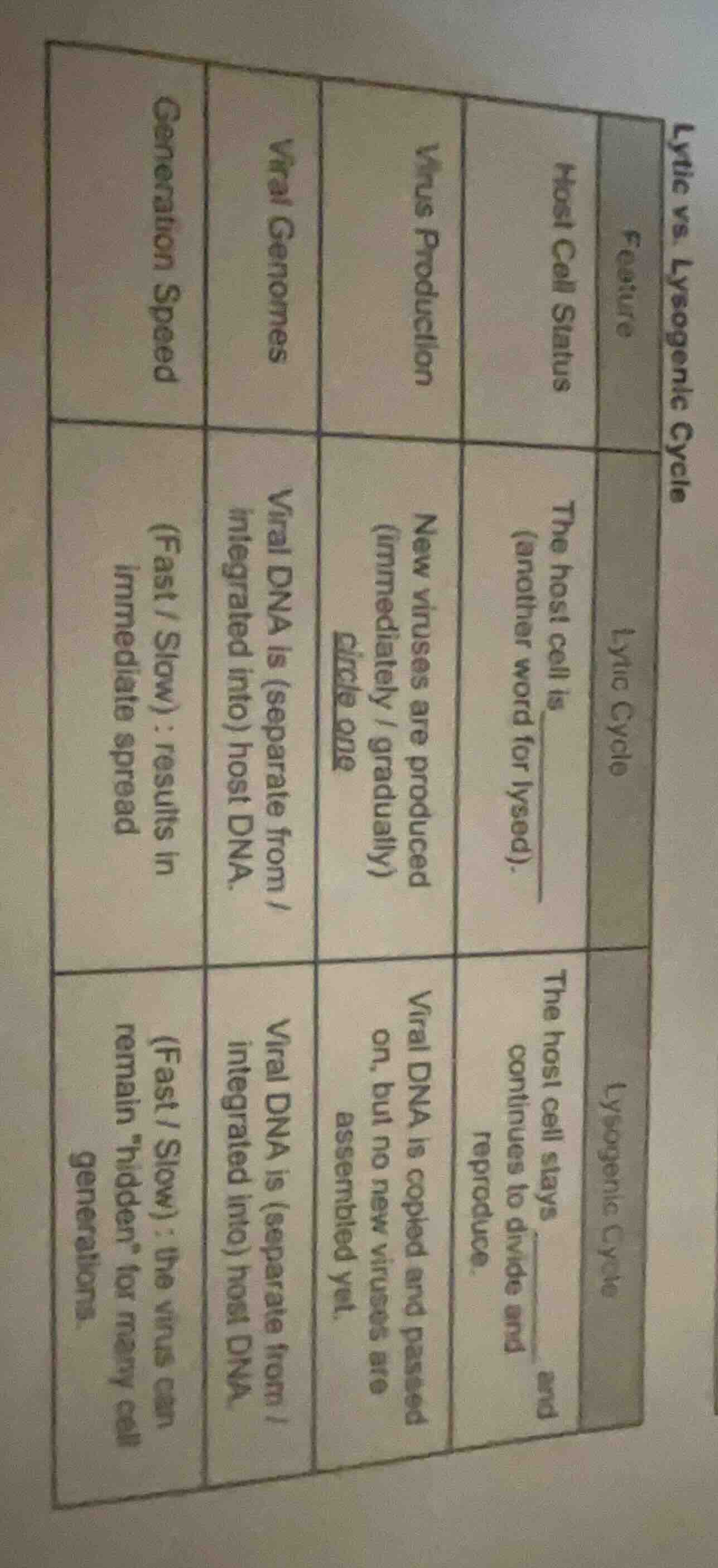
lytic vs. lysogenic cycle
feature
host cell status
virus production
viral genomes
generation speed
lytic cycle
the host cell is ______________ (another word for lysed).
new viruses are produced (immediately / gradually)
circle one
viral dna is (separate from / integrated into) host dna.
(fast / slow) : results in immediate spread
lysogenic cycle
the host cell stays ______________ and continues to divide and reproduce.
viral dna is copied and passed on, but no new viruses are assembled yet.
viral dna is (separate from / integrated into) host dna.
(fast / slow) : the virus can remain \hidden\ for many cell generations.
- Lytic Cycle - Host Cell Status: In the lytic cycle, the host cell is destroyed (lysed) as new viruses exit, so the term is "destroyed".
- Lytic Cycle - Virus Production: New viruses are made right away to quickly exit the lysed cell, so "immediately" is correct.
- Lytic Cycle - Viral Genomes: Viral DNA remains separate from the host's DNA during active replication in the lytic cycle.
- Lytic Cycle - Generation Speed: The lytic cycle is fast, with immediate spread of new viruses.
- Lysogenic Cycle - Host Cell Status: The host cell remains alive and functional, dividing normally while the viral DNA is integrated.
- Lysogenic Cycle - Virus Production: No new viruses are assembled during the latent lysogenic phase; viral DNA is just copied with host DNA.
- Lysogenic Cycle - Viral Genomes: Viral DNA integrates into the host cell's DNA and is copied along with it.
- Lysogenic Cycle - Generation Speed: The lysogenic cycle is slow, as the virus stays hidden through many cell generations.

Snap & solve any problem in the app
Get step-by-step solutions on Sovi AI
Photo-based solutions with guided steps
Explore more problems and detailed explanations
| Feature | Lytic Cycle | Lysogenic Cycle |
|---|---|---|
| Virus Production | New viruses are produced immediately (circle one) | Viral DNA is copied and passed on, but no new viruses are assembled yet. |
| Viral Genomes | Viral DNA is separate from host DNA. | Viral DNA is integrated into host DNA. |
| Generation Speed | Fast: results in immediate spread | Slow: the virus can remain "hidden" for many cell generations. |