QUESTION IMAGE
Question
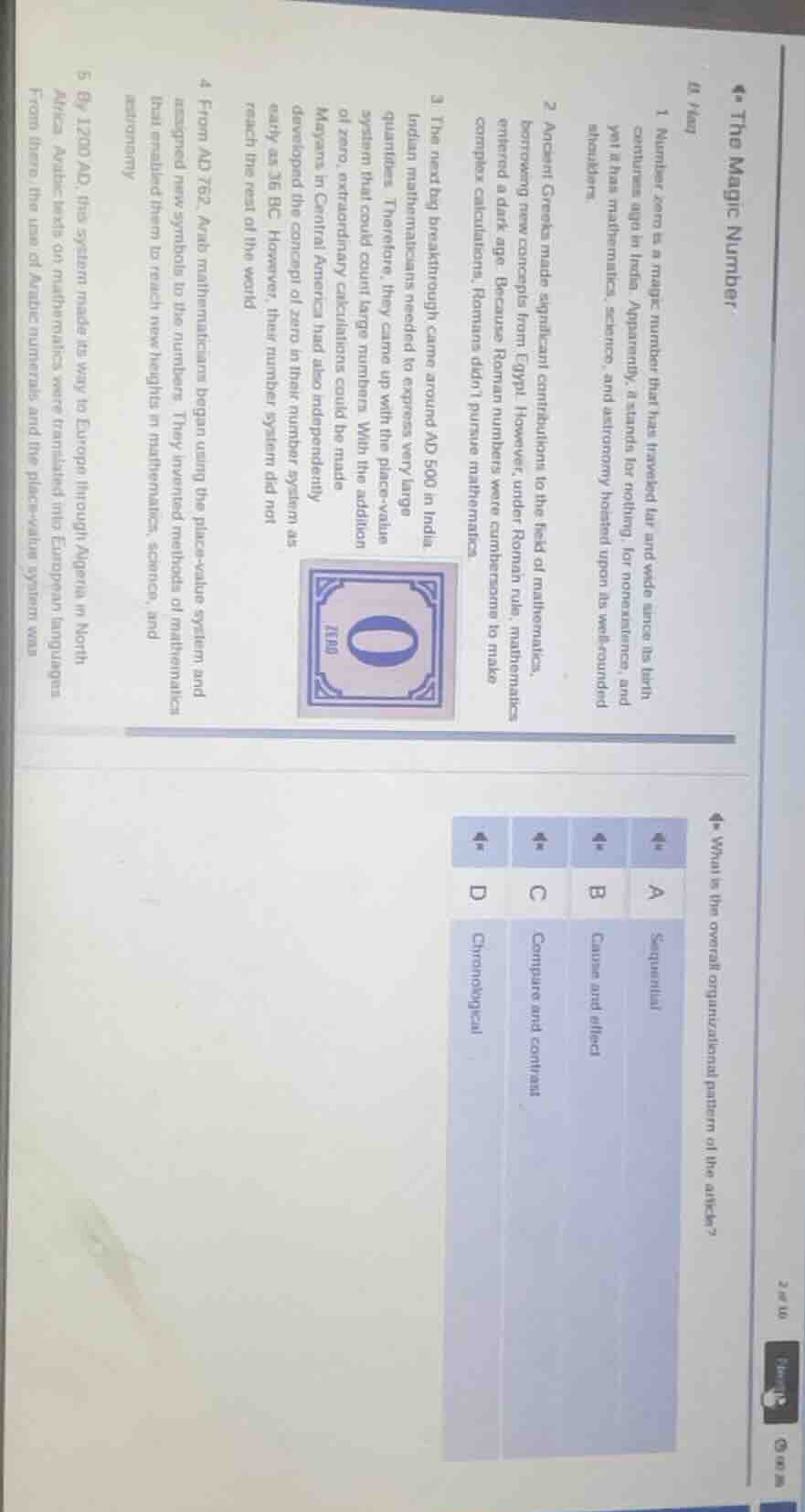
the magic numbermap1. number zero is a magic number that has traveled far and wide since its birth centuries ago in india. apparently, it stands for nothing, for nonexistence, and yet it has mathematics, science, and astronomy hoisted upon its well-rounded shoulders.2. ancient greeks made significant contributions to the field of mathematics, borrowing new concepts from egypt. however, under roman rule, mathematics entered a dark age. because roman numbers were cumbersome to make complex calculations, romans didnt pursue mathematics.3. the next big breakthrough came around ad 500 in india. indian mathematicians needed to express very large quantities. therefore, they came up with the place-value system that could count large numbers. with the addition of zero, extraordinary calculations could be made. mayans in central america had also independently developed the concept of zero in their number system as early as 36 bc. however, their number system did not reach the rest of the world.4. from ad 762, arab mathematicians began using the place-value system and assigned new symbols to the numbers. they invented methods of mathematics that enabled them to reach new heights in mathematics, science, and astronomy.5. by 1200 ad, this system made its way to europe through algeria in north africa. arabic texts on mathematics were translated into european languages. from there, the use of arabic numerals and the place-value system was spread.what is the overall organizational pattern of the article?a sequentialb cause and effectc compare and contrastd chronological
The article organizes information about the number zero by tracking its development and spread across different time periods: starting with its origin in India long ago, then the Ancient Greeks/Roman era, the AD 500 Indian breakthrough, AD 762 Arab use, and finally its arrival in Europe by 1200 AD. This follows a time-based, chronological structure.

Snap & solve any problem in the app
Get step-by-step solutions on Sovi AI
Photo-based solutions with guided steps
Explore more problems and detailed explanations
D. Chronological