QUESTION IMAGE
Question
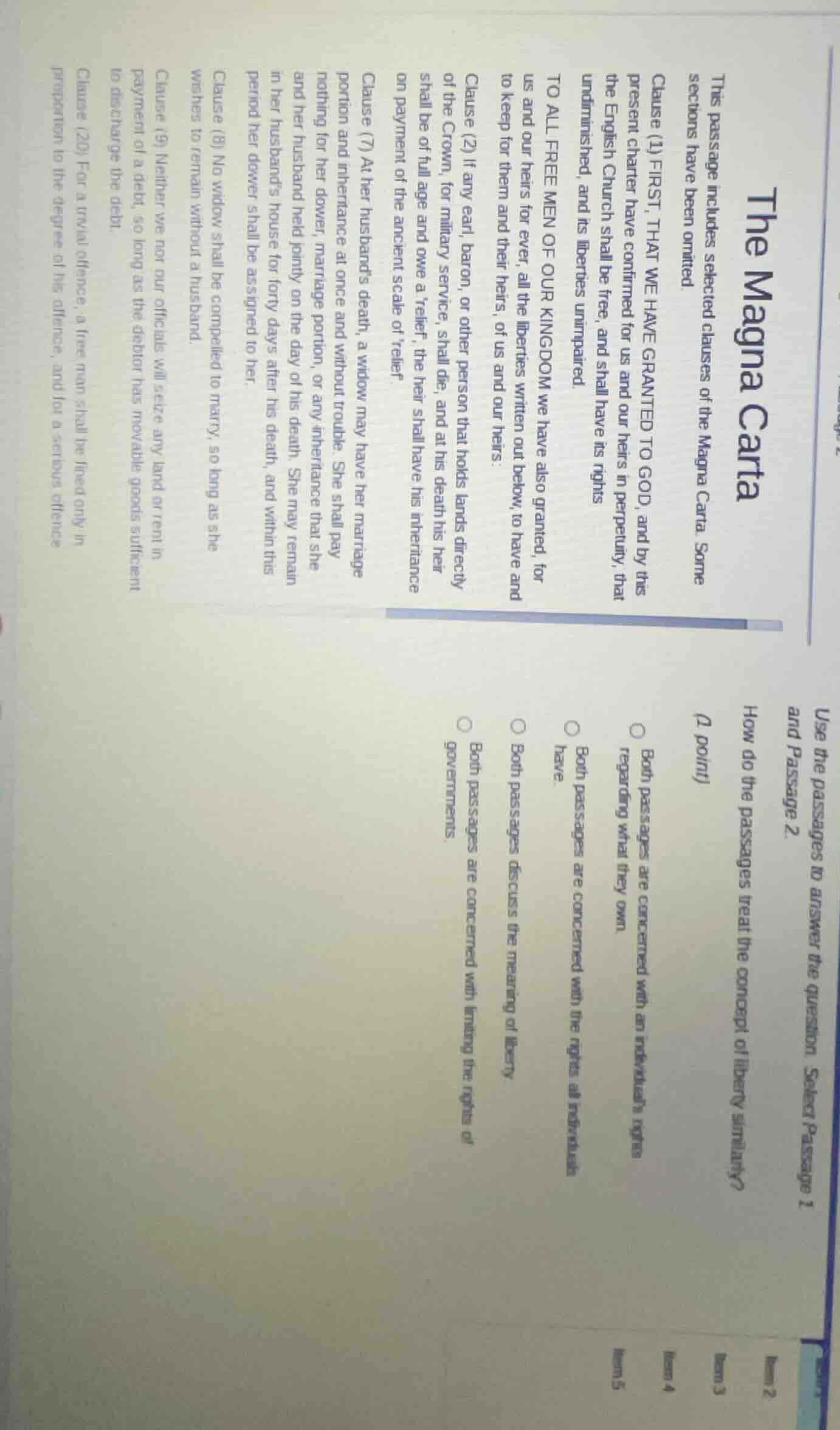
the magna carta this passage includes selected clauses of the magna carta. some sections have been omitted. clause (1) first, that we have granted to god, and by this present charter have confirmed for us and our heirs in perpetuity, that the english church shall be free, and shall have its rights undiminished, and its liberties unimpaired. to all free men of our kingdom we have also granted, for us and our heirs for ever, all the liberties written out below, to have and to keep for them and their heirs, of us and our heirs: clause (2) if any earl, baron, or other person that holds lands directly of the crown, for military service, shall die, and at his death his heir shall be of full age and owe a relief, the heir shall have his inheritance on payment of the ancient scale of relief. clause (7) at her husband’s death, a widow may have her marriage portion and inheritance at once and without trouble. she shall pay nothing for her dower, marriage portion, or any inheritance that she and her husband held jointly on the day of his death. she may remain in her husband’s house for forty days after his death, and within this period her dower shall be assigned to her. clause (8) no widow shall be compelled to marry, so long as she wishes to remain without a husband. clause (9) neither we nor our officials will seize any land or rent in payment of a debt, so long as the debtor has movable goods sufficient to discharge the debt. clause (10) for a trivial offence, a free man shall be fined only in proportion to the degree of his offence, and for a serious offence correspondingly; and a free man shall be fined only in proportion to the degree of his offence, and for a serious offence correspondingly; and... use the passages to answer the question. selected passage 1 and passage 2. how do the passages treat the concept of liberty similarly? (1 point) both passages are concerned with an individual’s rights regarding what they own. both passages are concerned with the rights all individuals have. both passages discuss the meaning of liberty. both passages are concerned with limiting the rights of governments.
To solve this, we analyze the Magna Carta passage (Passage 1) and assume Passage 2 (not fully shown but related to liberty). Let's evaluate each option:
- Option 1: "Both passages are concerned with an individual’s rights regarding what they own."
The Magna Carta clauses here focus on church rights, inheritance, widow’s rights, etc.—not just "what they own." Eliminate.
- Option 2: "Both passages are concerned with the rights all individuals have."
The Magna Carta (Passage 1) grants rights to "free men," "widows," the church, etc.—implying universal (or broad) individual rights. If Passage 2 also relates to liberty (a core right), this fits.
- Option 3: "Both passages discuss the meaning of liberty."
The Magna Carta (Passage 1) grants rights (e.g., church liberty, widow’s rights) but does not define liberty. Eliminate.
- Option 4: "Both passages are concerned with limiting the rights of governments."
Passage 1 focuses on granting rights to people/church, not limiting government rights. Eliminate.
The Magna Carta passage (Passage 1) grants rights to free men, the church, widows, and heirs. If Passage 2 relates to liberty (a right), both passages center on rights individuals hold. Other options are inconsistent: Option 1 is too narrow, Option 3 misinterprets the focus, and Option 4 is incorrect (Passage 1 does not limit government rights).

Snap & solve any problem in the app
Get step-by-step solutions on Sovi AI
Photo-based solutions with guided steps
Explore more problems and detailed explanations
B. Both passages are concerned with the rights all individuals have. (Assuming the option label; adjust if the original has different identifiers, but the reasoning confirms this as the correct choice.)