QUESTION IMAGE
Question
b. main ideas
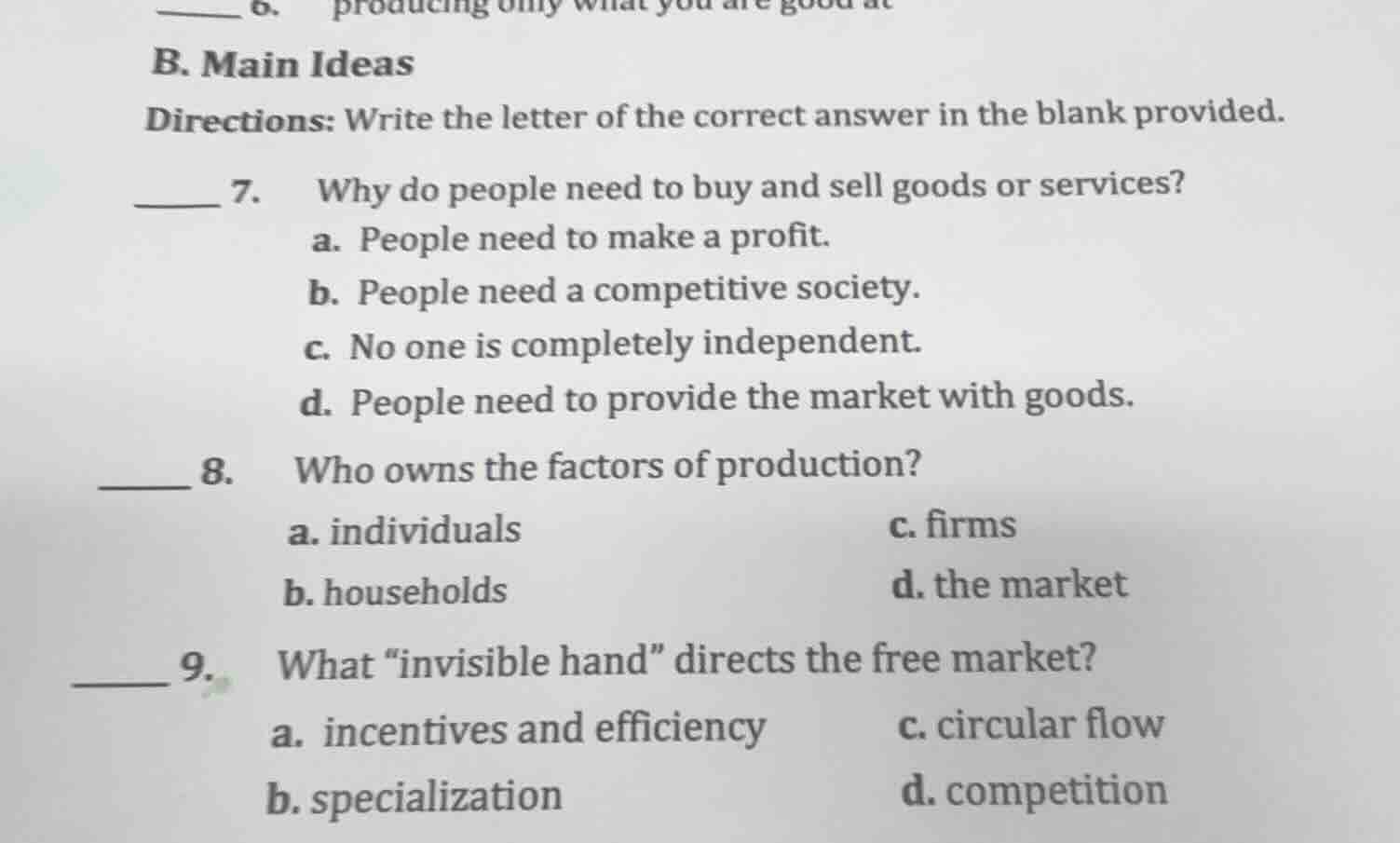
directions: write the letter of the correct answer in the blank provided.
______ 7. why do people need to buy and sell goods or services?
a. people need to make a profit.
b. people need a competitive society.
c. no one is completely independent.
d. people need to provide the market with goods.
______ 8. who owns the factors of production?
a. individuals c. firms
b. households d. the market
______ 9. what \invisible hand\ directs the free market?
a. incentives and efficiency c. circular flow
b. specialization d. competition
Question 7
To determine why people buy and sell goods/services, analyze each option:
- Option a: Making profit is a business goal, not the core reason for exchange (people exchange because they can't produce all they need).
- Option b: A competitive society is a result of exchange, not the reason for it.
- Option c: Since no one is self - sufficient (can't produce all goods/services they need), they must buy/sell. This is the fundamental reason for trade.
- Option d: Providing goods to the market is a result of production, not the reason for buying/selling.
In economic theory, the factors of production (land, labor, capital, entrepreneurship) are owned by households. Households supply labor (their own work), land (if they own property), and capital (savings, etc.) to firms in exchange for income. Individuals are part of households, firms use factors of production, and the market is a mechanism, not an owner.
In a free market, the "invisible hand" is related to how self - interested actions lead to economic order. Competition (among buyers and sellers) drives producers to be efficient, offer better products, and set appropriate prices. Incentives and efficiency are results, specialization is a production method, and circular flow is a model of economic activity. Competition is the force that directs the free market as the "invisible hand".

Snap & solve any problem in the app
Get step-by-step solutions on Sovi AI
Photo-based solutions with guided steps
Explore more problems and detailed explanations
c. No one is completely independent.