QUESTION IMAGE
Question
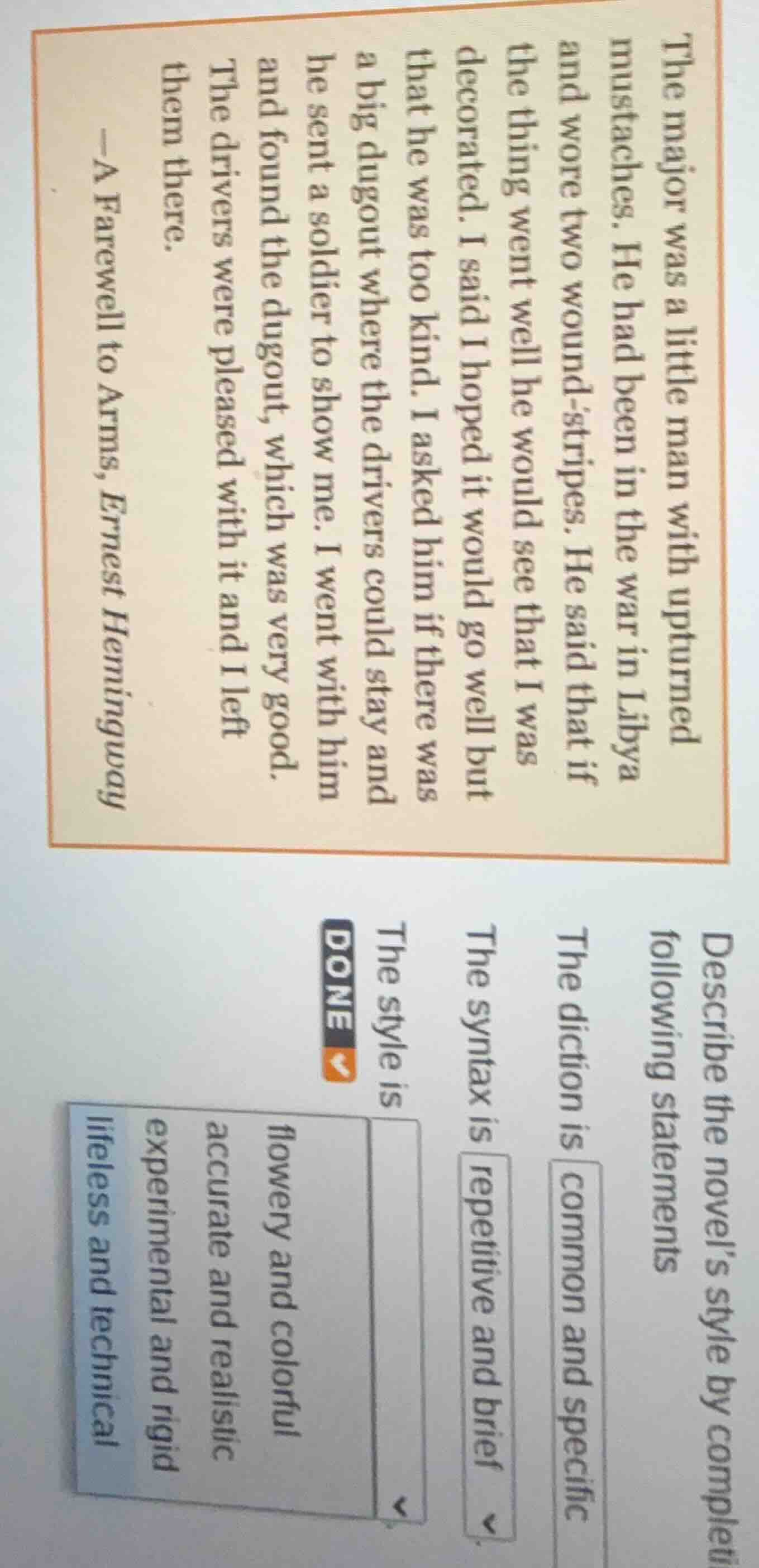
the major was a little man with upturned mustaches. he had been in the war in libya and wore two wound-stripes. he said that if the thing went well he would see that i was decorated. i said i hoped it would go well but that he was too kind. i asked him if there was a big dugout where the drivers could stay and he sent a soldier to show me. i went with him and found the dugout, which was very good. the drivers were pleased with it and i left them there.
—a farewell to arms, ernest hemingway
describe the novel’s style by completing the following statements
the diction is \boxed{common and specific}
the syntax is \boxed{repetitive and brief}
the style is \boxed{flowery and colorful\accurate and realistic\experimental and rigid\lifeless and technical}
- Diction: The passage uses simple, everyday language (e.g., "little man," "wound-stripes," "dugout") that is specific to the military context, matching "common and specific."
- Syntax: The sentences are short, simple, and use repeated subject-verb structure (e.g., "He had...", "He said...", "I said...", "I asked..."), fitting "repetitive and brief."
- Style: Hemingway's writing here is unadorned, focused on factual, concrete details of the war experience, which aligns with "accurate and realistic."

Snap & solve any problem in the app
Get step-by-step solutions on Sovi AI
Photo-based solutions with guided steps
Explore more problems and detailed explanations
The diction is common and specific
The syntax is repetitive and brief
The style is accurate and realistic